
Health director: Charlotte has ‘not peaked yet.’ Meck suspends release of COVID model
With reopening already underway and the trend of coronavirus spread “stable,” Mecklenburg County officials say they will stop — at least for now — publicly releasing timelines that predict a “peak” demand on hospitals.
The swift reversal comes days after a Penn Medicine data scientist said Mecklenburg is consulting a coronavirus model that’s no longer “appropriate,” WFAE reported Saturday.
But Mecklenburg Health Director Gibbie Harris on Thursday defended its continued use, saying “we have not peaked yet,” and the projection continues to be relevant for a geographic area that still hasn’t seen a surge in cases.
“We’re not publishing new models at this point in time,” Harris said in a Thursday virtual news conference. “That does not mean new models will not come out in the future.”
Health officials will continue to monitor the data used in the modeling daily, Harris said. But she noted that the current projections for a possible peak are complicated by the uncertainty of what will happen as more reopening occurs and less social distancing is observed.
Social distancing is “not trending in a direction that we’d like to see,” she said.
“We are not sure what we are going to see,” Harris said, referring to reopening underway across North Carolina. Mecklenburg officials are already preparing for a possible second coronavirus wave this fall, Harris said.
The state’s stay-at-home order remains in effect for at least another week, according to Gov. Roy Cooper’s plan.
COVID peak after reopening
Harris said a “higher peak” — or an increased need for ICU beds and ventilators — could occur as communities like Charlotte begin to reopen. There’s no data yet that suggests the Charlotte area has already reached its peak, Harris said.
“What we’re hoping is that if and when we do see a peak, that it’s a peak that we can manage,” Harris. “And that’s been the whole point behind the stay-at-home order.”
North Carolina has prevented a “sharp peak,” according to Dr. Mandy Cohen, secretary of the state Department of Health and Human Services.
“We didn’t experience a peak in North Carolina, and that was no accident,” Cohen said in a Thursday press briefing.
Phased reopening in North Carolina, which began May 8, is “not a get out of jail free card,” Harris said.
“A large majority of us are still susceptible to be infected,” Harris said. “As long we have COVID-19 in our community, we’re going to see cases.”
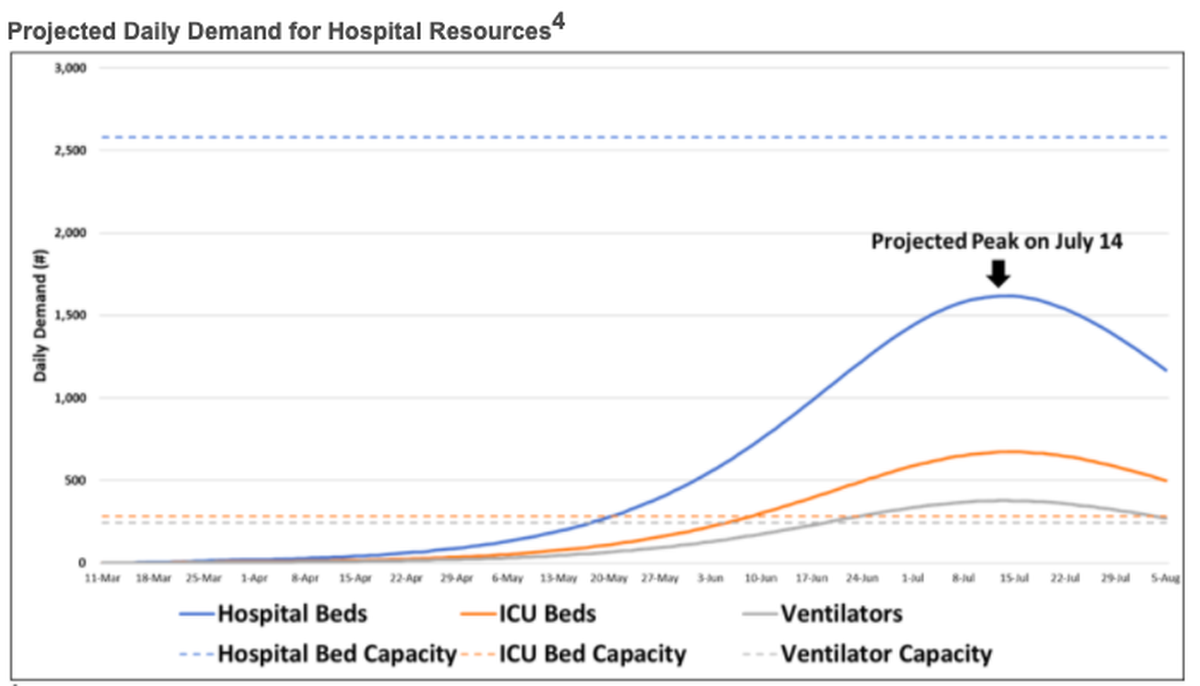
The greater Charlotte area is not expected to see its coronavirus “peak” — when hospitals could experience the greatest strain on resources — until July 24, Atrium Health CEO Gene Woods said during a Tuesday board meeting. Still, that peak would not surpass Mecklenburg’s capacity for hospital beds and personal protective equipment, the Observer previously reported, based on Woods’ comments.
Projections change over time
Over recent weeks, the predicted peak of coronavirus patients has changed several times. Each time, the peak was moved further away, suggesting social distancing, stay-at-home orders, and other preventive measures were working to “flatten the curve.”
Mecklenburg officials have used the University of Pennsylvania’s CHIME model throughout the pandemic, pulling coronavirus case information from the county’s health department, in addition to Atrium Health and Novant Health.
“As we’ve spoken about these projections and these models from the beginning, none of them are actually accurate,” Harris said Thursday. “They’re only as good as the data we have available to us.”
But Michael Draugelis, chief data scientist at Penn Medicine, said the UPenn model is meant to help officials anticipate a surge in cases at the start of a pandemic, WFAE reported. Mecklenburg’s first case of COVID-19 was reported on March 11.
There’s been a “slight decrease” in the average percent of individuals testing positive for COVID-19 over the last 14 days, local officials said Tuesday, the last time trend data was released in Mecklenburg. Hospitalizations at the region’s acute care facilities have also been declining in recent weeks. And the percentage of people tested for coronavirus who are positive is lower now than before. That comes as the county has increased testing and broadened the criteria for who is eligible.
Earlier projections showed the region could peak as early as mid-April, according to UPenn’s estimates — formally known as the COVID-19 Hospital Impact Model for Epidemics. As residents managed to “flatten the curve,” the peak continued to move into summer — spreading infections over a longer time period to avoid overwhelming hospital systems.
“You need to look at pushing back the peak date as a positive,” said Michael Thompson, an associate professor of public health sciences at UNC Charlotte. “That’s a way of saying we’re being successful, but people think it’s prolonging the agony.”
‘Confusing’ from the start
County Commissioner Susan Harden said she wants to know what other information Mecklenburg Public Health is using for decision-making, beyond the UPenn model.
“I think the messaging behind the models has been confusing from the beginning,” Harden told the Observer Wednesday. “There’s been a lot of variability in these models.”
County Commissioner Susan Rodriguez-McDowell said the models have been “troublesome” as they continuously change. A “peak” date may no longer be meaningful, Rodriguez-McDowell said, since Mecklenburg County residents managed to flatten the coronavirus curve.
“The actual date itself, I don’t know if it really matters that much,” Rodriguez-McDowell said Thursday. “But it’s good for people to see how the community is responding as a whole.”
Mecklenburg officials have warned models can be volatile as more information becomes available throughout the pandemic, including through expanded coronavirus testing efforts.
UPenn’s analysis incorporates data on how many people are infected and recovered from COVID-19. It also gauges how long it takes for coronavirus cases to double in a community, with Mecklenburg’s rate at every 21 days.
But Thompson said UPenn’s model is only intended to predict a single wave. As the model tries to fit data points into a perfect bell-shaped curve, Thompson said, it would be difficult to capture future outbreaks without starting a fresh analysis — or turning to another predictive tool.
The UPenn model may also struggle to incorporate declining social distancing as North Carolina gradually reopens, which could trigger a shift in the coronavirus curve, Thompson said.
This story was originally published May 14, 2020 at 4:36 PM.