
Creeks, streams around Charlotte need help. Mecklenburg may raise stormwater fees.
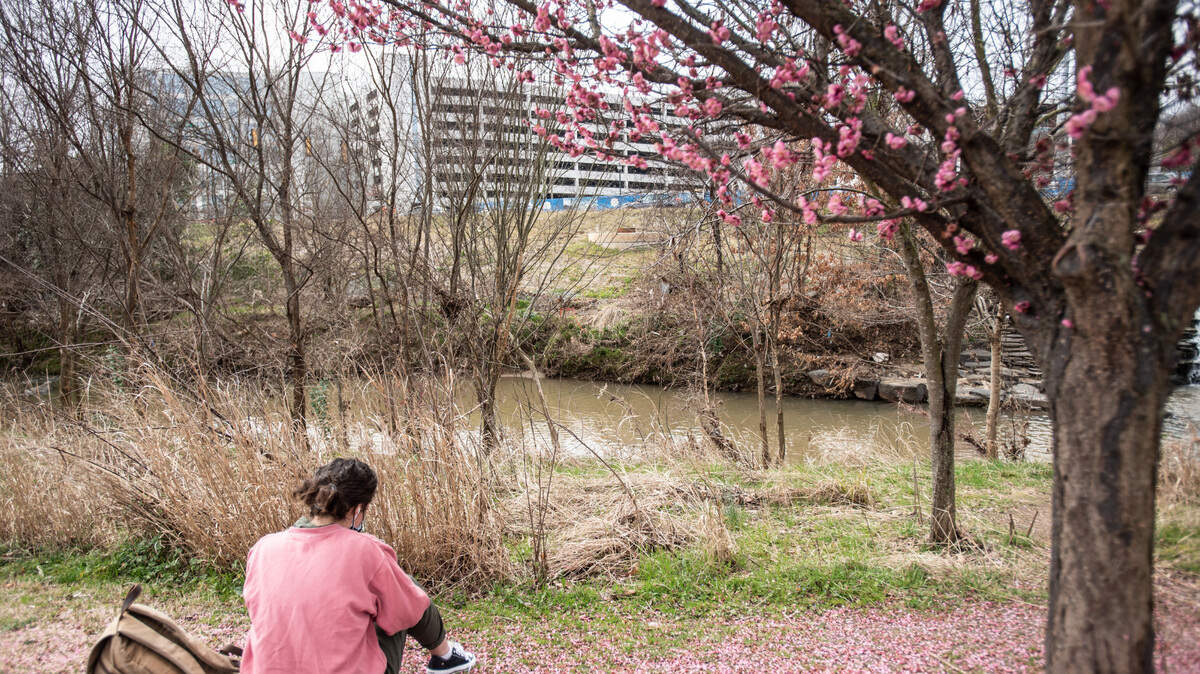
As Mecklenburg envisions a more sustainable future that prioritizes clean air and water, households across the county will need to foot the bill to counteract some of the damage wrought by frenzied urban growth.
Under the crush of new development — and an unforgiving patchwork of impervious asphalt without enough environmentally-friendly infrastructure — billions of gallons of rainwater gush into the county’s creeks, eroding the banks and scraping out the bottoms.
Pollutants, unable to seep into soil, sweep into waterways, threatening the presence of aquatic organisms that indicate the relative health of creeks. It’s not just a Mecklenburg concern — it cascades across the region and country, said Rusty Rozelle, the water quality program manager at Storm Water Services.
“There are a lot of challenges ahead,” Rozelle said in a recent interview with the Observer. “The (water) channels don’t fix themselves. You’ve got to go in and fix them, and it’s usually expensive.”
County commissioners are weighing two options for increases to stormwater fees, including rate increases for either five or 10 ten years.
▪ Within a decade under the more aggressive plan, the average household would pay $59.40 per year — an increase of more than 312%.
▪ In the other plan, the yearly fee would cap out at $29.40, said Dave Canaan, Mecklenburg’s Storm Water Services director. That’s a 104% increase from the current cost.
It’s still too early in the capital planning process to know exactly when, and for how long, a fee hike could take effect, county administrators say. The county’s current stormwater fee is $1.20 per month for what’s known as Tier II residential, which accounts for the bulk of households, said county spokeswoman Pam Escobar. (Charlotte and other municipalities have additional stormwater fees).
The potential increase in fees only reflect the base amount from the county, meaning residents in Charlotte and elsewhere across Mecklenburg may end up paying more.
Mecklenburg’s aim, rooted in an environmental leadership action plan that’s slated to be adopted this spring, is to accelerate stream restorations and flood mitigation projects, Rozelle said. There’s also the question of revamping recent state legislation — and potentially requiring developers in Charlotte to install or retrofit controls to mitigate flooding and water quality degradation.
”We have so much work to do,” Commissioner Elaine Powell, who chairs the Environmental Stewardship Committee, told the Observer. “We need to start working on it now.”
Environmental targets
At their retreat in late January, county commissioners contemplated environmental targets that can be reached in 2035 or 2030. Other priorities involve retrofitting county buildings with renewable energy sources, replacing the county’s fleet with electric vehicles, treating invasive species and purchasing more parkland, which commissioners say is vital to bolstering the footprint of Mecklenburg County Park and Recreation.
The environmental leadership action plan — also a hallmark of the coming fiscal year budget — can be continually refined to reflect evolving technology and climate change discussions at the national level, Deputy County Manager Leslie Johnson said at the retreat.
But as Commissioner Leigh Altman put it, Mecklenburg must act with a sense of urgency and triage environmental issues that will only escalate without interventions.
”I’m not excited about the choices because they’re all important, and I don’t relish the prospects of ranking them,” Altman had said.
Environmental advocates favor the compressed 2030 timeline, though Johnson cautioned that’s also the costlier path for taxpayers.
Households and commercial customers would begin paying higher storm water fees in the next few years, though Mecklenburg officials have not locked in the exact start date.
Using the aggressive plan and assuming increases start immediately, the fee for residential customers would climb to $2.45/month in fiscal year 2026, $2.95/month in 2027, $3.45/month in 2028, $3.95 in 2029, $4.45 in 2030 and $4.95 in 2031. The numbers are still preliminary, Escobar said.
Powell, a staunch environmental advocate, said she’s comfortable with the 2035 framework — and other commissioners agree with Johnson’s recommendation. Under that timetable and assuming an immediate start, the residential storm water fee would rise to $1.45/month in fiscal year 2022, with incremental increases each year until the fee is $2.45/month in 2026.
Rozelle likened storm water fees to a much-needed oil change for a sputtering car engine. Without the maintenance, “the engine is going to blow.”
“If it isn’t raised, we’re going to be moving at a snail’s pace restoring these streams,” Rozelle said. “There will probably be more degrading. We’re never going to get ahead.”
Suitable stream miles
Commissioners will adopt new environmental policies later this spring, followed by adopting the county budget in June.
Some investments are already in place, like stream water restoration initiatives — just at a significantly lower scale than needed. Despite limited resources, there are also local success stories, county administrators say.
In 1998, only 25% of all stream miles in Mecklenburg were suitable for human contact, Rozelle said. Fast-forward to 2019 and 96.91% of all stream miles became suitable.
Those waterways, once a nuisance plagued by sewage overflows, are now a “remarkable” community asset — especially amid the coronavirus pandemic, he said.
And it is encouraging for Storm Water Services to detect mayfly larvae in the creeks, including McAlpine, as a signal for clean water.
“Not all water surfaces need to be suitable for prolonged human contact, but all waters are supposed to have aquatic organisms,” Rozelle said. “It’s the basis of the food chain. If you don’t have these organisms, then you don’t have fish.”
The suitable stream mile percentage dipped slightly to 92.35% last year, though Rozelle said the change isn’t statistically significant. Streams with higher bacteria counts include Four Mile Creek in Matthews, Little Sugar Creek near Atrium Health Carolinas Medical Center and McDowell Creek in Huntersville.
Storm Water Services could not determine the exact cause, though Rozelle suspects it was likely due to waste from nearby wildlife like deer or passing flock of sparrows that triggered elevated bacteria readings.
Those microscopic creatures aren’t obvious to walkers or cyclists, yet the scoured creek beds with trees collapsing inward signal a looming environmental crisis. Powell said she recently toured Fisher Farm Park in Davidson to survey the erosion.
“It is real life in Mecklenburg County,” she said. “What can we do to make sure we’re protecting quality of life for the future? I think about that all the time in Environmental Stewardship because the population has grown so rapidly.”
Gavin Off contributed to this report.
This story was originally published March 1, 2021 at 8:37 AM.