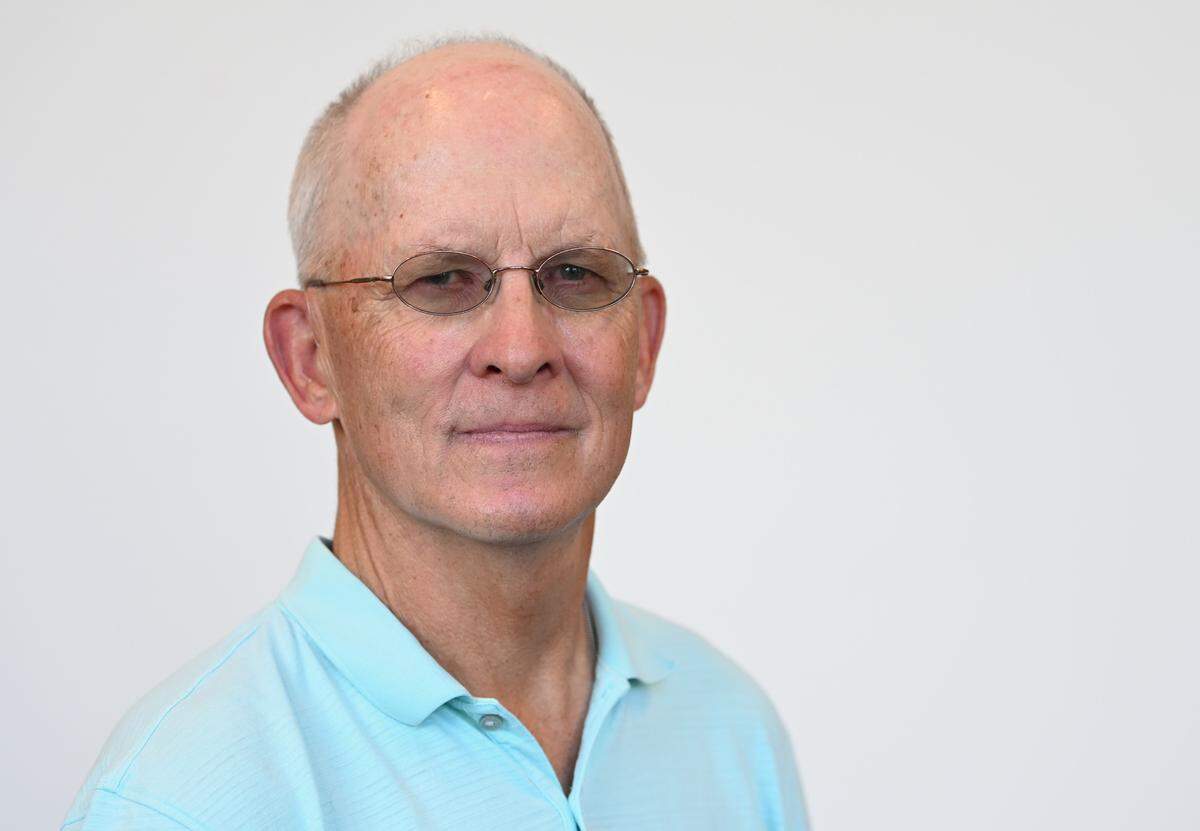
Street preacher’s COVID death in NC went viral. Widow tells his story 1 year later.
Landon Spradlin only got as far as Concord. His wife believes God sent him there not to die, but to have his best chance of living.
In the early afternoon of March 17, 2020, the evangelical minister and longtime blues musician, with his wife Jean at his side, collapsed during a bathroom stop along Interstate 85 North, three hours south of their rural Virginia home.
Spradlin died a week later at Atrium Cabarrus Medical Center. He was 66.
When she talks about Landon on the anniversary of their final days together, Jean Spradlin describes her husband’s feel for others and his skill with a guitar.
“He could play one chord, and because of his heart, he could lead people right into the presence of God,” she says.
Any fitting epitaph, Jean believes, would focus on Landon’s ability to love — as a husband, a father, a pastor and a friend. That made him essential to hundreds of lives. To repeat a pet phrase of Jean’s, he was never just a number.
But in one sense he was: Landon Spradlin was the second person to die in North Carolina from COVID-19.
His passing in the predawn hours of March 25 — along with the death in the same hospital of a Cabarrus County man only hours before — sent an early message shock-waving across the state that the worldwide pandemic was no longer contained on our TV screens and from this point on would fundamentally and indefinitely change our lives.
BEHIND THE STORY
MOREComing Friday
What life was like around Charlotte before last year’s stay-at-home order: Jean Spradlin, whose husband Landon was one of the earliest COVID-19 victims in North Carolina, takes part in a series of interviews looking back.
Visit CharlotteObserver.com on March 26 to see “Two Weeks To Shutdown.”
The state’s first victim has never been publicly identified. Spradlin? To his family’s horror, his death quickly drew worldwide headlines, providing a telling glimpse of how the U.S. response to COVID-19 would become inextricably entangled and weakened by partisan divides.
Concord, for a short time at least, offered a simpler and somewhat kinder narrative. From the moment Spradlin tumbled from the front passenger seat of his white Ford F-250 and onto the pavement of a service station parking lot until his death a week later, the doctors and nurses of a small-town hospital fought to save him.
Jean Spradlin is brought to tears when discussing how she and her dying husband were treated.
“We were guided there by God. God had us go to Concord,” she told the Observer during a recent phone interview. “Never in my life have I experienced that sort of kindness and concern ... I’ll always remember the humanity of it.
“They were the best part of the worst time of my life. I almost felt adopted. And they did everything they could to save that man’s life.”
Critics seize on Trump factor
The care and support both Spradlins received during those final days did not extend beyond the hospital’s walls. Within hours of his death, Landon Spradlin become an early punchline of the pandemic, frozen in time as the Trump-supporting street minister who posted on Facebook that the media had created mass “hysteria” over the pandemic to undercut the president.
He shared his thoughts not knowing that he had already contracted the virus that would kill him.
Spradlin, according to some of his most extreme detractors, got what what he deserved by ignoring the science and choosing instead to mingle with 1 million potential carriers at Mardi Gras.
A year removed, Jean Spradlin still bristles at some of the online reactions her husband’s death elicited.
“People who I personally did not know wrote to me that because Landon believed in Trump, they said they were glad he was dead, that he deserved it,” Jean said. “The people who had the most to say were the people who had the strongest opinions about Trump, not the coronavirus. They used the disease to piggyback their hatred of Trump.”
Jean says she sees now that she and Landon were driving headlong into a perfect viral storm when they gathered in New Orleans in mid-February, an annual Mardi Gras family trip to play music, spread the gospel and visit friends.
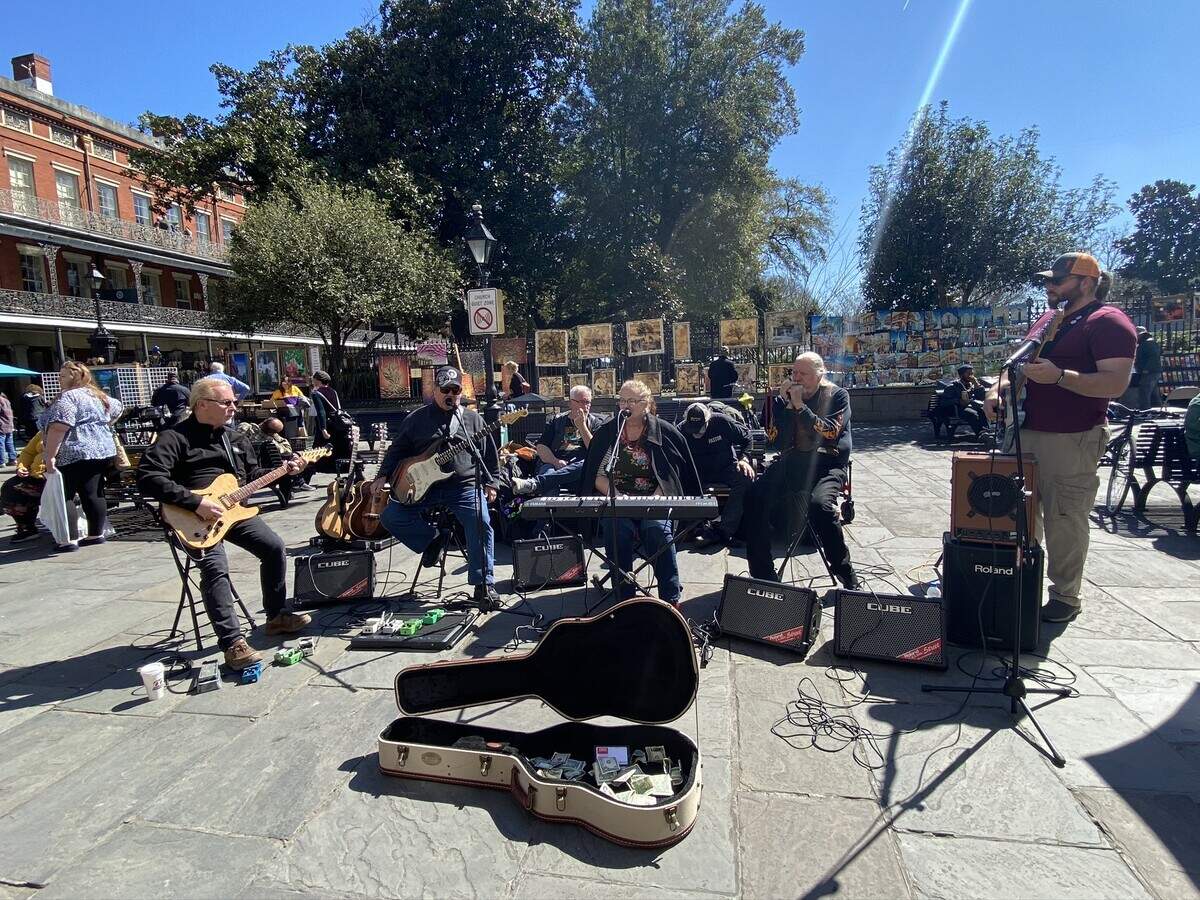
At the time, however, the Spradlins, like millions of other Americans, did not see the virus as a clear and present danger. It appeared no closer than Seattle, and had not surfaced in rural Virginia or even on Bourbon Street.
Mardi Gras went on as scheduled. So did the family’s trip. The Spradlins arrived in New Orleans on Feb. 18. Two daughters living in Texas joined them.
Around the time that the family was setting up its street ministry and plugging in their amps in Jackson Square, Trump was promising the country that the the virus was under control and would soon burn itself out. Instead, the country has been hit by almost 30 million cases, and some 545,000 have died.
“People blame Landon, but he wasn’t wrong in his statement. That didn’t mean we felt that the coronavirus was to be taken lightly. We just didn’t know it was already here,” Jean says.
“Then it hit New Orleans like a bulldozer,” Jean said, “and we had been right in the middle of it.”
Eternity
Landon Spradlin preached about a hands-on God who performs miracles daily — from healing the sick to restoring lost limbs to raising the dead. During a music symposium he took part in a few months before his death, he spoke of the need to take “quantum leaps” of faith, not small steps.
Naturally, when Jean describes how she first met him, her words take on almost miraculous tones.
In 1984, she had moved from California to take a temporary job in rural Virginia. One Sunday, based on a recommendation from a new acquaintance, she went looking for a new church.
A short man in a gray suit opened the door at Blue Ridge Gospel Tabernacle as she was about to turn the knob.
“Hi,” Landon Spradlin told her. “We’ve been expecting you.”
Thirty-six years later, Jean Spradlin’s voice still shivers when the describes the exchange. “When he said that, it felt to me like eternity. It felt like the echoes of eternity,” she says. “He was the best thing in my life beside Jesus.”
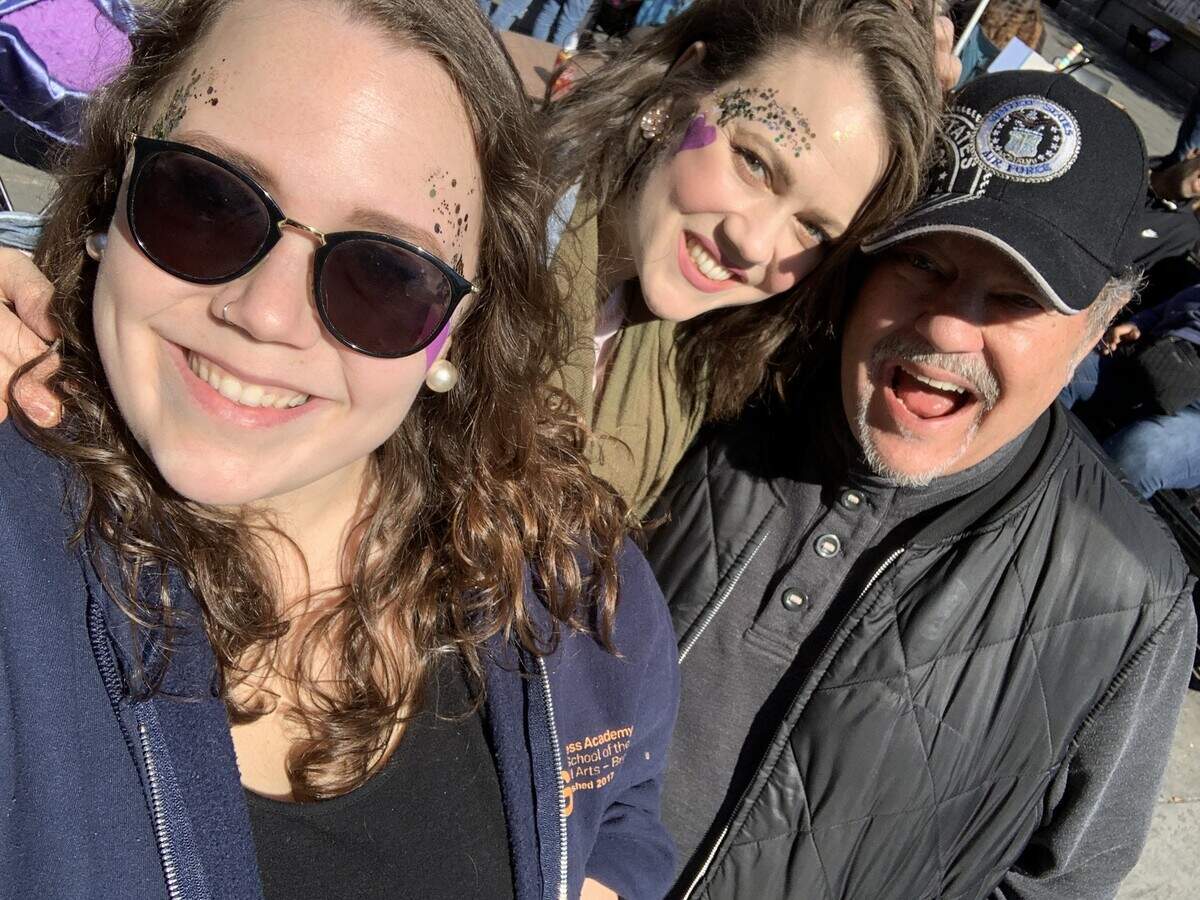
The couple married that October. They had five children. Jean was never a traditional pastor’s wife because Landon was never a traditional pastor.
He liked to say he had a congregation in every city, largely because a big part of his ministry focused on musicians who didn’t make Sunday services because they had been performing live only hours before.
His favorite town was his home town: New Orleans. Jean says the couple’s last trip there in 2020 was longer than normal because they wanted to begin looking for a home. By that time, Landon had closed down his Virginia church and was throwing himself head first into his Mardi Gras ministry.
“His mission was to go into pubs, clubs and bars, play the blues and connect with musicians and just tell them that Jesus loved them,” his daughter, Jesse, told the BBC.
“Mardi Gras is like Times Square in New York during New Year’s Eve. It’s a sea of people just drinking and partying. He was loud and laughing and in his element.”
But then Landon got sick. Jean says the couple always picked up some kind of bug during Mardi Gras as the streets and bars filled, and the below-sea level city turned into a viral Petri dish in the midst of all the revelry.
This time, Landon didn’t get better. He made two trips to the VA hospital in New Orleans. On the second, Jean says, Landon was tested for COVID-19. The results came back negative.
Still, Landon’s cough and breathing problems worsened, so much so that the couple decided to head home two weeks early so Landon could see his VA doctors there. They left the morning of March 16, towing a Jeep behind them. Landon, according to Jean, was too weak to help with the packing. Home was 900 miles away.
After spending the night north of Atlanta, the couple reached Charlotte midday on the 17th. Landon’s coughing had eased off as he rode quietly in the passenger seat. Jean thought he was resting.
Gretna was still three hours north when Jean pulled off the interstate in Concord for a long-overdue bathroom stop. When she went to the passenger side to help Landon, she says, “He just poured out the truck. He didn’t know what was going on.”
“I said, ‘Landon, you’re scaring me.’ And then he just fell to the ground.”
Another service station customer called 911. An ambulance appeared within minutes. Jean says she heard a number: 47. She knows now that the number described the percentage of oxygen in Landon’s blood.
Her husband had not been resting during the drive, he had been slowly suffocating.
The phone call
After 36 years of marriage, the Spradlins’ last talk came down to five words that Landon struggled to say from his hospital bed on March 18.
“I’m sorry,” Landon mouthed around his breathing tube, then, “I love you.”
A nurse at Atrium Cabarrus interrupted. Landon’s blood pressure was spiking. They needed to sedate him. Jean says she stayed an hour longer, rubbing his arm, telling her unconscious husband repeatedly, “Don’t leave me. Don’t leave me.”
Then medical personnel came back in the room. Landon’s COVID test had come back positive. “You’re going to have to leave,” Jean recalls them telling her. “You probably have (the disease) now, too.”
She says she was led out of the hospital by two armed security officers. Her daughter picked her up out front.
“It was nothing but loving, but they were very concerned,” she recalls. “This was just the beginning.”
Jean says Atrium later moved her from her hotel and into a rented home. The staff brought in some furniture, food and an air mattress. They arranged for Jean to get wireless service.
As she quarantined, all five of the children traveled from as far away as California to keep vigil. Several turned up outside the house carrying signs that read, “We love you. We’re here for you.”
The hospital called from time to time to get permission for various procedures that the staff hoped would bring Landon around. “They were all fighting for him. Like he belonged to them. Like he was important to them,” Jean says.
Nothing seemed to work. Back at the rental house, Jean says she felt the inevitable pressing in around her.
“My kids were saying, ‘It will be alright.’ My friends were saying, ‘It will be alright.’ I already knew,” she says. “God had prepared my heart. I knew he was not coming back. All I’m waiting for is the phone call.”
The call came at 3 a.m. on March 25. She drove home that afternoon. She still had one week of quarantining to go.
Had Landon’s funeral not occurred in a worldwide medical emergency, Jean believes 1,000 people would have shown up. Instead there were 30.
She said she was told not to touch her husband in his open casket. She did anyway, laying a tissue on Landon’s chest so she could rest her hand there. The mortuary had shaved Landon’s mustache. She says she never saw him without it. The family could not find a trumpet player. So a musician friend, Brad Mullen, plugged in his portable sound system and played “Taps” on his guitar.
In May, Jean moved to Texas to be closer to two of her daughters. She bought a house in Fort Worth and works two days a week in a medical office.
Looking back, she knows Landon’s family and friends prayed relentlessly for his recovery. She doesn’t blame God that those prayers went unanswered. She tries to keep her own loss in perspective.
Several of the musicians who shared microphones with Landon in New Orleans succumbed to COVID-19, Jean says. she has a niece who lost seven family members to COVID-19.
“Can you imagine?” she asks.
“Life happens to everyone. People mistakenly are blaming God for what’s happened over the last year. But this disease has the devil written all over it.
“It wasn’t God who killed Landon. It was God who received him.”
She finds it ironic how politics got entangled in all of this. Her husband was the Trump-loving pastor. She now finds herself on the “extreme side” of mask advocacy.
“This is a demonic disease. Small children are dying. Grieving parents are out there and people still won’t wear masks,” she says. “I know it’s wrong for me to say but I can see myself talking to people in Walmart, saying, ‘Who do you want to kill? Do you want to kill that little girl right there? How about that old man? Are you willing to murder someone by not wearing a mask?’’’
Had he survived, Jean believes, Landon would have worn a mask, too. But his critics on Facebook and Twitter would have missed that about him and a lot more.
“They didn’t see anything they didn’t want to see,” she says. “They only saw Trump. They didn’t see the man who died.”
The family won’t be making that mistake. Thursday marks the anniversary of Landon’s death. After work, Jean and the kids will gather on Zoom to celebrate his life. They’ll share funny stories, she says, and they’ll try to laugh.
This story was originally published March 25, 2021 at 6:00 AM.