A Charlotte neighborhood honors gold history. But is it leaving out another?
Once, some of Charlotte’s earliest streets were paved with crushed rocks, laced with tiny gold flecks.
Decades after the discovery of gold in 1799 in Cabarrus County, the mining industry boomed. People came from all over the world to dig for gold in Charlotte.
Reminders like the city’s Gold District and UNC Charlotte’s gold-mining mascot, Norm the Niner, refer to this nugget of Queen City history. But an important part is often left out or overlooked: Charlotte’s gold industry was heavily reliant on slave labor.
This month’s Latta Plantation controversy raised awareness about the importance of lifting up the experiences of enslaved people on plantations in North Carolina. The history is pervasive: Charlotte’s history, like that of the South and of the United States, is inextricably intertwined with the history of slavery — scars of which we pass by every day.
Charlotte Gold District
New development and recent commercial investments have led to re-branded part of Charlotte, between uptown and South End, as the Gold District. It’s the area bordered by Morehead, Graham and Winnifred streets and Southwood Avenue.
The district’s website calls the Gold District a neighborhood “where people could come with shovels in their hands, make their own destiny, and improve their own quality of life,” and a mural in the neighborhood depicts an underground mining tunnel. It’s being branded to honor the neighborhood’s gold mining history and increase interest in the area. An extensive timeline on the Gold District’s website makes no mention of the forced labor of slaves.
Although mine structures and shafts are no longer visible, the majority of the old gold mine tunnels run under Charlotte’s streets.
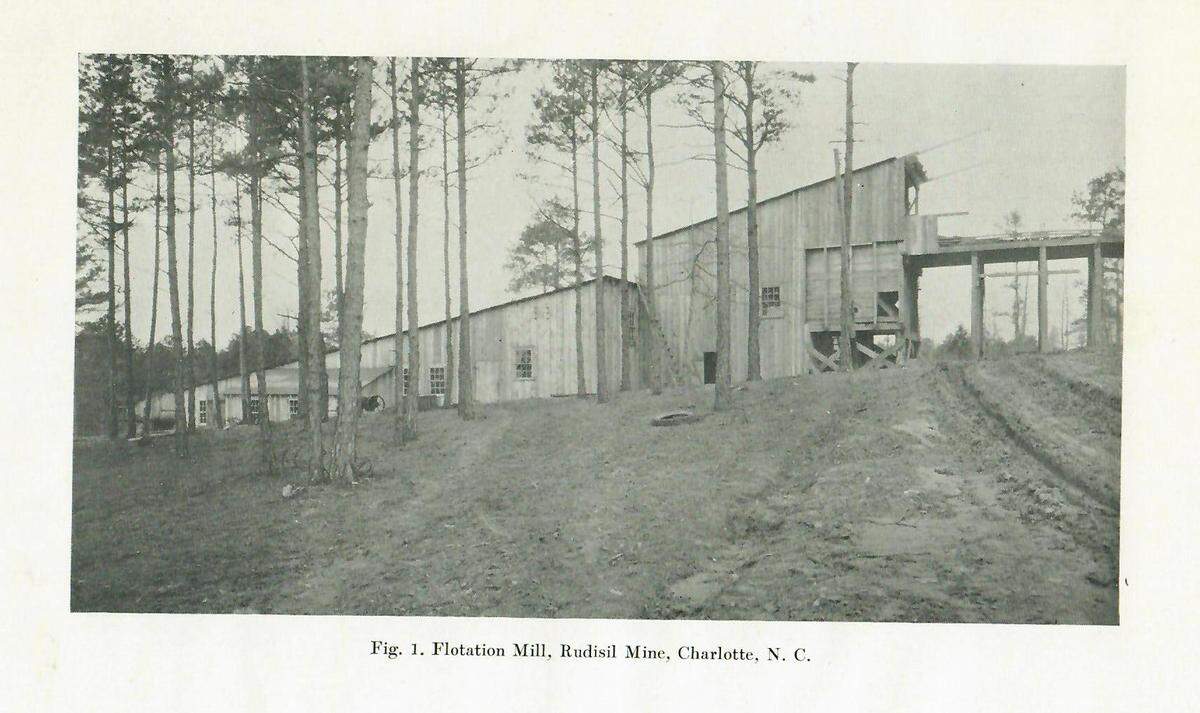
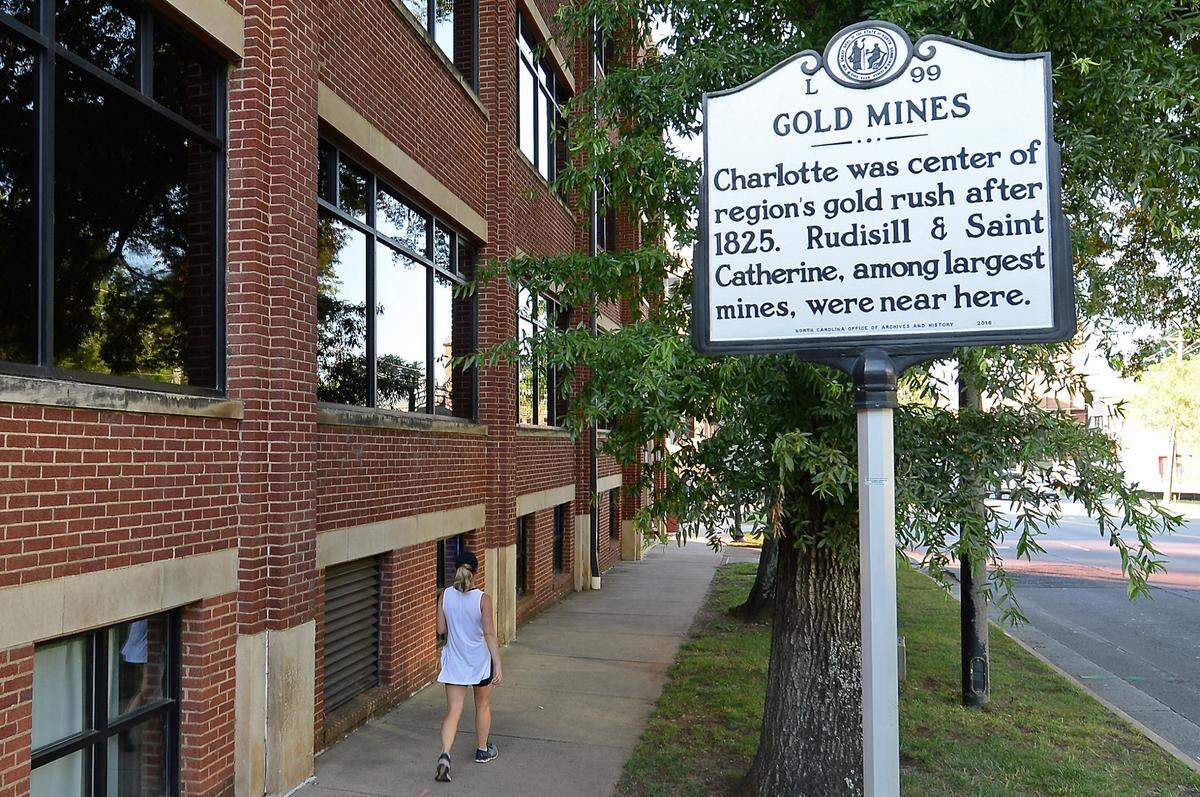
Signs mark the location of former gold mines near present-day Mint Street and the Panthers’ Bank of America stadium. The Rudisill and St. Catherine Mines were the most profitable. The historic markers name the two mines and say the gold gleaned from the mines contributed to the “wealth of many.”
But those who became rich off the gold weren’t the slaves who were forced to work in the dangerous mines. They go unmentioned.
Slavery in gold mines
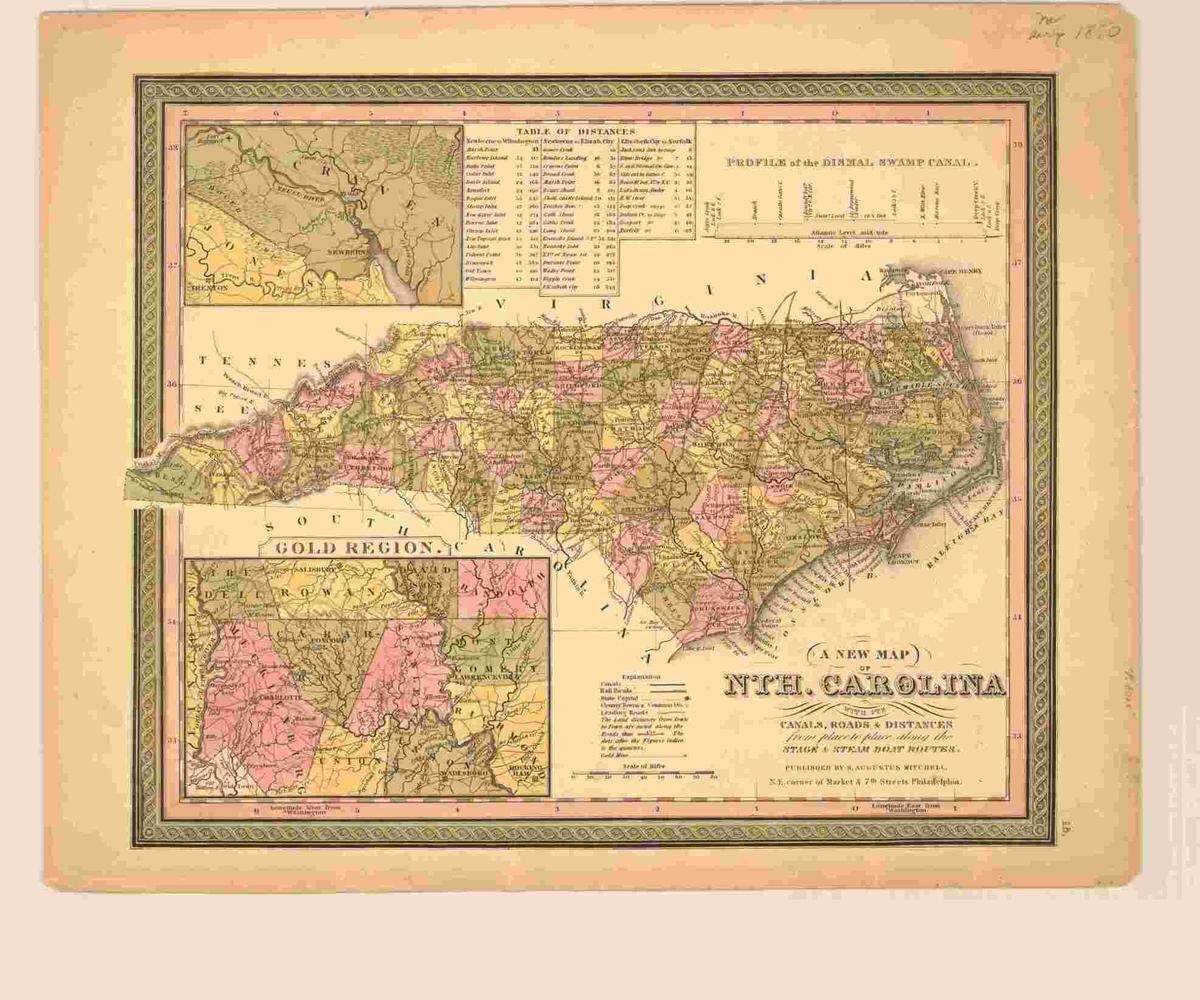
North Carolina was home to the first gold rush in the United States. A man named Peter, who was enslaved, in Cabarrus County, is largely accepted by historians as the person who discovered the largest amount of gold in the region’s first mining site, giving way to the gold rush.
Starting in the 1830s, immigrants and slaves alike dug gold in mines, sparking Charlotte’s trajectory as the banking capital of the country.
“Slavery was what made the economy here go for the first two-thirds of the 19th century as we were moving from a just settled crossroads to a small town,” local historian Tom Hanchett said.
Jeff Forret, a historian whose master’s thesis at UNC Charlotte focused on slave labor in gold mines, described gold mining as “a really cosmopolitan activity.”
It was reported that 13 different languages were spoken in one mine.
“We don’t traditionally think about enslaved people working in the gold mines. We only think about harvesting tobacco, cotton and rice, but they played a huge role in mining gold, which, at the time, was a very sort of skilled labor,” Levine Museum historian Willie Griffin said.
“Once gold was discovered here, a lot of foreigners, especially from Italy, began to immigrate into the country to mine gold… but there were some labor disputes between owners of the mines or companies that ran mines, wanting to bring in slave labor and undercut some of the miners that came here to earn a living.”
Using slave labor became more popular after immigrant mine workers began striking over wage disputes.
“It was one of the things that made enslaved labor that much more attractive, because the owners could force them to do it,” Forret said. “But there were some reports of enslaved people being paid small amounts of gold dust, which is a pretty unusual sort of thing that happened.”
An advertisement in the Charlotte Journal — which circulated in the early to mid-1800s and was previously published as the Miner’s and Farmer’s Journal, according to records with the Library of Congress — offers a $25 reward for the “delivery” or jailing of a slave named Jacob who escaped from the Capps’ Gold Mine. It was printed Feb. 10, 1831.
(The Charlotte Observer was first printed as the Charlotte Chronicle in 1886.)
One of the things that inspired Forret’s thesis was that slaves who worked in the mines would often secretly mine gold for themselves, pocketing little nuggets they could find.
But that was nothing compared to the wealth acquired by those who would become the mothers and fathers of Charlotte.
“Enslaved people, at best, were getting some grains of gold dust out of this,” he said. “Plus whatever they might be able to pocket secretly.”

A re-envisioning and reckoning
Current re-development of the Gold District centers on restaurants, bars, art and museums, including one planned that would focus on the history of mining in Charlotte.
But it’s not clear how much slave labor will be included in that narrative.
The Observer could not reach multiple people on the Gold District’s board of directors, which helps promote commercial interest in the area.
“Charlotte hasn’t traditionally been considered a part of what we call the ‘cotton kingdom of the South,’” Griffin said.
“We haven’t been traditionally seen as a Richmond, Charleston, or Atlanta because of the kind of city that we have been since the turn of the 20th century, a new South city ... But there were a number of plantations around the city and county.
“Charlotte just isn’t associated with that history.”
However, Griffin said the city is still deeply entangled with the history of slavery.
“I don’t think there’s any place in this county that isn’t,” he said.
At times, Griffin said, thousands of enslaved people would have been mining for gold in local creeks or rivers.
“And the gold they were finding enriched a lot of people,” he said. “Then if you move forward to the eve of the Civil War, 30% of the county’s population were enslaved people.
“They were making somebody wealthy.”
Many of the names of our city streets honor those people that benefited from slave labor, Griffin said.
“They’re connected in some ways to slavery and made their wealth through that. It doesn’t denigrate these people,” Griffin said. “What we have to do as a society is humanize these people… We have to do a better job of helping people understand context.”
Of the reimagining of the Gold District, Forret said he appreciates the recognition as a historian.
“But that history that we use also has to be as inclusive as possible,” Forret said. “And certainly, slave laborers were an important part of the working force in those mines, so that also has to be acknowledged as part of that reckoning with the past.”
This story was originally published June 26, 2021 at 1:32 PM.