‘Secretive’ creature feared lost for 90 years rediscovered in China and Vietnam

In 1934, scientists discovered a new species of olive-brown snake with distinct black and orange collar-like patterning in Vietnam’s Tam Dao National Park.
For nearly 90 years, the rare, “elusive” species — Rhabdophis angeli — seemed to have disappeared from the region where it was first discovered. Despite “extensive field surveys,” no other specimen was ever found.
According to researchers, Rhabdophis angeli is a “very fast-moving snake, which makes it difficult to encounter during general herpetological surveys.”
Researchers have now confirmed, due to a case of mistaken identity, that the species has been rediscovered, according to a study published Oct. 9 in the peer-reviewed journal Zootaxa.
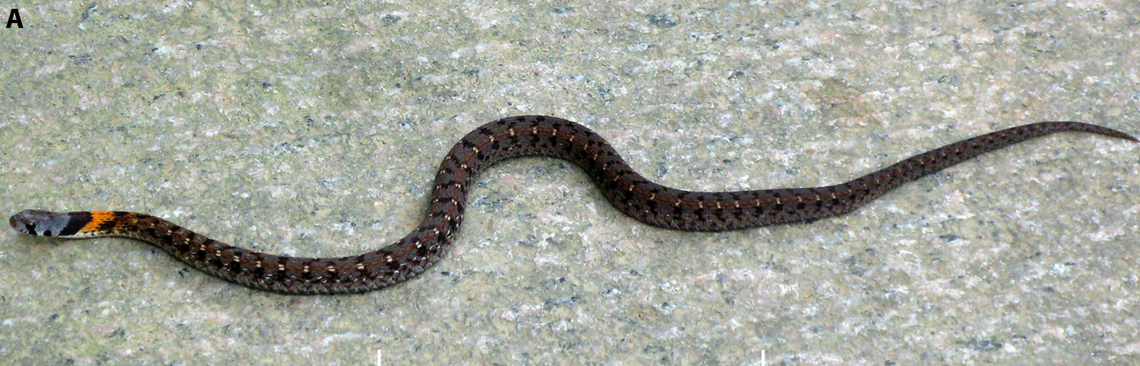
In 2014, researchers discovered a snake in Guangdong Province, China, which was similar in appearance to Rhabdophis angeli, but had minor differences like fewer teeth and slight color variations, according to the study.
They named it Rhabdophis guangdongensis and determined it was a relative of the long-lost Rhabdophis angeli, researchers said.
In recent years, however, researchers began to question the identities of some recorded snake specimens in the Rhabdophis genus. One museum specimen, in particular, caught their attention.
Collected in 1977 in Tam Dao National park, the snake was initially catalogued as Rhabdophis subminiatus. In 2000, it was identified as Rhabdophis nuchalis and a year later, recategorized again as Rhabdophis guangdongensis, according to the study.
Now, thanks to advances in DNA analysis, researchers have confirmed the specimen collected in 1977 was actually Rhabdophis angeli, researchers said.
Even more significantly, researchers have also determined that Rhabdophis angeli and Rhabdophis guangdongensis are actually the same species, the study said.
While the species now appears relatively widespread geographically, “it remains rare throughout its known range, possibly due to a highly secretive way of life in humid areas,” researchers said.
“The principal threat to this species is habitat loss and degradation,” researchers said. Tam Dao National Park in particular is facing “habitat destruction” and intensive, “large-scale tourism infrastructure development,” according to the study.
As a result, researchers recommend Rhabdophis angeli be listed as near threatened on the International Union for Conservation of Nature’s Red List, according to the study.
Researchers also call for the “implementation of more robust conservation actions and long-term ecological monitoring” of the Tam Dao Mountain Massif which is the core of Tam Dao National park.
“This mountain ridge harbours an exceptionally high herpetofaunal diversity,” researchers said.
“Despite its formal protection and the high levels of species richness and endemism with 47 amphibian and 99 reptile species currently recorded, the biodiversity of the park remains under considerable threat” due to “infrastructure development associated with tourism,” according to the study.
The research team included Tan Van Nguyen, Tosaphol Saetung Keetapithchayakul, Amy Lathrop, Nikolai L. Orlov, Duc Trong Nguyen, Nikolay A. Poyarkov and Patrick David.
This story was originally published October 20, 2025 at 3:08 PM with the headline "‘Secretive’ creature feared lost for 90 years rediscovered in China and Vietnam."