Charlotte council rushes to fill vacant seat, leaving little time for public input
In a one-week span, more than 140 applications poured in for an open Charlotte City Council seat, and the Democratic-majority council on Monday will select a person who will serve for 10 months.
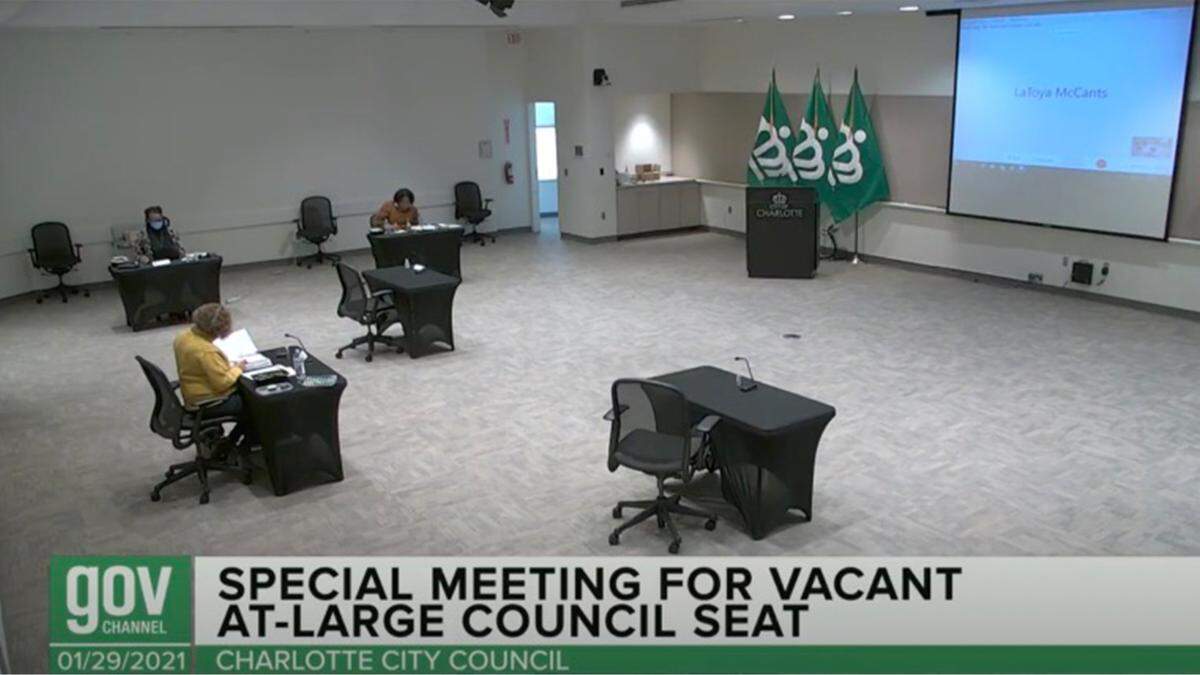
On Friday, 68 of the applicants signed up to speak at a public forum hosted on the city’s Facebook, YouTube and Government Channel pages, though a few did not show up. Around 135 members of the public were tuned in early into the hearing, between Youtube and Facebook.
Candidates presented their qualifications, and listed issues like homelessness, infrastructure, upward mobility and COVID-19 as priorities. Each candidate got two minutes to speak but few gave detailed policy proposals and there were no questions or rebuttals or interactions with the public.
That raises questions about transparency in a process that will seat someone who will make decisions on everything from transportation to zoning.
“A two-minute speech is not enough for the public to know how you stand on crucial issues,” said Robert Dawkins, a community activist who works in areas like police reform and affordable housing. “And we hope the city is using more than an elevator speech to decide who is going to serve at-large for a city of close to 900,000 people.”
But council members say they wanted to fill the seat quickly because of the critical decisions the person will help make on issues such as affordable housing and infrastructure.
“There’s a reason why the 15th-largest city in the country has an 11-, 12-member City Council,” council member Braxton Winston said. The council has four at-large members and seven district representatives. “There’s a lot of work that needs to happen and not one of us has the ability to do everything that is needed.”
Former at-large council member James “Smuggie” Mitchell stepped down abruptly this month after taking a job with a private construction company that does business with the city and other public entities. That raised questions about potential conflicts of interest.
State law expressly grants authority to city councils to fill vacant seats if a position opens before the end of a term. But the process of taking applications, voting to fill the seat and the timing of that is left up to municipal governments.
Unlike a state law governing vacancies on county boards, a city council in North Carolina does not have to follow a strict 60-day rule to fill an open seat. State law also does not set forth detailed steps for filling city council vacancies — such as requiring candidates to fill out applications or holding a public forum.
There does not appear to be a Charlotte ordinance that prescribes an exact process the city would use to fill a vacancy on the council.
The City Council earlier this month voted on the steps for filling Mitchell’s old seat — and the timeline left minimal opportunity for the public to weigh in.
A final list of the eligible candidates was published 24 hours before the scheduled forum Friday, and although the forum was announced as a public meeting, with a live-stream available, there was no option for participants to take questions or for the public to interact with the candidates.
Council member Dimple Ajmera said her phone has been ringing off the hook with calls from candidates and endorsements from community members. Ajmera was chosen from six applicants for the District 5 seat in January 2017, the same month that former council member John Autry stepped down to serve as a member of the N.C. House. She then ran at-large.
Ajmera said she has had private conversations with her colleagues to figure out how to narrow down the list.
A majority of council members cannot discuss candidates in a closed meeting, but they can meet one-on-one or in small groups, said Frayda Bluestein, a faculty member at the UNC School of Government.
Mitchell, who is a Democrat, must be replaced by a member of the same party, according to state law. Due to his sudden resignation, whoever is appointed to replace him will serve nearly half a typical council term.
The city received 143 applicants for the position, including community advocates, former elected officials and candidates who have run unsuccessfully for office, among others.
But 36 of them were deemed ineligible, largely because they were registered as unaffiliated voters. Others had incomplete or late applications, or resided outside of the city.
What critics say
Brooks Fuller, director of the North Carolina Open Government Coalition, said the short timeline, given the sheer volume of applicants, is cause for concern, even if the number has been whittled down.
“That’s still dozens of people that citizens of Charlotte don’t really know anything about yet,” said Fuller, also an assistant professor of journalism at Elon University.
Still, he said, appointments are a fundamentally political process. No matter what happens, he said the City Council members should be transparent about how they came to their decisions.
“I think that what the leaders in Charlotte owe to the public is a full justification for their choice,” he said.
Dawkins said he’d like to know where the candidates stand on the city’s priorities concerning economic development, police accountability, transportation and utilities. He said the system by which the council appoints members is “not the most fair” because it does not involve public input.
“It should be that City Council has to ask the candidates where they feel about their current priorities and where they fit in on that,” Fuller said said. “If it’s not lining up with what the city’s been fighting for, how do we know that we’re not just getting somebody to warm a seat?”
What council members say
Council members defended the process and said that they are keeping public input in mind.
Tariq Bokhari, one of two Republicans on the council, said the downside of having so many applicants is that they can’t hear as much about their views on various issues. He said because he’s in the political minority, he’s waiting to weigh in on the process until the Democrats come up with a shortlist.
“It’s a trade-off,” he said. “I personally think more people being involved in local politics is good, and worth the fact of not being able to go in deep with a couple people.”
Winston said the public will be at the table, because members are elected to make decisions based on the desires of their constituents.
“If we’re doing our jobs right and democracy is working, the views of the people will be considered,” he said.
In an email, council member Victoria Watlington said there needs to be a “well-thought-out” process for filling vacancies in the city’s charter. Until then, she said, the public should be empowered to reach out through email, social media and other channels.
“Don’t wait for a process to tell you when to give input!” she wrote.
This story was originally published January 29, 2021 at 2:33 PM.