
What can a Republican do to win in Charlotte? This group will make a push.
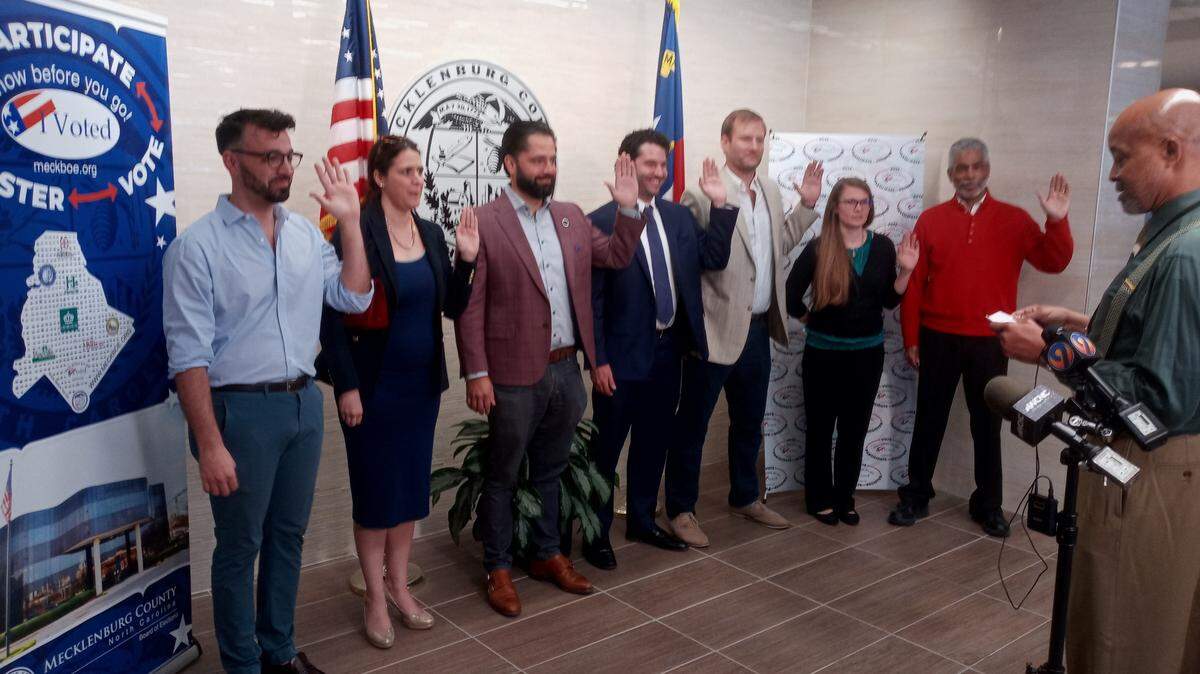
By Charlotte politics standards, something unusual happened Wednesday: spectators at the Board of Elections erupted into cheers for a group of Republican candidates.
Organized by City Councilman Tariq Bokhari, the candidates have big ambitions. They want the mayor’s seat and a majority of the City Council. Both have been controlled by Democrats for a decade or more.
Their strategy is two-fold. First, Bokhari said he hopes to raise $250,000 to be shared by the field of candidates, which includes eight people as of Wednesday. That money would bolster the amount each candidate would raise independently.
Second, they want to harness any disappointment that voters might have about the status quo of Charlotte’s political leadership. Several candidates said that minority communities are suffering because of broken promises made by the city’s Democratic leaders, particularly in areas like affordable housing and economic mobility.
They also are united on a platform of enhancing public safety and increasing the salaries of officers at the Charlotte-Mecklenburg Police Department.
The primary is currently scheduled for May 17, and the general election for City Council is scheduled for July.
Charlotte Republicans running for office
The candidates are Stephanie de Sarachaga-Bilbao, who is running for mayor; Kyle Luebke, Charlie Mulligan, David Merrill and Carrie Olinski, who are running at-large; James Bowers, who is running for District 3; and the City Council’s two Republican incumbents, Bokhari and Ed Driggs.
Any Republican running for City Council, with the exceptions of Bokhari and Driggs, will face a tough battle.
The last time a Republican won an at-large seat was in 2009. Charlotte’s last Republican mayor was Pat McCrory, who won in 2007.
About 19% of registered voters in Charlotte are Republicans, according to data from the city’s latest redrawing of City Council districts. About 35% are unaffiliated or belong to another party, and 46.5% are Democrats.
In City Council District 7, the one held by Driggs in south Charlotte, there will be substantially more registered Republicans than Democrats under the city’s new election map. Bokhari’s district, just north of Driggs’, has a more equal share, but has slightly more Republican voters.
But the Republican slate appears undeterred.
“I’m more excited than ever,” Bokhari said, “because over 10 years now the Democrats have ruled this city with an iron fist and things have not gotten better.”
He and other candidates pointed to the abolition of single-family zoning, rising housing prices, poor morale at CMPD and the decision last year by council members to give themselves and Mayor Vi Lyles pay raises. (Charlotte still allows people to build single-family homes. It eliminated “single-family only” zoning, which previously prevented the construction of multi-family units across 84% of residential land in Charlotte unless rezoning was approved.)
Building regulations that increase the cost of new homes has helped fuel the affordability crisis in the city, according to the group, which filed to run Wednesday.
They also said the city has done too little to bolster public transportation networks and road improvements, and not done enough to address safety concerns of bus drivers that have flared in the weeks after CATS driver Ethan Rivera was shot and killed. Several bus drivers attended a City Council meeting this week, saying they felt unsafe at their jobs and that the city has failed to protect them.
At least part of the Republican candidates’ strategy will focus on reaching non-white voters.
“It’s time to make a change so that Charlotte is a city that every single community can thrive in, whether you are white, Black, Hispanic, Asian, LGBTQ or straight, whether you’re rich or poor, whether you’re young or old,” Mulligan said. “Right now we are a city that is far too divided. And guess what? That division keeps the people who are in power, in power.”
The eight candidates includes one Black member, one Hispanic member and one gay member. Luebke said he would be the first openly gay Republican to serve on Charlotte’s City Council if he’s elected.
Black voters make up 46% of all registered Democrats in North Carolina (a higher percentage than any other racial group) and are more likely than any other racial group to register as Democrats, according to a 2020 report by UNC Chapel Hill.
Nearly 80% of Black North Carolina voters are Democrats, according to the report.
A Democrat at the scene responds
Whether their message resonates with voters or not, Republicans will face stiff competition when they’re up against Democratic incumbents, said Dan McCorkle, a Charlotte political strategist and Democrat who was at the Board of Elections on Wednesday.
“I’m very confident in Democrats maintaining a 9-2 majority or even a 10-1 majority,” he said. “We’re gonna fight hard as Democrats always do in the city of Charlotte.”
McCorkle added that he favored having competitive races, from the City Council all the way up to Congress.
“May the best candidates with the best messages and best campaigns win,” he said. “We will absolutely take this challenge.”
This story was originally published March 3, 2022 at 10:19 AM.
.jpg)