
Baltimore developer used stealth to sell a big-dollar casino to rural NC county

Two years ago, Senate leader Phil Berger sought to pass legislation to bring casinos to North Carolina, including one to his home county to counter a gambling complex opening just across the border in Danville, Virginia.
That was big news. North Carolina had banned casinos, except for those U.S. law allows on land owned by Native American tribes, for more than two centuries.
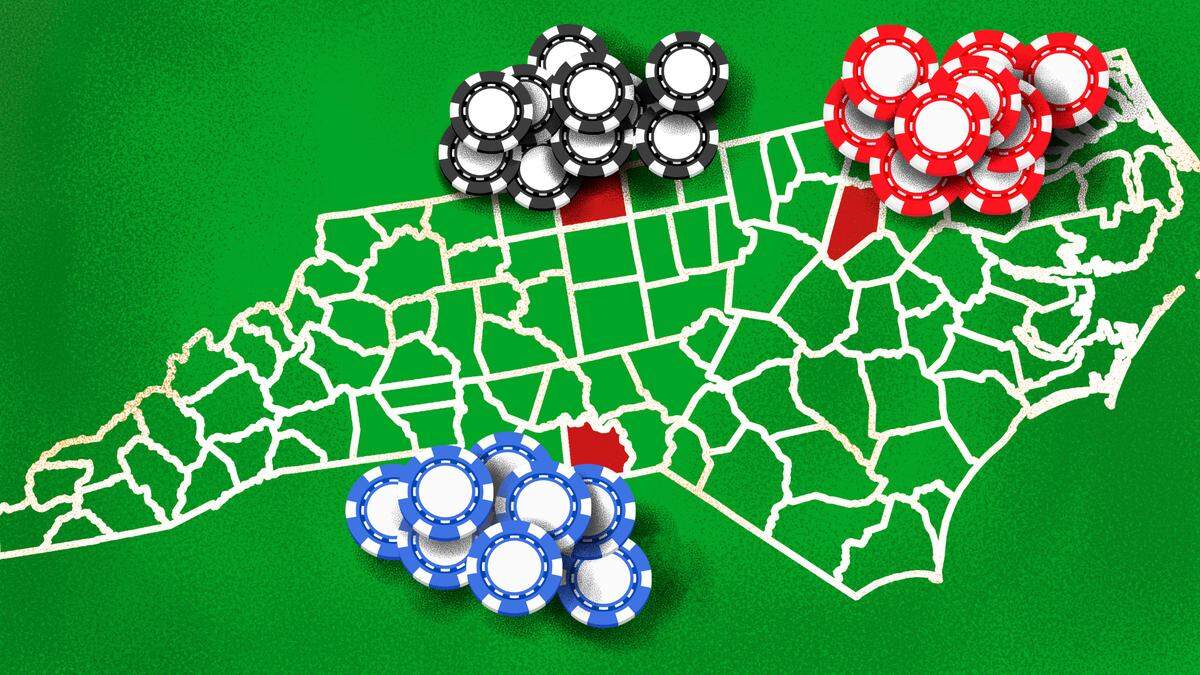
Draft legislation he and House Speaker Tim Moore discussed with reporters would have opened three lower-income counties to casinos. Three favored counties — Anson, Nash and Berger’s home of Rockingham — were each roughly an hour’s drive from one of the state’s three biggest population centers. Officials in all three were eager for economic growth.
But before any talk of legislation became public, a major casino developer quietly cultivated local government support in all three counties. It acquired options to buy land. If the legislation had passed, The Cordish Companies of Baltimore could have had a head start over any competitor.
The casino push failed. But moves on its behalf show how behind-the-scenes players help advance political and corporate agendas without the public’s knowledge.
It’s long been known that Cordish hired top North Carolina lobbyists and spread campaign funds among Republican lawmakers as it sought to improve its chances of building casinos here. But much was not made public. County officials took an overnight trip to a Cordish casino, for one, with whoever paid the bill not known. And a Cordish lobbyist targeted specific lawmakers considered key swing votes.
Also not publicly disclosed: Cordish had help from a former top aide to Berger — Jim Blaine, a co-founder of The Differentiators, a fast-growing consulting firm that has worked with dozens of powerful political and business clients.
Blaine met with Anson County officials at a private meeting at a sports shooting business in early 2023 to inform them about an economic development project that could turn the county’s fortunes around, said Anson County Manager Len Sossamon in an interview. That was roughly four months before lawmakers confirmed legislation was being drafted.
“The initial discussion was just that, would we be interested in, you know, a casino entertainment district,” Sossamon said.
Community casinos in North Carolina?
Cordish has been in real estate development since its founding in 1910. It expanded into gambling in 1981, and now has casinos in Florida, Pennsylvania and near its Baltimore headquarters.
Cordish came out a winner after Virginia lawmakers in 2020 began approving legislation that allows localities to hold referendums on casinos. The company broke ground on one in March in Petersburg.
The company connected with North Carolina officials as early as 2021, lobbying reports show. In September that year it hired then Gov. Roy Cooper’s former Commerce Secretary Tony Copeland and Drew Moretz, a former UNC System vice president.
The following year, it was Copeland who first approached Berger about “pursuing an economic development opportunity through authorizing commercial casinos and surrounding tourism districts in rural areas,” the state Senate leader said in a written statement released Wednesday.
By May 2022, the company had begun land negotiations in Nash County, according to one property owner. It had secured options in Nash and Rockingham counties by the time draft legislation emerged. An option deal was struck in Anson in 2023.
In the fall of 2022, Cordish had begun reaching out to Rocky Mount officials with its casino plans, and asked them not to make them public, WRAL was first to report and The N&O confirmed with city councilman Lige Daughtridge.
It wasn’t until April 12, 2023, that the media began reporting Republican lawmakers were showing an interest in allowing casinos. After that, much of the reporting focused on plans for Rockingham and Nash counties, places where visible community opposition emerged.
In Anson, the situation was a little different. Opposition wasn’t as loud, and details on what Cordish was pitching stayed behind closed doors. Records obtained by lawyers bringing a casino-linked defamation suit, however, reveal moves Cordish and its advocates made there. The News & Observer obtained those records from Anson County in a public records request.
Despite its proximity to Charlotte, the state’s largest city, Anson County has struggled to keep residents and businesses. It has lost more than 15% of its residents since 2010, the U.S. Census reports, and its population is now roughly 22,500. Nash and Rockingham counties each have more than 90,000 residents.
Just as the pandemic hit, Anson County residents learned it didn’t have enough business to keep open its only Walmart, located on the outskirts of Wadesboro, the county seat.
A new casino and conference center that a Cordish representative said it planned to invest $500 million into would have brought in roughly $20 million in tax revenue annually, the county manager estimated. That’s equal to a third of the county’s $60 million annual budget.
“It would have been awesome,” Sossamon said in an April interview in his Wadesboro office. “I wouldn’t have to go to the legislature to ask for money to build projects.”

Priming the pump for NC casinos
Weeks before Sossamon said he was first told about a possible Cordish casino project for Anson, The Differentiators conducted a poll of state voters that produced supportive findings about expanding legal gaming in North Carolina.
The results told lawmakers that their support for expanded legal gambling might win votes come election time if the expansion was cast in specific ways.
“Gaming expansion is not a deciding issue for voters,” its report about the poll said. “But the things that could be done with a large new revenue source — cutting taxes, expanding popular programs, or funding local infrastructure — can be deciding issues for voters.”
Greater Carolina, a Republican-affiliated nonprofit supportive of gaming here, posted the poll on its website, along with a market analysis dated March 22, 2023, that said casinos in Anson, Nash and Rockingham counties could bring in a combined $1.7 billion in annual revenue.
Blaine, The Differentiators co-founder, helped introduce Sossamon and county Commissioner Jamie Caudle to Cordish’s casino plans at a private meeting in early 2023, both county officials told The N&O in interviews. Zach Almond, a lobbyist registered to represent Cordish in North Carolina, invited them to the meeting at the sports-shooting business.
Almond is a partner in a lobbying firm called Almond Miner Government Relations, which Cordish says it hired in its lobbying reports. The Differentiators has called Almond a member of its team too. Its website from 2021 to 2024 said he focused on “down-ballot races below the legislative level” with the consulting firm.
Sossamon and Caudle said they could not recall the date of the meeting with Almond and Blaine, but both said it happened before Almond arranged for Anson County officials and others to tour Cordish’s casino near Baltimore. Correspondence shows Almond was working on that trip in late March 2023.
Correspondence between Almond, Cordish and Anson officials shows Blaine was also a go-to for information about casino legislation and was in the loop on Cordish’s public relations moves.
When Sossamon wanted to know what language about local zoning rules was included in draft legislation allowing casinos, Almond directed him to Blaine. When Cordish made a media splash with $21 million in grants in the Pittsburgh area, a company executive emailed the news to Almond and Blaine.
Berger did not respond to a request at the end of April for an interview for this story. He no longer supports legalizing casinos in North Carolina, his statement released Wednesday said. It stressed that Berger’s relationship with Blaine “did not play a role in my decision-making process” on casinos.
Cordish Companies didn’t respond to interview requests, nor did Blaine. Almond declined to comment due to the defamation lawsuit, his lobbying firm partner said.
Undisclosed push to sell Cordish to Anson County
Talk first surfaced publicly about possible legislation to authorize casinos when then-Rep. Jason Saine, a Lincolnton Republican, was quoted in a WUNC news report on April 12, 2023. Then a chief budget writer, Saine didn’t mention specific counties but told WRAL two days later that legislators were considering allowing them in Eastern North Carolina. That report also referenced the market analysis on Greater Carolina’s website.
That day, on April 14, Almond shepherded four Anson county officials and other community leaders in two cars from Wadesboro to Cordish’s Baltimore-area casino. That was three months before Berger and Moore confirmed they were considering casino legislation.
Sossamon, as well as Anson County commissioners Caudle and Robert Mims, attended. Each said they don’t know who paid for the overnight trip. Others invited included Anson Register of Deeds Greg Eudy; Lynn Clodfelter, a Republican district attorney for neighboring Montgomery and Stanly counties; David Griffin, a local construction company owner; and Uhwarrie Bank CEO Roger Dick, county records show.
Democratic county Commissioner Lawrence Gatewood said a fellow commissioner invited him on the trip, but he did not go because of his caution over “taking trips at someone else’s expense.”
Reece Saunders, Anson County’s Democratic district attorney at the time, knew nothing about the trip, he said.
The group left early that Friday morning and stopped at Lemaire, an upscale restaurant in Richmond, Virginia, for lunch, an itinerary in the county records shows. They arrived at Cordish’s Live! Casino & Hotel, which claims the largest gaming floor in the country with more than 200 table games, by mid-afternoon.
Joseph Weinberg, Cordish’s gaming CEO, gave a tour that was followed by cocktails and dinner at Live!’s The Prime Rib restaurant at the casino, the itinerary says. They were to drive home the next day.
Anson County commissioner meeting minutes from 2023 make no mention of the trip to Cordish’s Baltimore property.
Gatewood said he was filled in about Cordish’s interest in building a casino in Anson County three days after the Baltimore trip, at a second meeting Cordish representatives held at the sport shooting business, he said.
At a May 18, 2023, meeting of the county’s Economic Development Corporation, county Commissioner Caudle talked about the casino in closed session, minutes show. But the casino plans were not discussed in county meetings open to the public, minutes show.
Also in 2023, Cordish secured “multi-year” options to buy land in the western part of the county along U.S. 74, said Don Scarborough, a local real-estate agent who handled them. He did not provide a date.

Mutual aid to get legal casinos in NC
Craig Travis, who filed the defamation lawsuit that revealed some of what was unknown in Anson, opposed placing a casino in Rockingham County.
His lawsuit alleges that three Rockingham commissioners, including Berger’s son Kevin Berger; a county GOP official; and two political groups defamed him. That occurred, he says, during his 2024 campaign to get back on the board, which he lost by a close vote.
In preparation for a possible trial, Travis’ attorneys issued subpoenas demanding many records, including correspondence between county officials and Cordish Companies. They also sought records from The Differentiators, including any communications with Greater Carolina, which published the analysis supportive of the casinos in the three counties.
Almond, the Cordish lobbyist, didn’t only help sell the casino plan to Anson County officials. He recruited Sossamon, the county manager, to help lobby legislators, say text messages released by Anson County.
Almond on May 30, 2023, recommended Sossamon meet with Rep. Dean Arp’s staff, one email in the county documents shows. Weeks later, in July, Almond sought the cell number of Sossamon’s cousin, Rep. Frank Sossamon, a Republican representing Granville and Vance counties.
By then, efforts to pass a casino bill hadn’t gotten off the ground and talk shifted toward including the casinos in the final version of the budget bill.
In recent years, Republican leaders have increasingly used the final version of state budget bills to insert major policy changes, The N&O has reported in its Power & Secrecy series. The practice has drawn strong opposition from Democrats and government watchdogs.
Almond voiced support for the budget-language strategy.
“I think we are really close to having it in budget,” Almond texted to Sossamon on Aug. 17. “We are working really really hard to make that happen.”
The men also discussed the need for Anson County to adopt a zoning ordinance that would allow for casino development. Almond let Sossamon know that Rockingham County commissioners had approved a zoning change by a 5-0 vote on 192 acres in Stokesdale that would be compatible with a casino.

Frustration after state lawmakers skip casinos
Subsequent texts show how tight the battle was to win votes for legalizing casinos. On Sept. 2, Almond asked Sossamon by text to contact his lawmaker cousin “and make sure he is still good” with supporting casinos. Sossamon said he would.
Three days later, Almond texted Sossamon the cell number of Rep. Mark Brody, a Republican who represents Anson and Union counties. Opposition from a lawmaker representing one of the counties that would be opened to a casino would be a huge blow.
“Heard brody is being flaky,” Almond texted. “We need his vote.”
Almond was “getting everyone to text him asking for his vote.” Sossamon agreed to text Brody, he said.
Later that night, Almond wrote the county manager that there weren’t enough votes among House Republicans to legalize casinos. He included salty language about Brody.
“Brody screwed us,” Almond texted.
“WTH??” Sossamon responded.
Almond texted back, cussing and accusing Brody of misleading him and Sossamon, as well as Republican legislators.
When asked about that accusation in a phone interview in April, Brody said he had told fellow Republicans in a House caucus meeting that he would support bringing the legislation to the House floor for a vote if Anson County commissioners wanted him to.
Brody also said he opposes governments supporting gambling in order to raise public funds. On top of that, he had questions.
He wanted to know more about the impact on county services, especially law enforcement, he said. He was concerned about the viability of a casino in Anson with the Catawba’s Two Kings Casino in Kings Mountain west of Charlotte already pulling gamblers from the area. One draft of casino legislation would have given the Lumbee tribe a chance to open a casino too, threatening more competition, he said.
“This isn’t Las Vegas, where people come from around the world,” Brody said.
The ups and downs continued. On Sept. 6, Almond texted Sossamon to say that the casino legislation was still alive. “I think Brody has come back to our side,” he wrote.
Four days later Almond recommended that Sossamon and Commissioner Caudle travel to Raleigh the following day to tell Republican lawmakers about their support for casinos. The lawmakers were discussing casinos during closed-door caucuses, Almond wrote.
Documents obtained for the lawsuit also show that Anson County officials received emails from residents and church leaders opposed to a local casino who raised concerns that it might attract prostitution and drugs.
Are NC casinos dead or just dead for now?
After Berger failed to get language approving casinos in the state budget bill, Republican legislators took a stab at pairing legalizing casinos with Medicaid expansion in a separate bill.
The prospect of pairing casinos with expanding how many lower-income North Carolinians were eligible for government health insurance angered Cooper and Democrats in the legislature.
“The Republican supermajority is breaking their promise to expand Medicaid and instead are using it to extort a shady, sole source casino deal that many of their own members find suspicious,” Cooper wrote in a Sept. 19 statement.
Three days later, state lawmakers passed a $30 billion budget — nearly three months after the fiscal year had started — that included several controversial provisions, including exempting themselves from the state’s public records law. But nothing authorizing casinos.
Almond told Sossamon in a text message just before the budget roll out that Berger “hasn’t given up yet,” and would try to pursue the casinos in 2024, but Berger was noncommittal to reporters.
This year, with a prominent anti-gambling Republican planning to run against Berger in a primary, the state Senate leader has said casinos would not be taken up.
Berger said opposition in his home county has convinced him not to pursue them.
“A number of voters in Rockingham County made it clear to me that this is not something they want,” Berger wrote. “I do not support moving forward with, and I will not pursue, legislation that would bring casinos to North Carolina or Rockingham County.”
The casino developer scaled back the number of lobbyists it had working state and local officials, from eight in 2023 to just two in 2025: Copeland and Moretz. The campaign donations ended in early 2023.
But Anson maintains one tenuous tie to the Cordish casino campaign. At a county commissioners meeting on Feb. 4, Caudle, now board chairman, proposed hiring Almond’s firm as the county’s first-ever lobbyist, at $5,000 a month.
That passed with a 4-3 vote. Gatewood, one of the opponents, questioned a hire being made without commissioners seeking proposals from others, a meeting recording shows.
“I’ve seen the impact that those guys already make in other areas of economic development, and that’s what this county has to have,” Caudle said when asked why no proposals from other lobbying firms were sought.
When asked by a reporter to provide examples of impact, he referred to the failed casino push.
“That’s the biggest economic development project that would have ever been put in Anson County if it went through,” Caudle said.
Campaign finance records also show Caudle had a tie to The Differentiators. His campaign paid the firm $14,500 for campaign consulting, according to election reports that The N&O viewed at the Anson County Board of Elections office in Wadesboro.
The total amount commissioner candidates individually spent on elections rarely exceeded five figures, according to campaign filings going back a decade that The N&O reviewed at the Anson County Board of Elections.
Caudle’s campaign paid the consulting company to produce voter data to help him win his inaugural race for the seat as an unaffiliated candidate, he told The N&O in an interview.
“It’s numbers, statistics,” he said. “How many Democrats? How many Republicans? How many Libertarians? How many Independents? All of those. How many white? How many Black? How many children? How many men? How many women? All numbers like that.”
Caudle later shared copies of two bills from The Differentiators for the amount reported, one for direct mail, the other for “live calling services.”
Each Anson County commissioner race typically draws only hundreds of voters, because the rural county is split up into election districts.

Court ruling may limit view of more casino efforts in NC
With the politically charged casino battle as a backdrop in the defamation case, a debate surfaced over which judge would hear it. The defendants in July asked that the case be assigned to a Special Superior Court judge appointed by state legislators.
Specifically, they requested Clayton Somers, a onetime chief of staff for Moore, the former Republican House Speaker, who appointed Somers a judge. They contended the lawsuit was complicated and needed a specialized judge.
Travis’ attorneys disagreed, and the senior resident judge for Wake County took their side. Superior Court Judge Robby Hicks, a Cumberland County Republican who was next in rotation, was then assigned.
But during the first scheduled hearing before Hicks on April 23, he announced that another judge would take the case. That occurred after The N&O reached out to Hicks’ office and asked about his relationship with The Differentiators.
Hicks’ campaign organization had paid the group nearly $72,000 for campaign administration when he was running for judge in 2022.
Hicks had realized The Differentiators were involved in the case, he said in court, but did not see any violation of judicial ethics in handling the matter.
Hicks announced another judge was available that morning to take up the case — Hoyt Tessener, also a Special Superior Court judge appointed by Moore. Tessener then heard arguments favoring and opposing dismissal.
Attorneys from both sides are waiting on a written opinion.
News & Observer political reporter Avi Bajpai contributed to this reporting.
Editor’s note: The push to bring casinos to North Carolina was widely reported by multiple news organizations in 2023. In addition to N&O reporting, some information depicted in the illustrations was first reported by Carolina Public Press, Democracy North Carolina’s retired executive director Bob Hall and WRAL.
Power & Secrecy is a News & Observer investigative series exploring both in North Carolina state government, especially the N.C. General Assembly since 2011, when Republican lawmakers won control of both chambers. Find stories at newsobserver.com/topics/power-secrecy.
This story was originally published May 8, 2025 at 5:00 AM with the headline "Baltimore developer used stealth to sell a big-dollar casino to rural NC county."