The town of Spring Lake is missing nearly $500,000 after hiring a finance director with personal bankruptcies, tax liens and no resume.
Travis Long
tlong@newsobserver.com
READ MORE
Bettering troubled towns
Money poured into one North Carolina town. After audits and a failed land deal, much of that money went missing. But where? Just how often does the state step in and take over a municipality? And as the state’s treasurer tries to change the system and tighten government oversight so this doesn’t keep happening, can it even be fixed? Take a deep dive with The News & Observer into Spring Lake and other failed projects.
Three years ago, Town of Spring Lake officials thought they were on the verge of an economic development deal that would put an end to the Cumberland County town’s now-notorious money problems.
The plan had three steps. Quickly create a nonprofit economic development corporation to borrow $3.5 million. Use the cash to buy roughly 85 acres along neighboring Fort Bragg’s northern border. Then swap that land for a base-owned property along N.C. 87.
That land had tremendous potential for bringing in a major employer that could dramatically fatten the town of 12,000’s tax base, a former town alderman and a former town manager said in interviews.
“That project was a game-changer for the town,” said Daniel Gerald, Spring Lake’s town manager at the time.
But that’s not how it played out. Today, that loan sits in default, with a bank expecting Spring Lake and its nonprofit to sell the properties to pay it off. While Fort Bragg had expressed a high interest in the land exchange, military leaders in Washington, DC never approved it.
It’s another Spring Lake mess to sort out for the state Local Government Commission, which took over the town’s finances in 2021. That’s on top of major financial problems, including possible fraud, unearthed in two state audits over the past six years.
State Treasurer Dale Folwell, who leads the commission, likens Spring Lake to an onion. “The more we peel, the more we cry,” he says.
Spring Lake’s problems, along with other North Carolina local government scandals in recent years, are prompting Folwell and others to push for additional checks on municipal and county government spending. Whether that succeeds rests with state legislators.
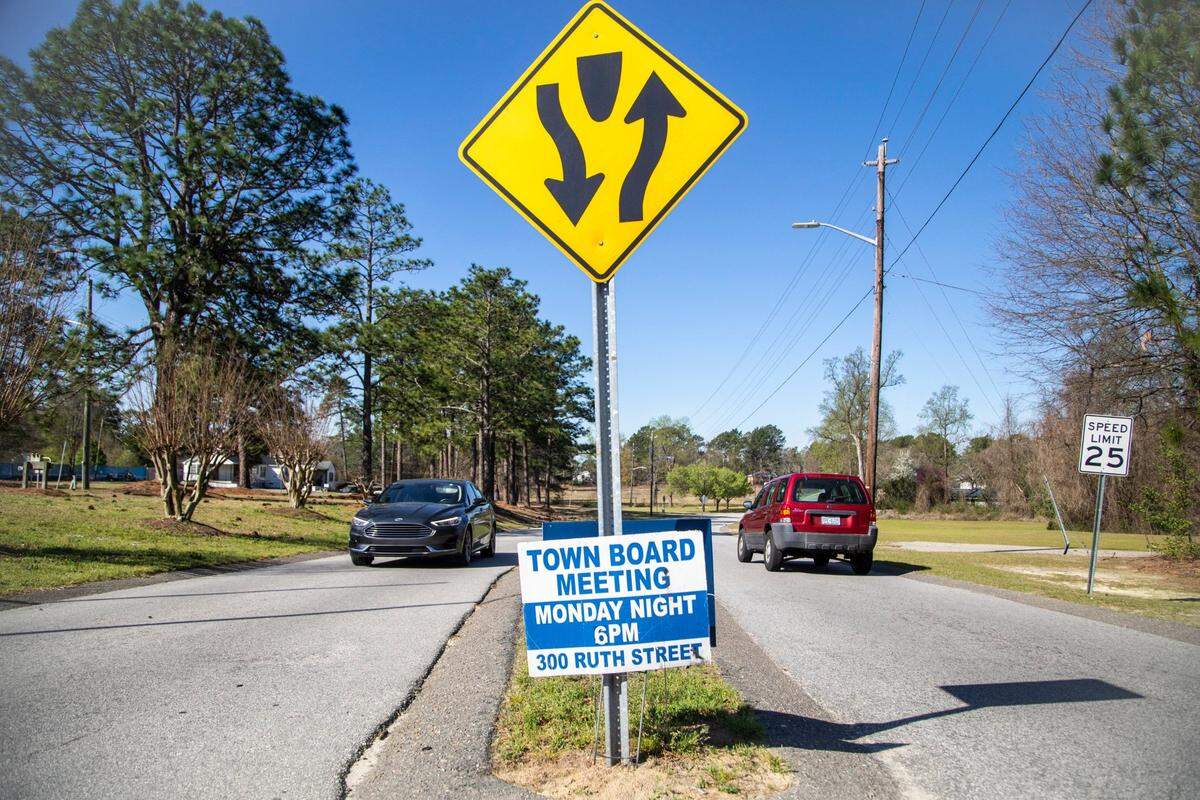
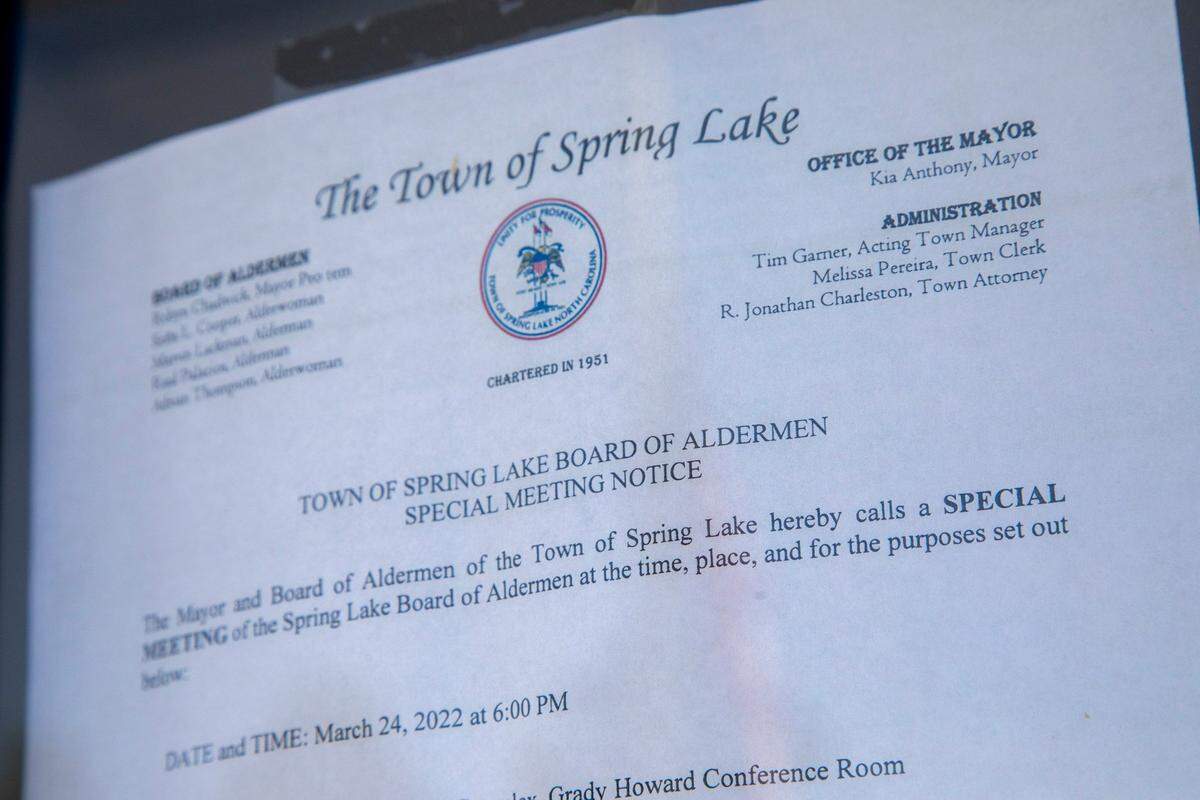
A notice of a town board meeting is posted on Ruth Street in Spring Lake Municipal Building Friday March 25, 2022. The town of Spring Lake is missing nearly $500,000 after hiring a finance director with personal bankruptcies, tax liens and no resume. Travis Long tlong@newsobserver.com
When the state plays fixer
North Carolina’s Local Government Commission is unique. Created during the Great Depression in 1931, the commission’s 43 staffers (soon to be 47) review the financial health and major financial decisions of roughly 1,100 local government units.
It is a check that has kept many municipalities from sliding into bankruptcy, those who track local government said.
But the safety net has holes, Folwell said. The $3.5 million economic development loan escaped the commission review and approval, for example, because Spring Lake planned to pay it off within five years, meaning it didn’t need LGC approval. If repayment terms had been five years or longer, the loan would have required LGC approval.
The state treasurer said he was skeptical of the town’s structuring of the loan so that the LGC wouldn’t need to approve it.
“Fifty-nine months is how you finance a damn car, not how you finance economic development,” said Folwell, a Republican first elected state treasurer in 2016.
Town correspondence shows officials there knew the loan didn’t need LGC approval but that the town planned to “discuss the transaction with LGC staff prior to the loan closing.”
Folwell said that discussion never happened.
Two reforms the treasurer has proposed would have given the commission authority over the Spring Lake loan before money was borrowed. Both are in Senate Bill 265, which has passed the Senate and is now before the House.
One would require local governments on the commission’s distressed “units” list to get LGC approval for loans requiring three or more years to pay off. Another would require LGC approval for any loans of $50,000 or more sought by local governments on the list. Spring Lake is on that list.
Another reform Folwell supports would give the commission the authority to refer evidence of fraud to the state Attorney General’s office for prosecution. Currently, that’s a call made by a local district attorney.
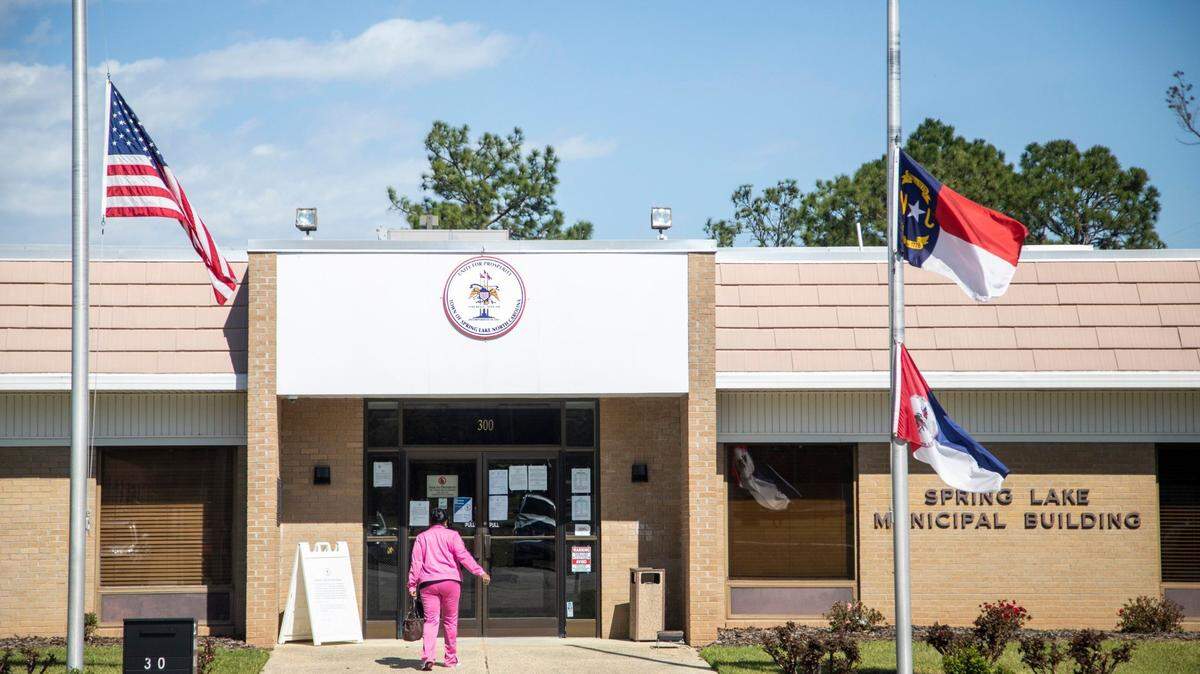
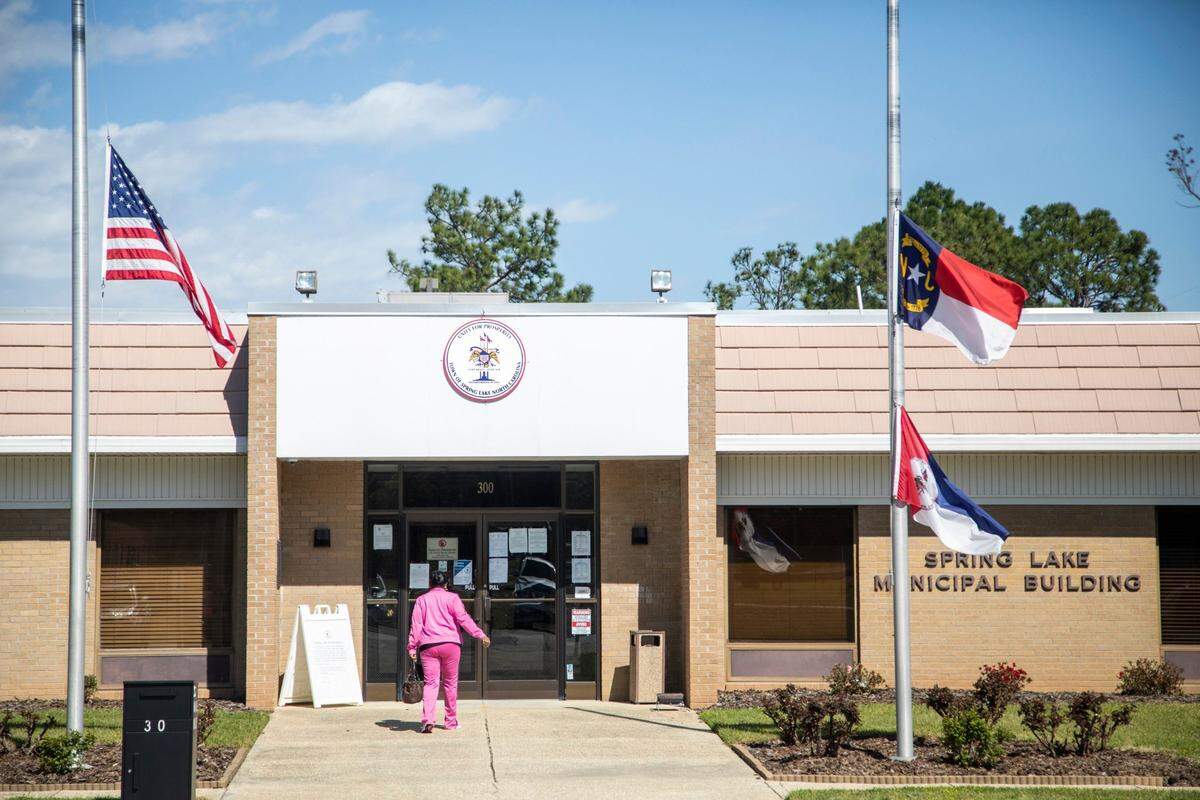
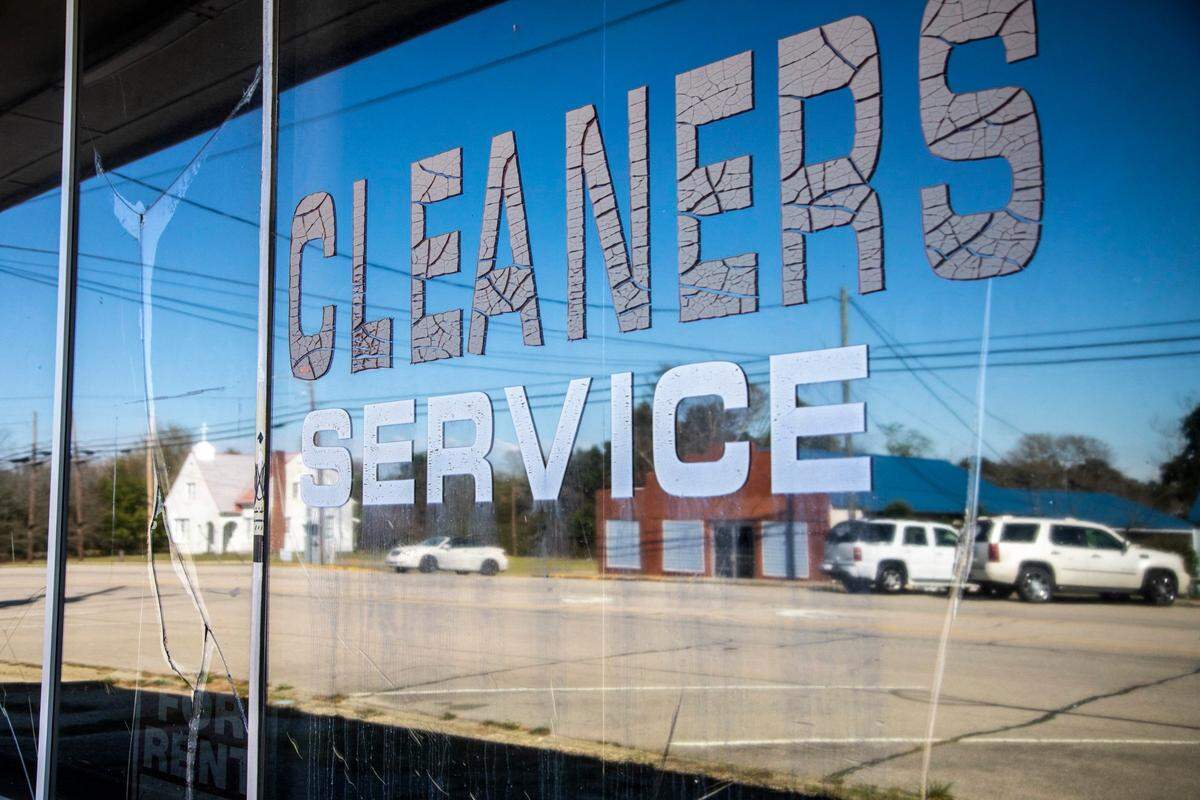
The scene outside the Spring Lake Municipal Building on March 25. The town of Spring Lake is missing nearly $500,000 after hiring a finance director with personal bankruptcies, tax liens and no resume. Travis Long tlong@newsobserver.com
Spring Lake’s deep financial hole
Spring Lake borders Fort Bragg. Many of its residents are soldiers connected to the sprawling Army post. The city of Fayetteville sits nearby to the southeast.
A state audit of Spring Lake released in March found a former finance director spent at least $430,112 for personal use, driving the town deeper into its financial hole. On June 10, federal authorities charged Gay Cameron Tucker with multiple criminal counts, embezzlement and bank fraud included. .
“We need these local elected officials and the ones they hire to stop what they are doing in terms of taking advantage of taxpayers,”Folwell said, adding: “There need to be some additional pathways to prosecution.”
Expanding prosecutions would help Folwell deploy a stick he already holds.
As state treasurer, he oversees the pension plan for state and local employees. A recently passed state law allows his office to penalize state and local officials who rip off the public by deducting the pension benefits accrued while they committed the crime.
“I can’t apply the felony forfeiture statute if I don’t have prosecutions and convictions,” Folwell said. “And there’s nothing that ticks off citizens and taxpayers more than to know somebody stole from them and earn pension credit while they did it.”
A notice of a special board of aldermen meeting is taped to the door of the Spring Lake Municipal Building Friday March 25, 2022. The town of Spring Lake is missing nearly $500,000 after hiring a finance director with personal bankruptcies, tax liens and no resume. Travis Long tlong@newsobserver.com
Is one proposed reform too punitive?
North Carolina League of Municipalities and the North Carolina Association of County Commissioners officials say they do not oppose several of Folwell’s proposed reforms. But one is too punitive, they say.
Folwell has recommended that the state Department of Revenue withhold sales tax revenues from local governments if they don’t submit an audit within a year after the close of the fiscal year. It would withhold the equivalent of 150% of the cost of an audit, with local governments getting the money back after an audit is turned in and LGC accepts it. That proposal is also in the Senate bill.
The audits, which are required by state law, cost a few thousand dollars for smaller local governments to more than $200,000 for Mecklenburg County, state treasurer’s records show. The audits help the LGC identify financial issues. The LGC reviews the audits and rates its financial concerns.
Each year, the LGC tracks distressed local governments with a color-coded spreadsheet showing whether they’ve turned in these required audits on time. Red means high risk, yellow moderate and green low.
But the most recent spreadsheet shows 36 local governments failed to turn in annual audits for the prior fiscal year, including small cities such as Goldsboro, Roxboro and Belmont. That’s an improvement over 2018, when 97 local governments had failed to turn in audits on time.
Some towns haven’t had their books audited for years. State Treasurer’s Office records show Askewville in Bertie County hasn’t turned in an audit on time in five years, while East Laurinburg in Scotland County and Princeville in Edgecombe County had yet to turn in an audit during all of that time.
The LGC is decommissioning East Laurinburg as a town. It will no longer exist at the end of June. Last year, a state audit reported its finance officer had misspent money, as well.
State Auditor Beth Wood supports the sales tax measure. She said the state needs an enforcement mechanism to push towns, counties and other local authorities to get their audits done.
“I believe the situation at Spring Lake would have been caught a long time ago had their audits been done on time,” she said.
A scene along Main Street in the town of Spring Lake, Friday March 25, 2022. Spring Lake is missing nearly $500,000 after hiring a finance director with personal bankruptcies, tax liens and no resume. Travis Long tlong@newsobserver.com
Caution: Don’t assume the worst
Kevin Leonard, the county association’s executive director, and Scott Mooneyham, the league’s political communications director, said state officials should be careful to not view Spring Lake as representative of the financial struggles other communities face.
Many local governments on the distressed list are suffering from the nationwide shift of jobs to urban areas. They’ve seen their populations and tax bases shrivel.
Some local governments are struggling to get the audits done for reasons beyond their control, Leonard said. The national board that oversees accounting standards has expanded them, and some auditors have consequently begun turning down local government auditing, he said. That means those continuing to handle the business aren’t keeping up with demand.
Meanwhile, local governments in rural and poorer parts of the state are hard-pressed to hire qualified people to produce the information needed for audits, he said, suspecting other employers are pulling away would-be candidates.
Penalizing governments facing these circumstances creates a “Catch 22,” he said.
“It seems to be counter-intuitive to withhold resources to a county that needs those resources to do a better job,” Leonard said.
Mooneyham cited Robbins, a town of 1,165 people in Moore County. It was once a thriving textile mill town. But when that mill closed down 32 years ago, a property worth tens of millions of dollars plunged to five-figures, creating a big hole in the town’s tax base.
It also meant a water and sewer system that was financed off of expected mill usage payments no longer had that revenue, putting financial stress on the remaining customer base, he said.
That’s a much different scenario than Spring Lake, a larger town joined at the hip to the nation’s largest Army base.
“I think there is a danger in trying to hold out Spring Lake as some example that reflects on all these other places that are dealing with just the financial struggles of rural America right now,” Mooneyham said. “I also think there’s a danger in pushing punitive legislation that might ultimately have the effect of damaging those local taxpayers in those communities even more.”
Was land deal a pipe dream?
Gerald and former town Alderman James O’Garra said that Amazon was interested in the Fort Bragg property. But other officials said they had not heard of any interest by the mega-retailer. Amazon is now building a distribution center six miles away in Fayettevile.
Robert Van Geons, the president and CEO of the Fayetteville Cumberland County Economic Development Corporation, doubted that Amazon had lined up behind Spring Lake’s land swap. “I’d be surprised if there was any conversation there,” Van Geons said.
Alderwoman Soña Cooper is the sole remaining board member from when the loan was approved. She said she supported it, because the base property had development potential, but no one mentioned Amazon to her.
Town minutes from July 22, 2019, show town board members voted unanimously to form Spring Lake Property Acquisitions to purchase the property. The nonprofit then obtained a $3.5 million loan from Charlotte-based Truist Bank to purchase property along West Manchester Road.
“The bank understands that the security being offered is the mortgage interest in the property that we are selling, plus the Town’s promise to pay,” Bob Jessup, a Chapel Hill attorney who represented the town on the financing, told the board, according to meeting minutes. Jessup declined an interview for this article.
Gerald, the former town manager, said the base could not sell its property to the town, but sought the property along its northern border, prompting the land swap idea.
The minutes do not mention Amazon, but Gerald and O’Garra said that was the company they were trying to land.
“It was looking real good,” O’Garra said. “Our whole board thought it was a really good deal to purchase this property and the attorneys that we had at the time thought it was a good deal.”
The land the town offered Ft. Bragg was adjacent to a gate to the Pope Army Airfield and would have added a security buffer to the base. Two letters from Fort Bragg — obtained by The News & Observer — show officials there wanted the land swap.
“The Town of Spring Lake has taken steps to make the parcels available to exchange, and I appreciate the speed in which they have occurred,” wrote Garrison Commander Col. Kyle Reed on May 13, 2019. “We have also invested time and resources to obtain valuations that will be used to determine the terms of the final agreement. It is my desire that these initial steps demonstrate the commitment of our organizations to accomplishing the land transfer.”
A letter in November 2020, however, noted a number of hurdles to a land swap, including a needed environmental study.
“The Army land exchange process is very detailed and involves multiple levels of review and approval,” wrote Garrison Commander Col. Scott Pence, who took over a few months earlier. “Unfortunately, due to the complexity of this transaction, there is no guarantee of a particular timeline to completion.”
By then, Spring Lake Property Acquisitions had taken out the loan and purchased the parcels. The mayor at the time declined to discuss the outcome.
“I’m going to reserve any comment about any of the things that have gone on in Spring Lake because a lot of things have to be sorted out,” said former Mayor Larry Dobbins. “I have no idea which direction things will go.”
A scene along Main Street in the town of Spring Lake, Friday March 25, 2022. Spring Lake is missing nearly $500,000 after hiring a finance director with personal bankruptcies, tax liens and no resume. Travis Long tlong@newsobserver.com
Who will pay back the $3.5 million?
As the town and base sought to complete the deal, the town’s financial woes hit a new low. In mid 2021, the town was looking at a $1.2 million budget deficit, and Wood was looking into financial irregularities. Shortly after, the town council agreed to let the state commission control the town’s purse-strings.
Folwell is hoping to keep Spring Lake’s taxpayers from having to foot the $3.5 million default. He said the LGC will not authorize the town to pay it off, which could mean the bank would take over the properties in a foreclosure.
“The Town of Spring Lake does not own these properties, and this is a separate transaction through an economic development entity,” Folwell said. “I think regarding whatever happens with this, it’s between that entity and the bank.”
He suggested the State Banking Commission, which he chairs, ought to look at the loan transaction given the uncertain underpinnings of the land deal.
And Folwell’s proposed reforms? They will require legislative approval. Some are included in Senate Bill 265, which cleared the Senate without opposition in last year’s session.
That bill is now before the House Local Government Committee, chaired by Republican Reps. Bobby Hanig of Currituck County and Sam Watford of Davidson County. It could be amended to include the rest of Folwell’s proposed reforms, though any changes will then require Senate approval.
Watford said the bill as it currently stands includes good measures for transparency and accountability.
“I don’t see anything wrong with it,” he said. “If everybody was perfectly straight up and did everything they were supposed to we wouldn’t need it.”
Dan Kane began working for The News & Observer in 1997. He covered local government, higher education and the state legislature before joining the investigative team in 2009.
Money poured into one North Carolina town. After audits and a failed land deal, much of that money went missing. But where? Just how often does the state step in and take over a municipality? And as the state’s treasurer tries to change the system and tighten government oversight so this doesn’t keep happening, can it even be fixed? Take a deep dive with The News & Observer into Spring Lake and other failed projects.