Abortion access is already limited in NC. It could get worse post-Roe v. Wade.
READ MORE
It will get harder
For many people seeking abortions in North Carolina, the procedure is already difficult to obtain. As more Southern states restrict access, the state will feel pressure on its abortion clinics, while the newest budget puts taxpayer money into pregnancy centers that steer clients away from abortion. Looking ahead to the 2022 elections, battleground districts near Raleigh and Charlotte could decide the future of abortion in NC. What can local leaders do to protect clinics, and what does this all mean for those who need care?
Expand All
.jpg)
At the Planned Parenthood clinic in Chapel Hill, Dr. Matt Zerden said he sees pregnant people at their most desperate.
Some have trekked hours across the state, expending precious sick days and gas money in the process. Those who have emptied their savings for a procedure ask him for a safe place to sleep in their cars overnight.
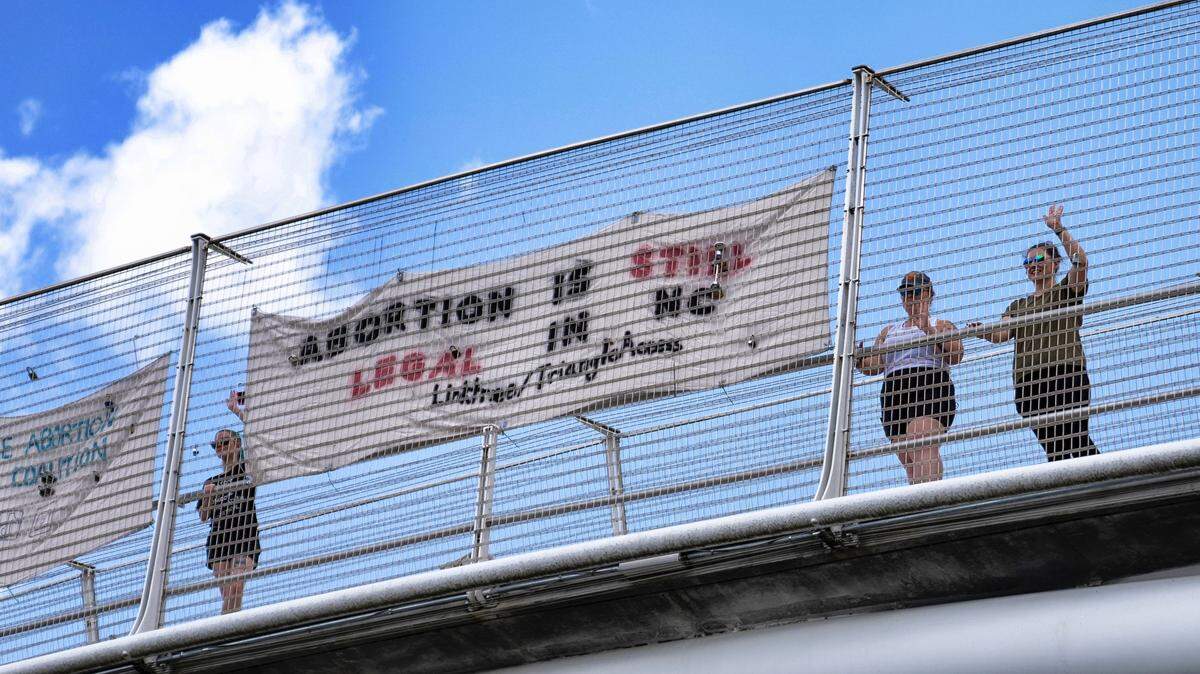
Every day he is reminded what most abortion providers in the state know to be true: Abortion is legal in North Carolina, but getting one isn’t easy for many.
Out-of-state patients have always come to North Carolina for an abortion at one of the state’s 14 clinics. The state functions as a beacon of abortion care in the South as North Carolina is one of the few remaining states with legal abortions.
The U.S. Supreme Court overturned Roe v. Wade last month, setting off abortion trigger laws in several states. The future of abortion rights in North Carolina depends largely on the results of November’s election and future elections.
Still, the state’s poorest people struggle to get abortions due to financial and logistic hurdles and laws intended to dissuade them from ending their pregnancies.
And with neighboring states restricting or ending abortion services, getting an abortion will only get harder for many.
“The reality is there are going to be patients, and people seeking abortion care, who are going to be forced to carry unwanted pregnancies to term because they cannot access care,” said Calla Hales, executive director of A Preferred Women’s Health Center, which has abortion clinics in Charlotte, Raleigh and parts of Georgia.
“That’s just a reality of this that people need to come to terms with,” Hales said. “And it’s an absolute disgrace.”
When birth control fails
The chances of Jenna Levine’s birth control failing were a fraction of a percent.
It seemed so improbable to her, that when she began developing sharp pains in her stomach in 2019, she rushed to the emergency room to check for ulcers. In UNC Rex Hospital, she was confronted with the near impossible: she was six weeks pregnant.
Levine knew immediately she wanted an abortion. The idea of growing a baby inside her body made her deeply uncomfortable. If she had kids they would have to be adopted, she had decided at a young age.
Moreover, at 22, she was in no financial position to raise a child. She lived in a two-bedroom apartment in Raleigh with her mom and worked at a local thrift shop that did not provide health insurance.
She told the doctors she didn’t want the pregnancy but it felt like they couldn’t, or wouldn’t, hear her.
“Nobody communicated with me the next steps or gave me resources or asked how I was doing,” she said. “They just took me into a bunch of rooms, stuck cameras in me, did ultrasounds and made me listen to heartbeats.”
They listed places she could call to schedule prenatal appointments and wrote an anti-nausea prescription for morning sickness. Alan Wolf, a spokesperson for UNC Health said if a patient is found to be pregnant, physicians typically refer them to an OBGYN or clinic for follow-up care and counseling.
When she asserted her wishes again, she felt her doctors turn cold and stoic, she said. She was discharged to find an abortion provider on her own., she said
She said she found a phone number online and scheduled an appointment, only to later find out that she had called a crisis pregnancy center that did not provide abortions and instead encouraged her to give birth.
Levine finally went in for an abortion appointment at a UNC hospital. She took pills to end her pregnancy that launched her into three days of excruciating pain.
Three years after the procedure, she is still paying off her medical bills.
Her stay in the emergency room cost almost $5,000, which was reduced by half when she couldn’t make payments, Levine said. The actual abortion and IUD removal cost nearly $400.
If the hospital continues to take payments out of her tax returns as they currently do, she estimates it will be another eight years before her debts are paid off.
“I am struggling to just put food in the fridge,” she said.
Still, she regards her choice to get an abortion as the best decision she’s ever made. In the years since the procedure, she began working at domestic violence nonprofits and started pursuing a business administration degree at Wake Tech Community College in the hopes of opening her own nonprofit.
“If I went through with this (pregnancy) I would just be working minimum-wage jobs for the rest of my life, not being able to focus on education,” she said.
Traveling to get an abortion
North Carolina’s 14 abortion clinics are largely clustered in metropolitan areas, leaving more than half of the state’s women without a clinic in their county, according to the Guttmacher Institute, a reproductive health think tank.
In 2020, just over 30,000 abortions were performed in North Carolina. More than 5,000 of those were performed on people traveling from outside the state, according to state statistics.
“There are only a handful of counties in the state that even have abortion providers,” said Hales, who has seen the impact on her clinics in Raleigh and Charlotte. “So it was already difficult in this state to access care because it involved traveling regardless. And there are a limited number of providers at that.
“The increase of patients that we’re going to see, that we’re already starting to see, let’s be honest, it’s going to further strain that ability to see patients and the wait time for patients across the board,” she said, “whether it’s in-state or out-of-state.”
Since the Supreme Court decision, call volume from out-of-state patients has gone up more than 50%, she said. And calls are coming from farther away.
“It used not to be a regular occurrence for me to get calls from Louisiana or Mississippi,” Hales said. “However, we’re definitely getting those now.”
Tina Marshall, founder of the Black Abortion Defense League, escorts patients into a Charlotte abortion clinic several times a week. She spoke to a woman who was scheduled to get an abortion at a South Carolina clinic on the day the Supreme Court made its decision. The woman was turned away because the clinic staff wasn’t sure if the abortion would have been legal under state law.
“She sat there for six hours and they came to give her money back,” she said. “They said they weren’t sure what they were supposed to do. She was pretty shocked and had to get an appointment at a Charlotte clinic.”
But it’s not just people from out-of-state calling clinics, said Amber Gavin, vice president of advocacy and operations of A Woman’s Choice, which has clinics in Charlotte, Greensboro and Raleigh and in Florida.
Abortion providers are also seeing more calls from people within North Carolina.
Some calls are from current patients scared and worried their appointments are no longer valid. And others are from people trying to get an abortion as soon as possible, worried the doors may close soon.
The average abortion-seeking person in North Carolina has to travel 27 miles one-way to reach a clinic that will perform an abortion before 22 weeks, according to the Guttmacher Institute.
State statistics show that about 65% of people who got an abortion in 2020 already had children.
“They know what it means to raise a child,” Gavin said. ”They know what it means for their family. And so they know what they’re doing is best for them and their family. So taking time off from work, finding child care, potentially traveling long distances, lodging, etc., are huge financial barriers to folks accessing abortion care.”
Abortion costs limit accessibility
A majority of patients who come to North Carolina clinics need financial assistance, Gavin and Hales said.
The cost of an abortion can depend on the type of procedure and the weeks of gestation of the fetus. A medical abortion, which involves taking a series of pills, can cost $400 to $600 while surgical abortions can cost at least $500 and go into the thousands.
Many times, patients are referred to local and national abortion funds that can help cover the cost. One of those groups is the Carolina Abortion Fund, which has seen a jump in its donations since a draft of the Supreme Court decision leaked in May. The fund only covers a portion of the procedure but doesn’t have income restrictions.
“Rights don’t necessarily guarantee access, right?” said Melissa Richard, co-chair of the fund’s board of directors. “Because economically if you can’t afford it, or if you’re ... living in a rural area and not near a provider, then you don’t really have a choice. So those are some of the bigger inequities.”
State and federal laws prevent government insurance from covering abortion except in the case of life endangerment, rape or incest. That means women on Medicaid, who are disproportionately people of color, have to pay hundreds of dollars out-of-pocket or find funding elsewhere to receive an abortion for any other reason.
Some people seeking an abortion, like Levine, are not aware of organizations that can help cover the cost.
“This creates enormous chaos and instability in their lives that are already operating at the margin of financial stability,” Zerden said.
North Carolina’s abortion laws
North Carolina has a number of state laws that abortion providers say pose more barriers once people make it to the clinic.
In 2015, North Carolina became the fifth state to require women to wait 72 hours between talking with an abortion provider and going through with the procedure. Medical associations and researchers have similarly concluded that mandatory waiting periods do not serve a clinical purpose. Several studies have shown that women rarely change their minds during the waiting period.
Abortion providers in NC are also required by law to read a lengthy text that tells patients about abortion alternatives, and their right to child support, among other things.
The waiting period is to give people a chance consider their decision, lawmakers said at the time.
“But it is a very difficult and permanent decision,” said bill co-sponor Rep. Susan Martin, to NC Health News. “Out of respect for the importance of that, we believe that more time is very important, because you can’t go back on this decision once it’s made.”
Zerden tells his patients he’s required to read the script by law, and not all of the points are relevant to their situation. Still, it’s emotionally taxing for already vulnerable patients, he said.
He remembered recently seeing a couple who had been given a fatal fetal anomaly diagnosis, which meant the baby would die shortly after birth. They had been to two maternal-fetal medicine specialists and undergone multiple ultrasounds that week to confirm the diagnosis.
As he read through the state-mandated text, he said, they started crying.
“They’re in this traumatic moment, they’re struggling to process the grief behind it, and then I’ve got to tell them about some unnecessary financial aspects,” he said. “It’s just completely inappropriate.”
Pushing for support of local clinics
Kristen Havlik was working two jobs, with no health insurance, when she found out she was pregnant. She sought an abortion at the Planned Parenthood clinic in Chapel Hill and doesn’t regret the decision years later.
“It was an extremely easy choice for me, because I already knew that I could barely afford to keep myself alive and that I needed to get rid of it as soon as possible,” she said.
The cost of her abortion was equal to one of her paychecks and was a financial burden, Havlik said.
“I really could have used the financial resources to pay for my abortion because I didn’t have much of a savings account,” Havlik said.
Now, in the wake of the Supreme Court decision to overturn Roe, Havlik knows there is a chance the state will act to further restrict abortion access depending on the 2022 elections.
She’s pushing local Raleigh leaders to provide greater support for abortion clinics now before that can happen including by adding buffer zones around the city’s two abortion clinics.
The future of abortion rights
Shortly after the U.S. Supreme Court’s decision, several GOP leaders publicly announced their desire to reinstate a 20-week abortion ban, which a federal judge ruled unconstitutional in 2019. Generally, 24 weeks is when a fetus is considered viable. North Carolina Attorney General Josh Stein is reviewing the case, but has voiced support for abortion rights.
If Republicans win the governorship or a few seats to create a veto-proof majority in the state House and state Senate in November’s election, or if they win control of the governor’s office in 2024, they will likely be able to go farther on legal restrictions.
After the ruling, one advocate called for laws protecting “every unborn child and mother” from “the scourge of abortion,” The N&O reported.
Gov. Roy Cooper vowed to fight for abortion rights and signed an executive order that sought to protect access to abortion services in the state, including people traveling from states with more restrictive laws.
Dr. Beverly Gray, an obstetrician and gynecologist at Duke Health, said restrictive changes would make a difficult process virtually impossible for the state’s most vulnerable pregnant people.
Gray doesn’t need to guess what will happen to the people who are unable to get an abortion. A famous study from the University of California, San Francisco, called the “Turnaway Study,” documented how women’s lives are impacted when local laws prevent them from getting an abortion.
The researchers followed 1,000 women from across the country, some of whom had received abortions and some of whom were turned away. Five years after they initially sought the procedure, researchers found the women who were turned away were more likely to have serious health problems, struggle to afford basic expenses and stay in touch with abusive spouses. Two of the women who were turned away died following childbirth.
“It tells the story of what is going to happen to patients when they’re turned away at a larger scale,” Gray said. “And it’s a sad story.”
This story was originally published July 22, 2022 at 6:00 AM with the headline "Abortion access is already limited in NC. It could get worse post-Roe v. Wade.."