More young people than ever are registering as unaffiliated voters. Here’s why I did.
READ MORE
The party of no party
Elections in North Carolina are close. Like, recount close. Unaffiliated voters may soon pass Democrats as North Carolina’s largest voting group. These independents already outnumber registered Republicans. Who are they and why do they keep on growing? This is The N&O’s special report.
Expand All
NC, party of none: Unaffiliated voters are now the state’s largest voting group
More young people than ever are registering as unaffiliated voters. Here’s why I did.
Here’s what NC voter information is public, and how to update your registration
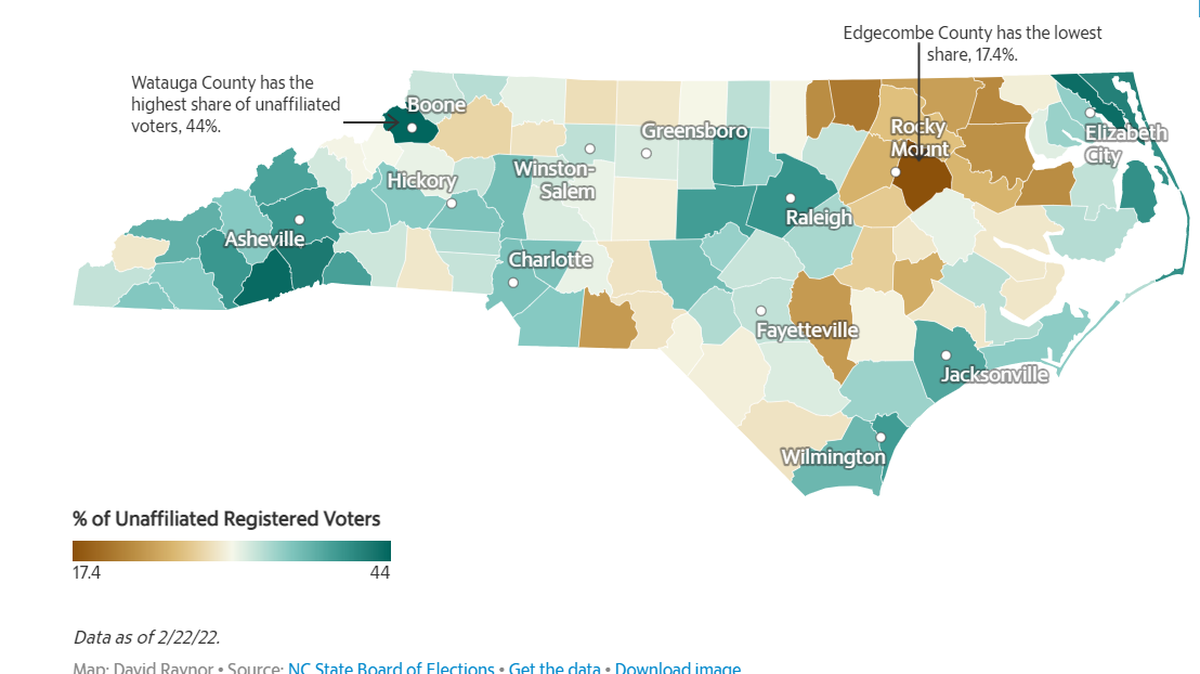
See how party affiliation has changed in NC, and where the unaffiliated outnumber partisans
Are you an unaffiliated voter in North Carolina? Take our poll
Because of my writing, I’m mistaken for a Democrat on a semi-regular basis. Republican and Democrat readers alike assume I am rooting for one party because I disagree with the other, and react to my work according to these preconceptions.
If anyone bothered to ask me what my party affiliation is, I’d tell them the truth: I don’t have one. Sure, I vote in the Democratic primary election, and I’ve always gone blue in the general. But I’ve been “unaffiliated” since I first registered in 2016, and I have no desire to change it.
My aversion to political parties has always been partially professional — I knew and continue to know how it’d be weaponized against anything I write. But I’d be unaffiliated even if I wasn’t a working journalist, just like half the young voters in North Carolina.
Unaffiliated voters now encompass a third of North Carolina voters. People between 18 and 34 — my age range — are more likely than older adults to forgo political parties altogether. About 43 percent of North Carolinians 18 to 34 are registered as unaffiliated; the older the age group, the more likely they will tie themselves to a political party. This correlates with national trends: more and more people are leaving their respective political parties, and young voters are leading the charge.
There are a few theories as to why we’re collectively forgoing parties. Maybe it’s who raised us, maybe it’s when we were raised. Maybe we don’t care about politics, maybe we just don’t care about these politicians. For me, it’s not ambivalence. It’s a distrust of our political parties and how much they really look to change the system.
When voting would come up in high school conversations, moderate students I knew would register unaffiliated because they didn’t want to choose a party. Despite differences of opinion, I thought the argument was sound. The more I learned about the U.S. political system, U.S. history, and comparative politics, the less I wanted to be tied to the mainstream Democratic party, and Republicanism was out of the question.
Pew Research Center’s political ideology quiz tells me I fall under the “progressive left,” a group that almost entirely leans Democrat but is half as likely to say they “strongly identify” as one. In actuality, the progressive leftists I know also span ideologies, all with more granular intricacies thanks to diverse theoretical perspectives and lived experiences.
In the United States, there is no political party of the Progressive Left. We fall into the same blue tent as establishment liberals and party mainstays. There’s a similar gamut of political ideology in the Republican party, from the religious right to corporate interests.
A Tufts University survey found that less than a quarter of young independents trusted the Democratic Party. Less than 13 percent trust the GOP, and they are less likely to see parties as something that makes their voices more powerful. It makes perfect sense: in the last year alone, we’ve seen Democrats walk back promises that would directly help young people and watched as a Republican-appointed judiciary strips away our rights. We have asked, and we failed to receive.
These two options are all we get if we want our votes to count for something. Even though there is a cornucopia of political parties across the U.S. and at least one other party listed on the North Carolina ballot, voting third party seems pointless in the election system we’re working with. The parties that have money and the parties who have held onto power are the ones that will prevail in our winner-takes-all system.
Pricey Harrison, a state representative for Guilford County, sees the faults in a political party system on the other side. Despite being a Democratic official, she says she feels no particular tie to the party itself. “If I could wave a magic wand, I would eliminate political parties and just try and function as a state government without people going to their partisan corners, even on simple amendments,” she tells me. Harrison introduced a bill in 2017 that would have shifted North Carolina primary to ranked-choice voting, where voters would be able to label candidates 1-4 in terms of their preference. If your first choice isn’t viable, then your second choice becomes your vote. Instead of winners and losers, it becomes a system where everyone can have their say.
I may be more inclined to join a political party if we had ranked-choice voting, or national proportional representation, where I could express my opinions more clearly without “throwing away a vote.” Even then, I don’t know if I see a point in choosing a label — as long as North Carolina’s elections are partially open, there’s no need to pick one. To me, choosing a label feels like it’d define me by the policy decisions of those who are more likely to work for the party than for me and my most vulnerable neighbors. What good is joining a unified voice if it isn’t speaking for me?
This story was originally published March 2, 2022 at 6:00 AM with the headline "More young people than ever are registering as unaffiliated voters. Here’s why I did.."