Democrats are changing their strategy for 2024’s must-win NC Supreme Court race | Opinion
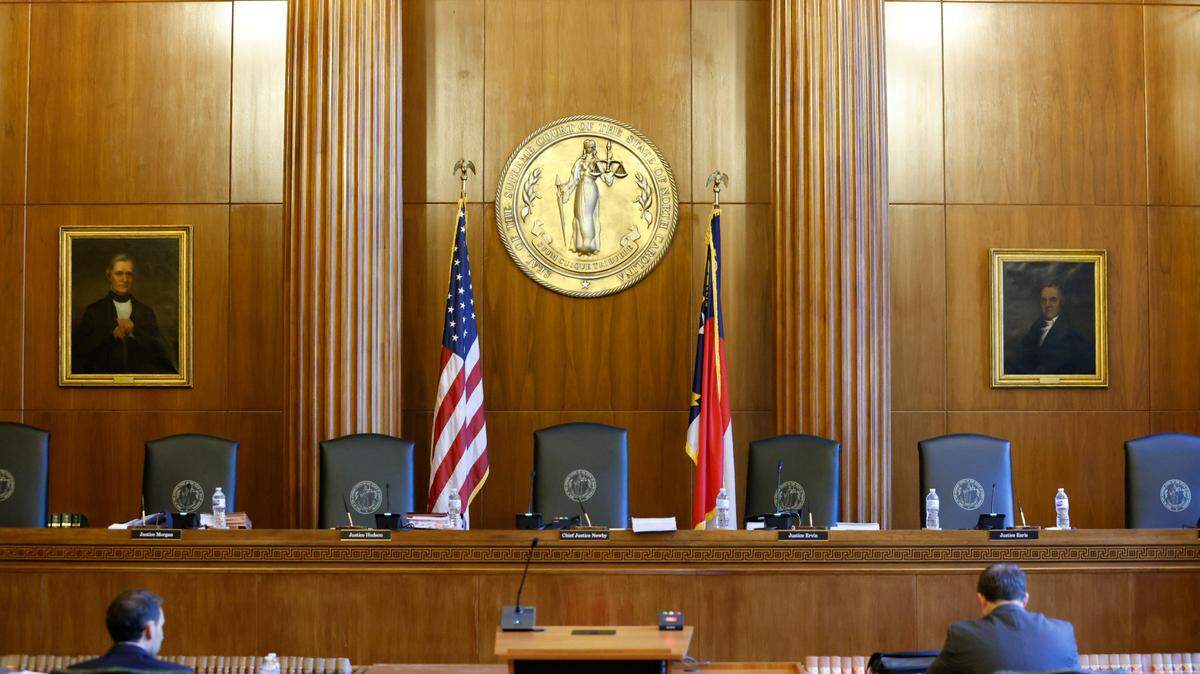
In the 2022 midterms, North Carolina Republicans swept every statewide judicial election on the ballot, regaining a majority on the state’s highest court for the first time since 2016.
It’s had massive political implications. The North Carolina Supreme Court’s new conservative majority has removed constitutional guardrails on extreme partisan gerrymandering, reinstated a voter ID law and a law that disenfranchises people with felony convictions, and may soon issue another consequential ruling in the perennially important Leandro school funding case.
The court will remain in Republican control until at least 2028, when Democrats could have a chance to flip GOP-held seats and assume the majority once again. In order for that to happen, though, they have to defend two of their own seats first.
The first of those seats will be on the ballot in November. The Democratic candidate is Justice Allison Riggs, who Gov. Roy Cooper appointed to the Supreme Court last year after Justice Michael Morgan stepped down from his seat. Her Republican opponent is Jefferson Griffin, a current N.C. Court of Appeals judge.
Griffin describes himself as an originalist, and his past rulings indicate a conservative interpretation of constitutional law. Griffin was one of four Court of Appeals judges to sign onto a controversial ruling that declared “life begins at conception,” potentially establishing a precedent for fetal personhood, back in 2023. That ruling, however, was later withdrawn.
Griffin also made headlines in 2021 for declaring in a written opinion that racial bias does not exist in the criminal justice system, saying, “The law is color blind and applies equally to every citizen in the United States of America.” Griffin received additional criticism for using that same opinion to directly criticize former N.C. Supreme Court Chief Justice Cheri Beasley’s comments on racial injustice, a move that many in the legal community called inappropriately political.
Supreme Court elections have been a pain point for North Carolina Democrats in recent election cycles. Prior to the 2020 election, Democrats boasted a 6-1 majority on the state’s highest court. But they haven’t won a Supreme Court election since 2018, and only two Democratic justices remain on the bench.
Mac McCorkle, a public policy professor at Duke University and a former Democratic consultant, said that 2022 signaled the end of the old judicial campaign strategy followed by many Democrats.
“Democrats have come across as way more unwilling to pin themselves down on the ideological spectrum,” McCorkle said. “But you just cannot cordon off these judicial races anymore. Unfortunately, in my view, these races are becoming more ideological and political races.”
Asher Hildebrand, also a Duke public policy professor and former chief of staff to U.S. Rep. David Price, holds a similar view.
“The fact of the matter is these are, in North Carolina and around the country, increasingly partisan affairs,” Hildebrand told me. “And I think what we’ve seen in recent years is that when justices embrace that fact or when candidates embrace that fact, and don’t shy away from it, voters respond to that.”
That was especially clear last year in Wisconsin, when Democrats won the most expensive judicial race in U.S. history and secured a majority on the state’s highest court for the first time in more than a decade. It was a proxy war of sorts over abortion and reproductive rights.
“The Democratic candidate really leaned into talking about issues like abortion rights, and voters rewarded her by electing her and reestablishing a Democratic majority to a state Supreme Court in a state that’s very closely divided, much like North Carolina,” Hildebrand said.
Republicans have made judicial elections a priority, and it’s paid off. They’ve invested money and time into launching sophisticated judicial campaigns, forcing Democrats into a more defensive position that hasn’t yielded much political success. They’ve realized that injecting politics and ideology into these races, for better or worse, is something that energizes voters who might otherwise overlook judicial races on their ballot.
North Carolina Democratic Party chairperson Anderson Clayton wants to change that. For the first time, Democrats have a coordinated campaign director focused exclusively on judicial races. Candidates like Riggs are speaking more openly about issues like voting rights and reproductive freedom, and what role state courts play in protecting them.
If Democrats lose in November, they technically still have a chance of flipping the court in 2028. But that will be significantly harder: they will have to flip even more seats in order to do so, and it’s difficult for a party generate investment and enthusiasm for races they haven’t proved they can win.
“We knew we had to get involved with owning that courts are about freedom and fairness and opportunity,” Clayton said. “And freedom means protecting your right to vote, your right to an abortion. It doesn’t mean stripping them away. And that is a message that we are going to really deliver on this year.”