How Charlotte FC makes the Queen City feel like home when English is a barrier
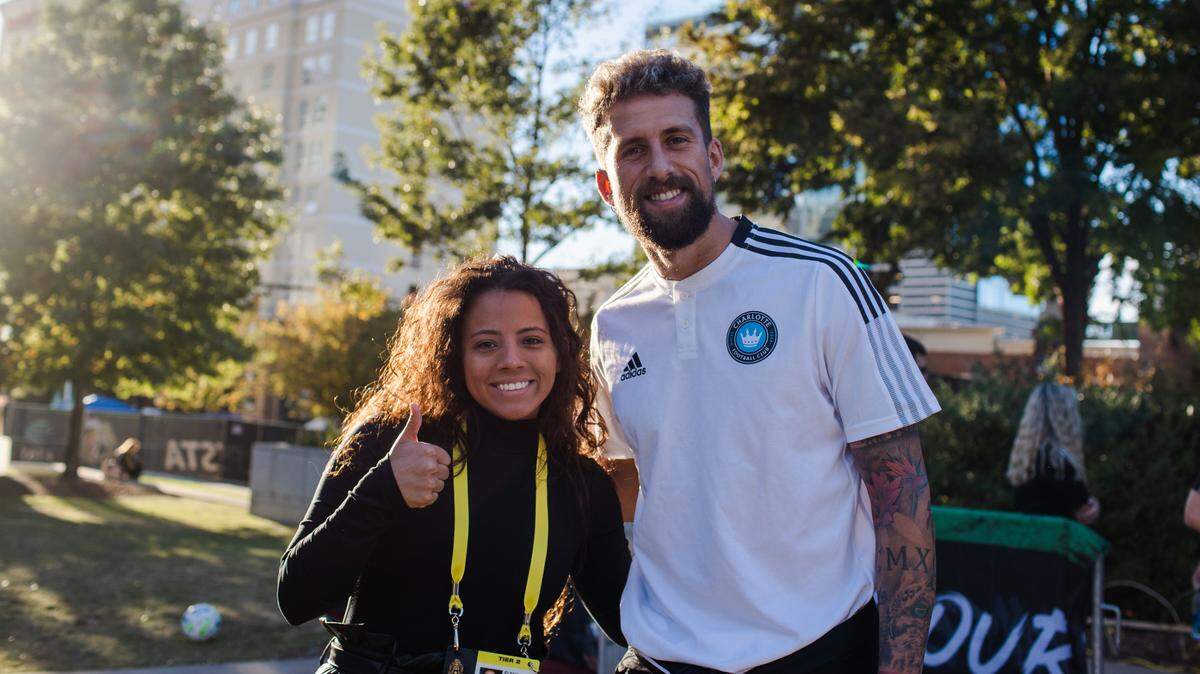
Guzmán Corujo is tattooed and tall, and maintains an intense focus while training as a professional soccer player. Elena Lemus has seen a more approachable side of Corujo’s personality, demonstrated off the field as he awaits preseason with Charlotte FC, the new Major League Soccer team preparing for its inaugural season in February.
Lemus described a moment that illustrated Corujo’s excitement and was unrelated to soccer. She said that Corujo called her after leaving a restaurant in uptown Charlotte, quite a distance from his hometown in Rodríguez, Uruguay.
“He said, ‘Elena, I just did this by myself,’ ” Lemus said. “‘I spoke to the waitress very slow (in English) and the waitress spoke to me slow, and I ordered my food.’ ”
“He tries,” Lemus continued. “He’s doing his best, and even though he’s from Uruguay, he wants to learn things here.”
Lemus is the player liaison for Charlotte FC, meaning she’s responsible for assisting athletes navigate their transitions to a new Southern city after signing with the MLS expansion team. Corujo was the first of multiple international players to arrive in Charlotte, most of whom were born in primarily Spanish-speaking countries and some of whom, such as Corujo, speak limited English.
“I think what is most difficult for me is the tenses,” Corujo said in Spanish. “That’s what I struggle the most with in speaking, but I’m taking (English) classes and I think with time I’m going to become more familiar with the basics of it and get better.”
Charlotte FC has signed 18 of up to 30 active players. Only four of the team’s players were born in the United States, an indication of the especially global roster the front office is assembling, even by MLS standards. Not all teams use their eight allotted international roster slots, but Charlotte FC plans to fill at least 11 after the club announced last Tuesday that it acquired its latest international spot from D.C. United in exchange for $250,000 in general allocation money.
For Corujo, who signed a pre-contract with Charlotte in September and will likely fill one of those slots, it’s his first extended stay in the U.S. The language barrier has been one of the many items that Lemus is assisting him and others with prior to the 2022 season.
Charlotte FC’s infrastructure has also been built around supporting a mix of cultures. The team’s head coach, Miguel Ángel Ramírez, is from Las Palmas, Spain, and he’s coached in five different countries — Spain, Greece, Qatar, Ecuador and Brazil — before moving to Charlotte. The team’s communications manager, Melissa Rincon, is often available to translate interviews with players and coaches from Spanish to English, or vice versa. But before pre-season training and regular media appearances, most of the logistics around player living and language will fall to Lemus.
“Pretty much I told Guzmán, ‘You’re gonna be the first (international) player (in Charlotte), so with you, we’re gonna open a lot of doors,’ ” she said. “‘We’re gonna know the process of how to find housing and get social security.’ ”
Lemus grew up in Guatemala and has been working closely with Spanish-speaking players signed with Charlotte FC, such as Ecuadorian midfielder Jordy Alcívar and Spanish midfielder Sergio Ruiz. She created a survey and presentation for players and coaches to gauge their housing and leisure preferences in order to facilitate their moves. (I.e., which neighborhood do they want to live in? Do they want to rent or buy a car? What do they like to do in their free time?) She also is helping players with items like setting up American bank accounts and phone plans, and said that she’s even recommended nail salons for their wives and girlfriends.
“Everyone keeps talking about trying Bojangles,” Lemus said, referencing the local restaurant chain known for its Southern chicken and biscuits.
Lemus arrived in Charlotte around the same time that Corujo was announced as the team’s seventh player. Before joining Charlotte FC’s staff, she held administrative and player-facing roles within MLS with Cincinnati FC, and within USL with Phoenix Rising, but she noted that the type of player liaison position she now holds is not standard across MLS clubs despite the heavy international influence in the league.
For Lemus, her role with Charlotte FC is personal. She stressed its importance to player well-being and said that she saw the need for a similar support system firsthand when she was a player on the women’s soccer team at Sterling College in central Kansas.
“When I came from Guatemala, I didn’t know any English and I decided to go to school in Kansas, where they don’t really speak Spanish,” Lemus said. “I remember when I was playing in college, my coach told everyone, ‘Don’t speak Spanish to her. Just speak English.’ He did it in a good way, because he wanted me to learn. But for me, it was like, ‘Oh, wow. How do you want me to perform and be happy if I can’t speak my language or understand people?’”
“Having that experience and struggling every day, not knowing what to say or how to be part of the team, but knowing I was good enough to be part of it, was something that I always thought (about),” Lemus said. “How do professional soccer players do it? How does a professional team do things?”
Corujo credited the Charlotte FC staff and Lemus in particular with facilitating his transition to the U.S. He said that he’s enjoyed the process of exploring the region, and has attended sporting events like the #MexTour match in Charlotte in October and multiple Charlotte Hornets games. He also met Ramírez and some of the team’s other players like Christian Fuchs, Adam Armour, Brandt Bronico and Alcívar.
“It’s good that we have different styles, different cultures,” Corujo said about Charlotte FC’s roster. “We just have to consider the variety and the differences to make sure that we meet the goals and the objectives of the team.”
Besides four U.S.-born players (McKinze Gaines, Jaylin Lindsey, Bronico and Armour), four other players — Joseph Mora (born in Costa Rica), Harrison Afful (Ghana), Pablo Sisniega (Mexico) and Fuchs (Austria) — hold domestic status for roster-building purposes and will not occupy an international slot. Other international players are aiming to secure their green cards ahead of the team’s first match Feb. 26 in order to hold domestic status.
Most of those players have come from Latin American countries: Vinícius Mello (Brazil), Yordy Reyna (Peru), Alan Franco (Ecuador), Alcívar (Ecuador) and Corujo (Uruguay). Four others are European: Anton Walkes (England), Jan Sobociński (Poland), Kristijan Kahlina (Croatia) and Ruiz (Spain). One player, Riley McGree, is from Australia, meaning Charlotte FC’s 18-man roster spans 15 different countries and five different continents.
“When you build a team that’s multi-national, everyone brings something a little bit different and that’s what is unique and awesome about soccer as a sport,” Charlotte FC director of player personnel Bobby Belair said. “I’m excited to see how all these players from all over the place gel together and how Miguel brings them together.”
Belair highlighted that as one of Ramírez’s strengths.
“That’s one of the reasons we brought him in,” Belair said. “(Ramírez) is gonna be able to get his hands on these guys and affect them on and off the field and bring them closer together. You can see how he’s done that with his staff already and the whole club.”
Players have yet to talk tactics with Ramírez, but Corujo said that he feels comfortable with every style of play. He emphasized that it will be important for the team to understand and adapt to Ramírez’s type of possession-based system in order to deliver results. The first match of the season is set against D.C. United in Washington, D.C. followed by Charlotte FC’s inaugural home match against the LA Galaxy on Mar. 5 at Bank of America Stadium.
“I think those two games will be the most important because they are a part of our initial steps in MLS,” Corujo said.
Those games will also be his first in the league, which he described as an attractive destination for international athletes because he considers MLS growing and located in a country that he’s found to be welcoming and full of variety.
“I’m very happy to be in Charlotte,” Corujo said. “… I think it’s very clean and the people have been very welcoming and very understanding of the language barriers.”
Before first kick, Corujo said he’ll continue practicing a new language and exploring a new city. He won’t be the only one. But the players from around the world will find a support system when they soon arrive in Charlotte, thanks in part to Lemus and Corujo helping navigate the cross-continental path for them follow.