This NC canoe slalom star doesn’t want to jinx Olympic hopes. But IF she goes to Paris...
Just as she does with her paddle and her kayak when negotiating a whitewater slalom course, Evy Leibfarth takes painstaking care to be precise with her words when navigating conversations about her chances of making it to the 2024 Paris Olympic Games.
“If I go, my coach will go,” the 20-year-old Bryson City native says of her personal coach, who also happens to be her dad.
“Having her be in Paris if I go is gonna be so amazing,” she says of her No. 1 fan, who also happens to be her mom.
Asked about the pressure of competing at canoe slalom’s highest level, she asserts: “I’ve gotten so much better at dealing with that, and I’m excited to bring that into Paris if I go.”
If she goes. If she goes.
Evy is sitting inside the main building at Charlotte’s U.S. National Whitewater Center, a familiar training venue for her, and is being careful not to be presumptive, which makes sense. There’s certainly no guarantee for her: Team USA only gets to send one athlete to France this summer in each of three individual events — women’s kayak (WK1), women’s canoe (WC1) and brand-new-to-the-Olympics women’s kayak cross (WX1) — with said athletes to be selected via trials events in Alabama this weekend and Oklahoma at the end of the month.
Certainly, anything can ha —
Actually, let’s let her explain.
“I don’t want to talk about my chances,” says Evy, who at 17 was the youngest in WK1 and WC1 at the 2020 Tokyo Games (held in 2021 due to the pandemic), finishing 12th and 18th, respectively. “I don’t like to jinx myself before a competition. In kayaking, anything can happen. I think that’s one of the really exciting parts of the sport, but ...
“Again, you can never really know anything for certain until it happens.”
Her coach-dad, on the other hand? He’s a little more willing to go out on a limb with a prediction.
Color breathing and attention anchors
Lee Leibfarth spent the better part of the ’90s racing competitively in men’s K1 and continued doing so into the next decade.
He also spent time, before Evy was born, as a coach for the U.S. junior national slalom team; he then qualified for and raced in the Olympic team trials in South Bend, Indiana, in April 2004, when Evy (which rhymes with “heavy,” by the way) was just an infant.
So it’s also no surprise that Lee and his wife, Jean Folger — who worked as a raft guide and kayak instructor — first started taking their only child out in kayaks on their laps when she was just a toddler. Or that, by the time Evy was 6 or 7, she was piloting her own.
But even they had to have been surprised by how quickly she demonstrated extraordinary prowess. By the time she was 12, she became the youngest athlete to enter the U.S. team trials, and finished sixth in WK1. By the time she was 14, Evy was the country’s top-ranked female paddler, of any age.
He’s been her coach all along, including in 2021, when they went to Tokyo together.
For Evy, her first Olympic experience was a dream come true, but also a struggle and a disappointment, because she fell short of her goal of reaching the finals in both of her events. “I had a little bit of a hard time dealing with that pressure,” she says. “I didn’t think that it would feel so intense, and then it did. Right before my run ... I was freaking out, and I just wasn’t able to paddle the way that I normally do.”
Since then, she’s put a major focus on sharpening her mental skills.
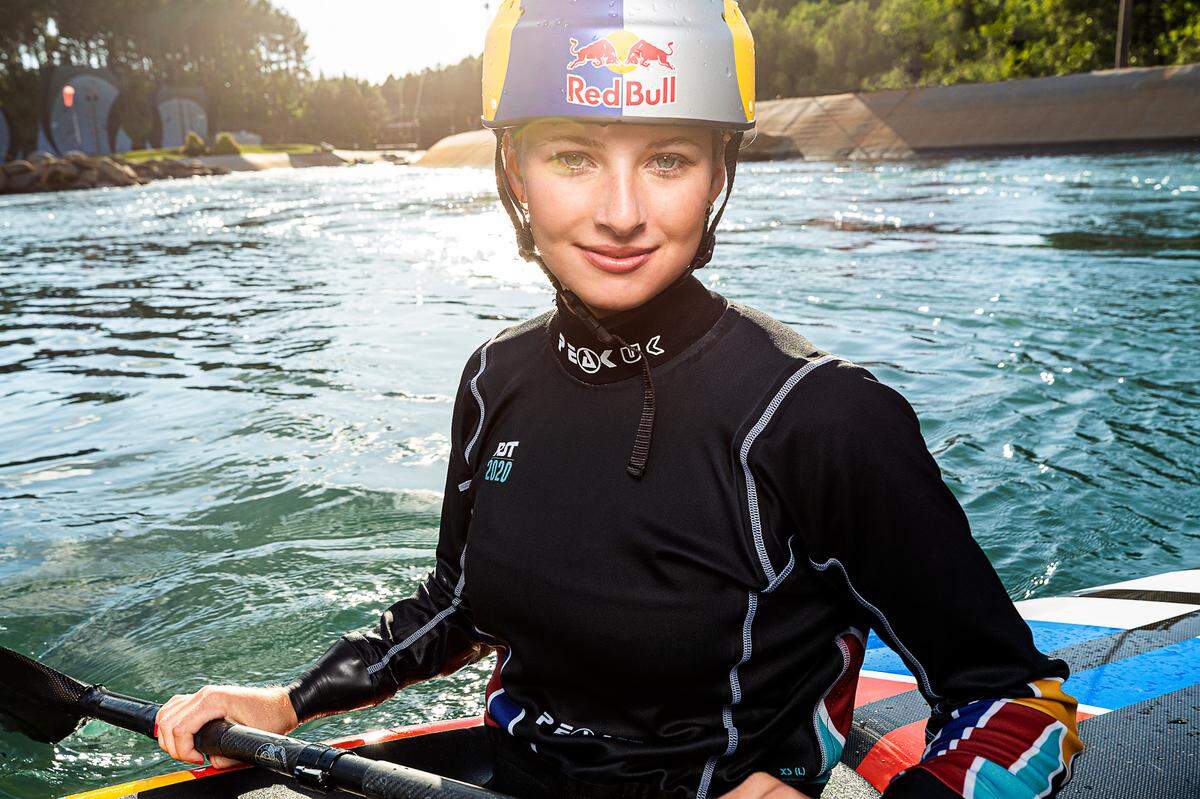
Evy’s main sponsor, Red Bull, has supported her in a number of ways over the past three years, including connecting her with its team sports psychologist, who introduced her to concepts like color breathing (which involves picturing a color that represents how you want to feel) and attention anchors (images that direct attention toward what’s important and away from what’s not).
While it’s hard to pin down exactly how much those techniques have helped, they certainly haven’t hurt. In 2022, she won at the International Canoe Federation (ICF) Junior/U23 World Championships in Italy and the Pan American Championships in Oklahoma City; in 2023, she notched victories at the Pan American Games in Santiago, Chile, then the ICF World Championships in London. The latter was the global qualifier for the 2024 Summer Games.
Due to her success in the run-up to this weekend’s team trials — which will award the Olympic spot in each event to the athlete who finishes with the most points — Evy has the rare benefit of already having earned three WK1 points (equal to a win in a trials race) and four WC1 points ahead of time, effectively making her a higher seed.
That’s why, when asked to describe how he would assess Evy’s shot at getting to Paris, Lee Leibfarth says this:
“I think it’s very good. Very good.”
That’s also still an apt way to describe their relationship as coach and athlete (and as dad and daughter) after all these years.
‘We bicker. But it’s a healthy bickering’
Evy knows what you might be thinking.
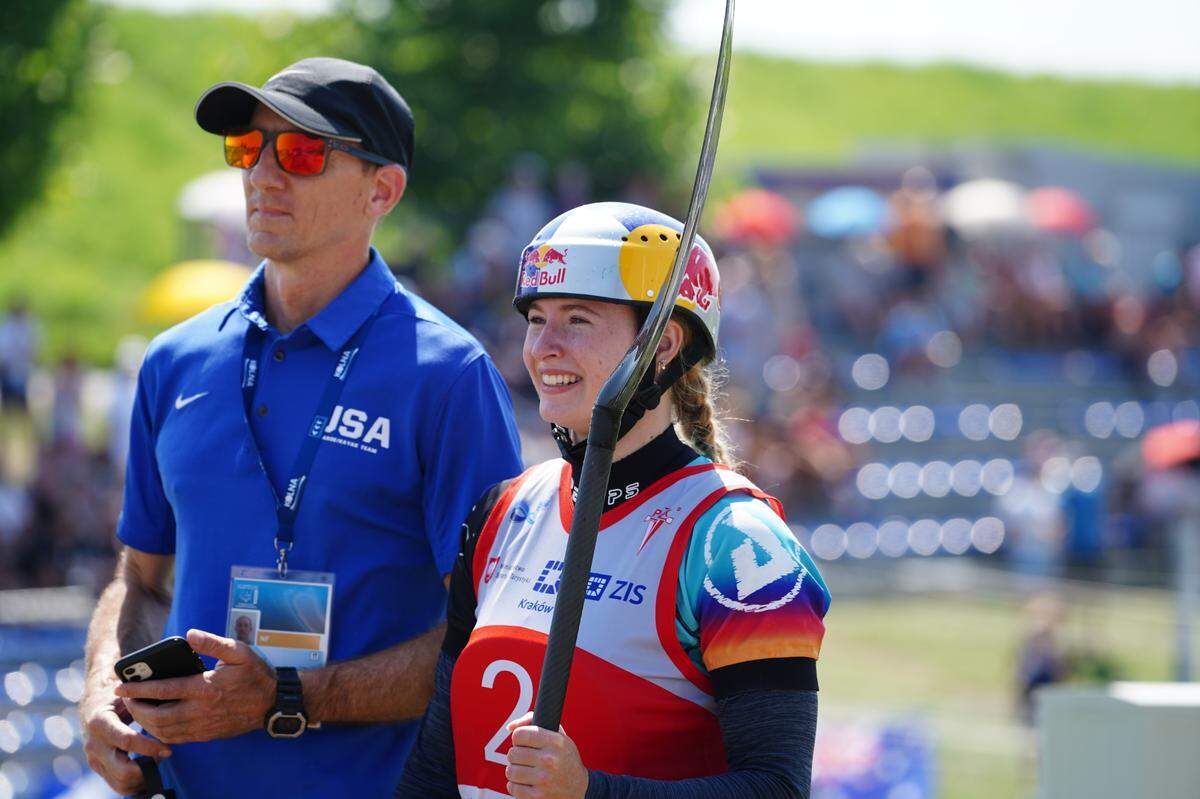
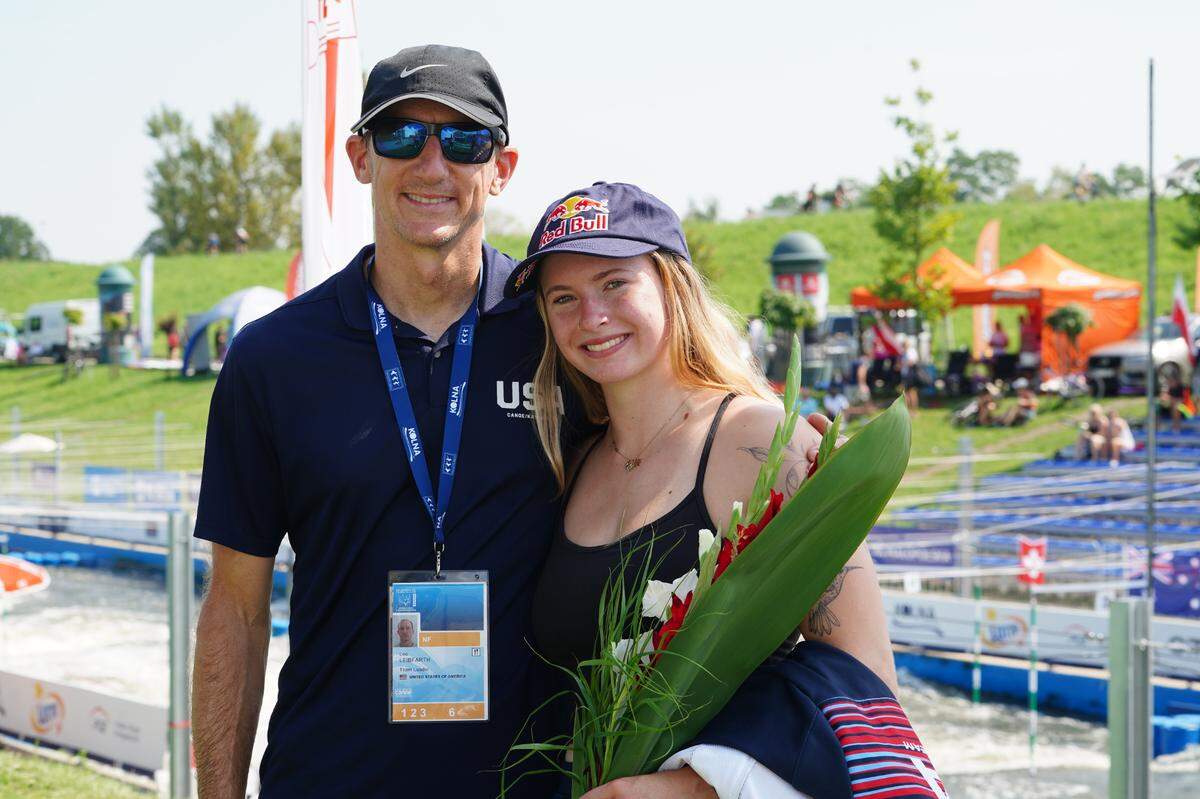
“It has such a negative connotation,” she says of society’s views toward parents who coach their kids. “But we’ve mastered the ‘he’s my dad when we’re at home and not at the course, and he’s my coach when we’re at the course or when we’re having a training meeting.’ Having that separation is so vital. A lot of times when it doesn’t work for people it’s because there’s not those boundaries.”
Lee agrees. “We both are able to give each other enough space, and that’s pretty important. I mean, we bicker about things all the time — but we’re able to keep it as a healthy bickering,” he says.
And when it’s come to the really big important life stuff that Evy has been navigating as she’s grown into an adult, they’ve been on the same page.
For instance, they agree about her education.
After graduating from the online K12 International Academy school in December 2020, Evy was accepted at Davidson College. She took a gap semester in the fall after Tokyo and started her path as a biology major at the college in January 2022, but then put her studies on pause again to prep for a run at Paris. She has set no solid date for resuming her enrollment.
Says Evy: “I want the college experience. I’m so excited to go here, and I love my friends from there. ... But also I have this amazing opportunity to do the sport that I love all around the world, and to tick off my goals and my dreams. So I did prioritize that over going to school in a linear fashion.”
Adds Lee: “College will always be there. ... I actually maybe encouraged her to take that time away from school if this Olympic medal was a big goal of hers.”
They also agree that she has a unique opportunity to inspire others as someone who identifies as bisexual and was among a record number of queer athletes who competed at the 2021 Olympics.
Evy is happy, she says, “getting it out there to people that it’s completely normal, that you shouldn’t feel ashamed, that no one should say that you’re any different, or any less, for being queer, bi, gay, whatever you identify as.”
Lee, meanwhile, thinks “the fact that she sees this as a platform to be a role model is awesome. If young women and young girls see that and are inspired by it, that’s incredibly cool.”
(One caveat: While Evy feels “really lucky that I have a platform to share my story,” she hopes someday being queer won’t be notable at all. Because “it has no bearing on who I am as an athlete. Stories on queer athletes should be centered on their athletic endeavors and not on their sexuality.”)
So is there anything this athlete and this coach disagree with each other about?
A close call becomes an Instagram poll
Sure, they butt heads. But before illustrating when and why, a bit of very basic background about the niche sport of canoe slalom, for the uninitiated.
The most distinct difference between WK1 and WC1 is that WK1 uses kayaks made for sitting and powered by a paddle with a double blade, while WC1 uses canoes designed for kneeling and steered using a paddle with one blade. What’s most similar is that, like slalom skiing, both are timed events where competitors navigate a whitewater course by passing through various gates, in this case a combination of upstream and downstream ones.
In competition, judges make the call on whether an athlete touches a gate (a two-second penalty) or misses one (a 50-second penalty).
During training sessions, however, it’s Dad’s word against Evy’s — and there have been more than a few occasions when they’ve clashed over a close call.
One notable example they both recall came after a practice run at the ICF World Championships in London last fall. “We were doing a video analysis after the session,” Lee says, “and there was one point where Evy, I thought, very clearly touched the gate. We were looking frame by frame and you could see the gate move, and she’s telling me, ‘But you can’t see me actually touching it!’
“So she posted the video on Instagram and created an Instagram poll,” he continues, chuckling. He says 80% of her followers said it was clean.
“That was a slay for me,” Evy says, laughing. “I was like, ‘Ha HA!’ He’s like, ‘I was there! I watched it!’ And I was like, ‘And?’”
“Yeah,” Lee says, chuckling some more. “That’s not the way it works in the Olympics.”
Of course, ultimately, Evy knows he’s got a point. She knows she needs to be perfect. She knows “anything can happen.”
“I have two amazing teammates with me on the national team: Ria Sribar and Marcella Altman,” Evy says. “They’re the other two girls going for the Olympic spot, and they’re really incredible paddlers, so it’ll be a really good fight for it.”
It’s about as close as she gets to talking about her chances this weekend. They’re the other two girls going for the Olympic spot.
Well, there’s that comment, and one she makes a few minutes later, after being asked for a tour of the tattoos she’s gotten inked on her body since turning 18 two years ago: “I have these cherry blossoms on my arm. I got them after the Tokyo Games (to represent) my first Olympics. So, any Olympics that I go to in the future, I want to get a flower that represents that to me.
“I haven’t decided what it’s gonna be,” Evy says, smiling as she once again chooses her words carefully, “if I go to Paris.”
Watch the U.S. Canoe Slalom team trials
Coverage will stream on Peacock from 10 a.m.-noon and 1-3 p.m. Saturday and Sunday from Montgomery, Alabama; and from 10 a.m.-2:30 p.m. April 26 and 27 from Oklahoma City, Oklahoma, with finals streaming from 5:30-8 p.m. on April 27.
This marks the first year the Olympics will include kayak cross (aka extreme kayak), which sees four athletes negotiating whitewater and slalom gates at the same time — and contact is allowed.
This story was originally published April 9, 2024 at 6:00 AM.