On Jessica McDonald’s path to World Cup, one woman taught her no one could steal her joy

READ MORE
Payback: The Jessica McDonald story
For striker Jessica McDonald, the U.S. women’s national soccer team’s ongoing legal battle for equal pay is just the latest fight she’s determined to win. A teen runaway who became a single mom, McDonald tells us for the first time how she used two stints of soccer in North Carolina to rise from a broken home to the pinnacle of her sport. Now, she’s using her voice to battle systemic inequalities in soccer. We hope you’ll explore these articles as well as a motion-graphic novel, plus listen to our 10-episode narrative podcast all spring.
Expand All
As important as it is to understand the role Jessica McDonald’s mother played in the foundation of her World Cup career, and especially the early part of her life, the influence of Jessica’s grandmother, Abbie McDonald, cannot be understated, nor can her personality.
Abbie speaks in mantras and with a certain authority that compels those around her to listen to the lessons she’s learned over 84 years of life. She is the mother of nine children, and both the protector and enforcer of the McDonald household.
“My first question is, ‘How was your day?’ ” she’d ask her children as they sat down for meals. “Respect your teachers. We got a problem? That’s why I’m here.”
Abbie and Vince Myers, Jessica’s father, had a “rough start,” Myers said. That was in the early days of his relationship with Abbie’s daughter, Traci McDonald. Vince and Traci were never married, but together they had their daughter, Jessica Marie McDonald. She was born Feb. 28, 1988, and became the love of Abbie’s life. Abbie became Jessica’s most stable influence.
To clarify, Abbie loves all of her children, grandchildren and great-grandchildren. There is no limit to her love, which is evidenced by the fact that her family members’ faces form her wallpaper. Nearly every square inch of the walls in her home in Glendale, Arizona — living room, kitchen, bedroom — are covered floor-to-ceiling in family photos.
“All kids are different,” Abbie said. “You’ve got smart ones. You’ve got dumb ones. You’ve got ones that don’t care.”
She punctuated this sentence with a full laugh, crystallizing why Myers described Abbie as one of his favorite people.
“She don’t hold back no punches,” he said about the woman he calls “Big Abbie.”
“She’ll tell it like it is. I like Big Abbie.”
Another point to clarify is that “big” is a descriptor that has more to do with the size of Abbie’s personality than her stature. Her petite frame commands a presence despite being confined to a wheelchair. Parts of her face and body no longer have the same mobility as they once did due to a stroke she suffered about 12 years ago, or her mobility just faded with age. But even in her later years, her physical ailments are offset by her frequent laughter and the way she animatedly moves her hands when she talks, almost as if even her aging body could not succumb to the force of her will.
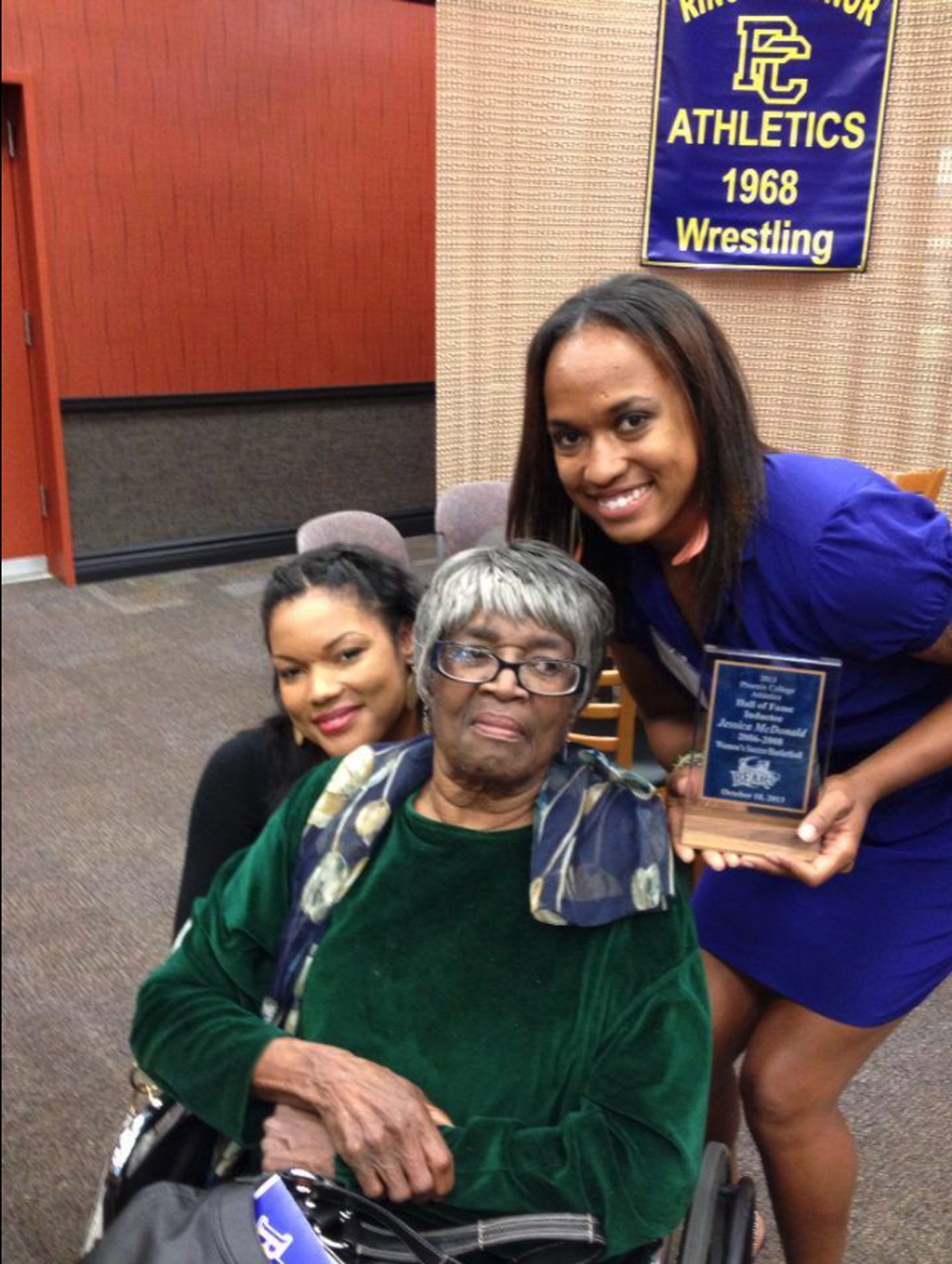
Grandmother ‘wouldn’t take any crap’
Abbie earned the respect of others through her conviction, while confronting those who crossed her with a sharp tongue. School administrators knew Abbie, as did the parents on the sidelines of her children’s and grandchildren’s sporting events.
“All the dads were afraid of her because she wouldn’t take any crap from them,” said Les Armstrong, the director of Jessica’s youth soccer club.
“I just thought it was funny. Grandma was there and all the men were afraid of her.”
Abbie developed her distinctive mettle at a young age. She graduated from an all-Black high school in Alexander City, Alabama, in the 1950s before transitioning to an Air Force unit for women in Syracuse, New York. There, she said she faced multiple instances of racial abuse by white teachers and other women in her unit. When one teacher told her that he expected her to fail his class, she said she responded by scoring the highest grade.
“He was upset,” Abbie said. “He didn’t know me. I’m a worker, and I can do anything.”
Abbie shared another story in which a white roommate in the unit awoke her one night with bloody bed sheets, calling Abbie a slur and directing her to give up her clean sheets. Abbie shot back.
“I said, ‘B—, you have lost your mind,’ ” she said.
She also said that she reprimanded her father on his deathbed for leaving her family for another woman.
“I told his ass off before he took his last breath,” Abbie said proudly.
Then she inserted a profound introspection.
“Kids don’t have any reason to suffer,” she said. “Nobody asked to be brought into the world. If we could pick our parents, we would be everything in the world.”
‘Don’t let anybody steal your joy’
For that reason, Abbie became a maternal figure to Jessica when Traci couldn’t be. She instilled her Christian faith and sense of self-worth in her granddaughter. Those beliefs helped lift Jessica over the hurdles she faced while trying to reach the highest level of women’s soccer.
The hurdles were frequent and began at a young age. On the field, Jessica was the target of the same racism that Abbie experienced in a past generation. She was often one of a few Black players at her youth soccer tournaments, and Abbie coached her on how to respond when other players or their parents called her a slur.
“We always had to defend ourselves by our actions, not by our words,” Jessica said.
“My grandmother would be like, ‘Please believe you better beat her on the field. You shut her up with your actions. You shut her up with your skill. You shut her up with your soccer intelligence,’ ” Jessica said.
In those circumstances, Abbie shared a line that she often repeated.
“Don’t let anybody steal your joy,” Abbie said. “Nobody can take that away unless you allow it.”

Dreams of being a Tar Heel, deferred
The mantras of fortitude were embedded in Jessica, but that didn’t make life easier, on the field or at home. Jessica faced an unstable living situation in high school as she shuttled between her grandmother’s home in Glendale and her father’s place in South Phoenix after leaving her mother’s home for good when she was 17. Jessica was stretched thin by a schedule crammed with sports commitments, and said that her grades slipped.
She didn’t qualify academically to attend the University of North Carolina, her dream school, although she was being heavily recruited to star on their NCAA Division I women’s soccer team.
Jessica instead graduated high school and spent the next two years attending a nearby junior college, Phoenix College, where she improved her grades and honed her game with the goal of eventually getting to Chapel Hill.
She graduated with honors from Phoenix College in 2007, and played three sports while training with the men’s soccer team for better competition. Jessica became the most-decorated women’s athlete in the school’s history. While there, UNC women’s soccer coach Anson Dorrance kept in touch with Jessica. Her speed and athleticism as a striker fit well on his team’s fast paced, high-pressing system, and getting to UNC remained her goal.
Partway through the 2008 season, she transferred to Chapel Hill, finally becoming a Tar Heel. She made an immediate impact on the women’s soccer team, starting in 17 of the final 18 matches of the season, and led North Carolina in assists that year despite missing the first seven games.

But it was the following season that Jessica cemented her place in the program’s history books.
In the 2009 national championship game, Jessica nailed a shot in the third minute against undefeated Stanford. Casey Loyd, who then went by Casey Nogueira, served a cross to Jessica, who sliced between two Stanford defenders and met the ball in front of the goal. UNC won 1-0 off her shot for its 21st national championship.
Abbie, who tries to watch all of Jessica’s matches, said that she had a feeling UNC would win.
“Stanford hadn’t lost a game at all,” she said. “And that’s when a team loses.”
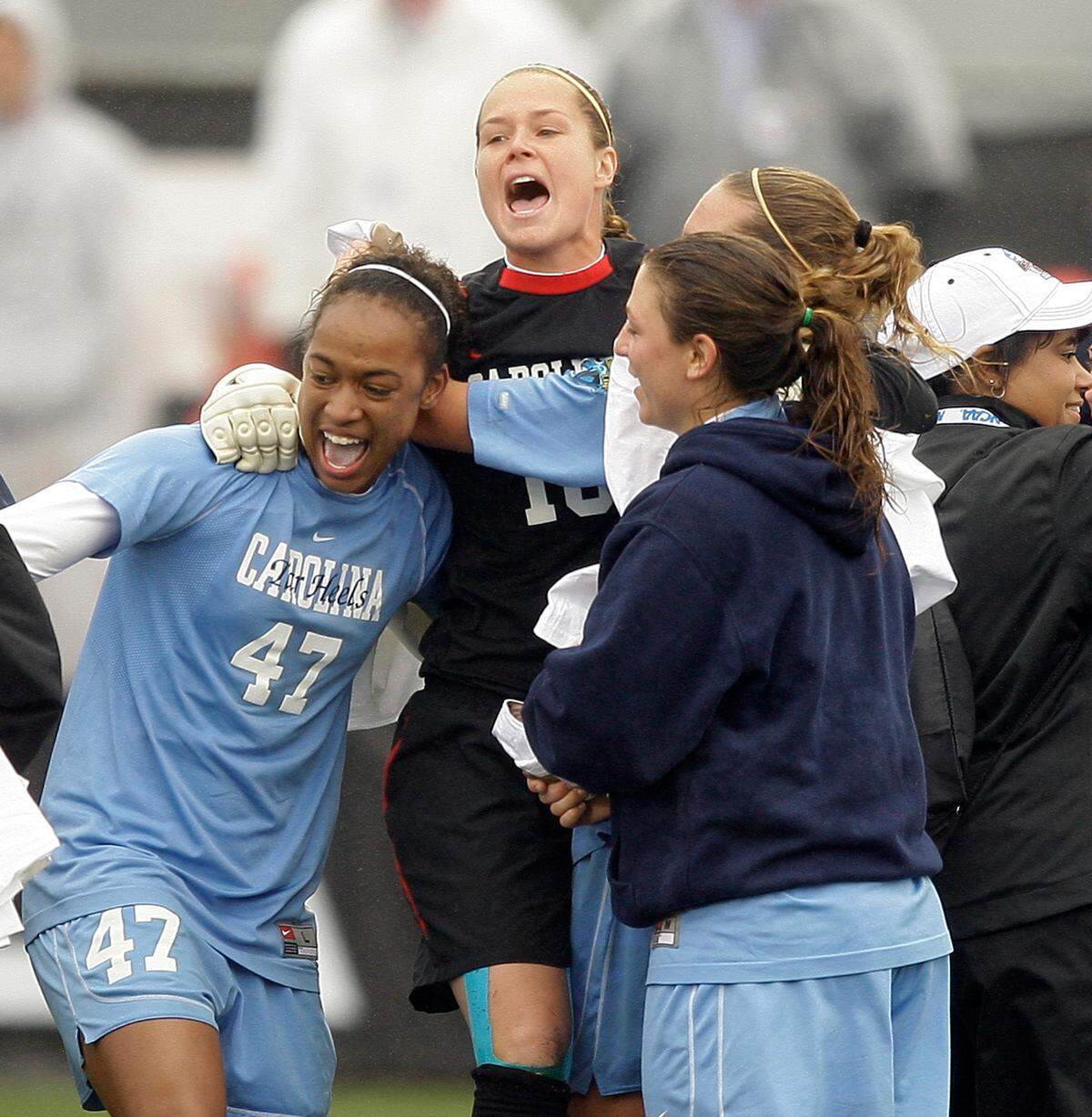
Dorrance is close with many of his former players, Jessica especially, and still mentions her hustle as an example for his current players to emulate.
“When I would sub her out, she’s breathing incredibly hard,” Dorrance said. “Why? Because she’s killing herself for me and her teammates.
“We coaches contribute something. But there’s something inside the great athletes that is why they’re great, and she had that piece.”
The next steps after leaving North Carolina
Jessica was set at that point on taking the next step in her soccer career, so she left UNC early and entered Women’s Professional Soccer (WPS) — America’s second attempt at a paid women’s professional soccer league after WUSA folded in 2003. Jessica was drafted in 2009 as the second pick for the Chicago Red Stars, joining a roster that included global icons like Megan Rapinoe and Brazilian legends Cristiane and Formiga.
After four appearances, Jessica earned her first start for the Red Stars. It was a big moment, she emphasized, the first start of her professional career. She took the field against Washington and within minutes experienced an athlete’s worst nightmare.
“I remember just being in shock,” Jessica said. “The trainer and some doctors ran over, checked my knee and immediately knew what the problem was.”
It was a sinking feeling, she said, followed by confirmation. After years of wear and tear on her body, Jessica fully ruptured her patellar tendon, a ligament that attaches the bottom of the kneecap to the top of the shinbone. Doctors told her that she had a one-in-10 chance of playing at a high level again, and that her estimated recovery time was two years.
So Jessica returned to Phoenix for rehab with little money or support. She couch-surfed between her friends’ and family members’ homes, and reconnected with a man she knew at Phoenix College named Courtney Stuart.
A year later, while 23 years old and still recovering from her injury, she learned they were unexpectedly pregnant.
This story was originally published March 15, 2022 at 9:00 AM with the headline "On Jessica McDonald’s path to World Cup, one woman taught her no one could steal her joy."