CMS finds fewer guns in second semester. Are preventative measures working?
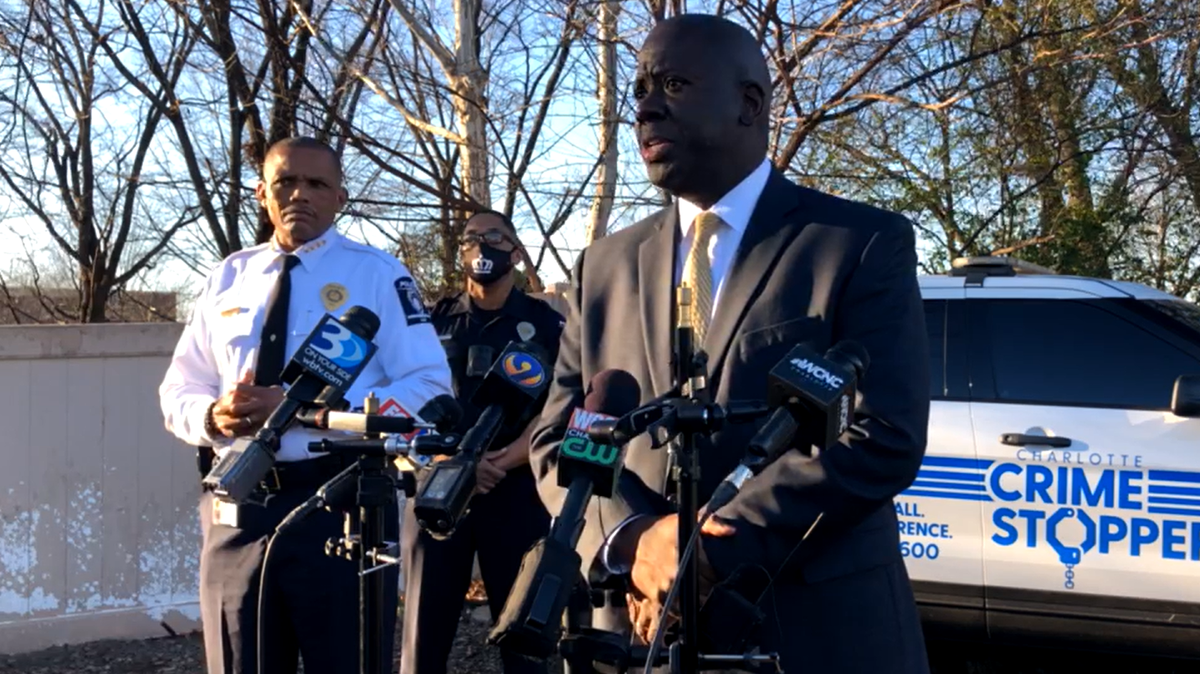
Guns turned up in Charlotte-Mecklenburg Schools at record rates during the first half of the school year, but steps the district took to curb the crisis may be working as classes come to a close.
Body scanners, a reporting app and more opportunities for students to participate in real conversations about guns and safety are contributing to a drop in the number of guns on district campuses, officials, parents and students say, adding that there’s still work to do.
“I do believe that scanners have contributed to the decrease of weapons found on campus throughout CMS, but with some caveats,” said Jacqueline Dinh, a junior at Olympic High School. “The fact that schools have to have body scanners in the first place is an issue in itself.”
During the first four months of the 2021-22 school year, 23 guns were found on campuses across CMS, breaking the previous high of guns found on school grounds during the entirety of 2018-19 school year when the total reached 22. Since January, seven guns have been found. All but one of the guns reported in schools were seized without the trigger being pulled.
On Tuesday, an unloaded gun was found inside a student’s backpack at Harding University High School before the student went through scanners. On Monday, the principal at Coulwood STEM Academy in a message to families confirmed a student brought a gun to campus. In response, officials barred students from bringing backpacks onto campus the final two days of school — the last day is Wednesday.
The only time a gun was fired this school year on a CMS campus was in December when a shot was fired at West Charlotte High School during a fight between two students over a backpack.
The sharp drop comes during a time when teen gun violence is still prevalent outside of school walls. Charlotte-Mecklenburg Police last week arrested two teenagers in connection with the shooting death of a 15-year-old boy over Memorial Day weekend.
“The issue of school violence sadly reaches far beyond the purview of a school district,” said Eric Gaestel, an eighth-grade teacher at McClintock Middle School in Charlotte. “Any solution worth exploring must be holistic in its approach to keeping all schools within a single district as safe as possible. It isn’t realistic to place all of the responsibility of keeping students and staff safe on the schools themselves. It will take a collective effort by the cities, states and federal governments to recognize the reality of the vastness of our current school safety dilemma.”
‘Schools are the safest place for children’
Following the 10-year high for guns found on campuses and multiple fights, then-Superintendent Earnest Winston pleaded with families to prevent students from bringing guns to school. In December, Winston announced plans to install body scanners, implement a reporting app and double random safety screenings — all aimed to prevent weapons from coming into buildings.
Winston also turned to community partners for help, sharing strategies such as the Alternative to Violence program. The city and county launched the program in the Beatties Ford area last year as a “violence interruption” initiative offering pathways to employment and affordable housing.
Since then, body scanners have been deployed at 21 high schools, and every student and staff member in grades 6 through 12 have been educated on the “Say Something” Anonymous Reporting System. District officials say the body scanners work as preventative tools as well as prohibitive tools.
“Students know the scanners work,” said Eddie Perez, a media relations specialist for CMS. “Case in point, a firearm was found by the scanners at Phillip O’Berry.”
Since the “Say Something” app was launched in February, the district received 1,115 tips.
SAVE Clubs (Students Against Violence Everywhere) were created, and the district started boosting its campus security, hiring 53 associates.
“I have heard that staff particularly are feeling safer about the use of the body scanners,” CMS board member Margaret Marshall said. “Students are looking out for each other and from what I have heard, the Say Something App is getting info on many things that students are concerned about.”
Restorative, nurturing place
Dinh said she believes it’s important for schools to be a safe and welcoming educational environment. Children need a restorative, nurturing place to learn, she said.
CMS has 474 school counselors, 128 social workers and 102 school psychologists to help with the social and emotional needs of its students. Officials say they also ensure students know they have access to mental health resources at every school.
Dinh pointed to a Minneapolis school district that incorporated a student safety coaches program. The model helped the district move “to become a racially conscious, trauma-sensitive and healing-centered school district” by building trust with students and proactively addressing issues and behavior, according to its website. The district serves a population of students with severe mental health needs, according to the site. Students receive therapeutic approaches and “healing-centered” behavior support.
“CMS needs to better fund programs that help disadvantaged kids that come from low socioeconomic statuses,” Dinh said. “ESL programs, translators, coaches/mentors, psychologists, and counselors help these kids simply feel like kids, thus making school what it is — school.”
Rae LeGrone, a teacher at Olympic High, says during the pandemic there was a push for children to be back in classrooms because schools are the safest place for children.
“Although mass shootings are shocking and unacceptable, they are the outlier,” LeGrone said. “More children are hurt or killed at home and in our community than in schools.”
Keeping on top of rumors
Gaestel has taught at McClintock Middle for three years and feels safe, in part, because his school has a resource officer from the Charlotte-Mecklenburg Police Department. The campus also has an active school security associate.
CMPD has 50 officers on district campuses, and the CMS Police Department has nine. The Huntersville Police Department has five, the Cornelius and Matthews police departments have two and Davidson Police Department has one.
“CMS has been proactive in their pursuit of keeping our schools a safe space for our students and staff,” said Gaestel, who is a member of the Superintendent Teacher Advisry Council. “The implementation of (body scanners) in heavily-populated schools, our Safe Schools curriculum, which is taught in every homeroom across all grades, as well as, the consistent diligence and awareness of the staff to keep on top of any rumors surrounding the threat of violence have proven to be very successful.”
CMS frequently conducts random safety screenings in its middle and high schools, and campuses are closed, meaning exterior access doors are locked, according to the district’s safety page on its website.
“CMS cannot solve school violence by making its schools feel like prisons,” Dinh said. “I do think body scanners have deterred people from bringing weapons onto campus, but this is not the final answer to the issue of violence.”
CMS will spend the summer fine-tuning body scanning protocol.
“The scanners have been utilized successfully but are still new to all schools,” Perez said. “During the summer, school staff will provide feedback in order to improve protocols and extend their use beyond the current implementation.”
Community partners
Earlier this year, the CMS Community Partnership and Family Engagement Department held “Let’s Talk about Safety” workshops in the six learning communities in the district.
The events provided an opportunity for CMS to hear from key community partners “whose mission and goals align with public safety in our communities and in our schools,” Perez said.
Adrianne Hobbs is the vice president of youth development for YMCA of Greater Charlotte, a community partner.
“The Y works with teens during out-of-school time to create experiences that focus on their mental well-being, activating their voices in positive ways and developing who they are as unique individuals,” Hobbs said. “We hope and feel that one of the outcomes of this (teen) programming is safer environments for youth.”
Officials with Be SMART, a public education campaign created to raise awareness that secure gun storage can save children’s lives, participated in the safety town hall event at East Mecklenburg High on March 24. They also participated in a CMS “Coffee Break” Facebook Live event a month earlier to spread the gun safety message.
“We have also been engaged in conversations with the school board and county commissioners on how to spread the Be SMART message more widely through the community,” Shannon Klug, the Charlotte co-lead for Be SMART, said. “We’re working toward the goal of zero guns on school grounds.”
From a parent perspective, Klug said, the body scanners installed at her son’s high school likely act as a deterrent, and she’s happy to see the “Say Something” app implemented.
In addition to safety measures, LeGrone says keeping buildings safe requires making sure caring adults are in schools, getting to know the children and monitoring behavior and changes over time. Keeping adults means increasing wages for hourly employees, ensuring positions are filled and a stable workforce is in place in every aspect of a child’s day: the bus, cafeteria, halls and classroom.
“In most cases, we cannot successfully react to a person intending to carry out a mass shooting — we must instead be proactive in our approach to mental health in schools,” LeGrone said. “On good days I feel safe in my school. The more staff that resigns, the less adult presence in buildings, the days without a nurse or social worker — those are the days when I start to question how safe it is here.”
This story was originally published June 7, 2022 at 2:16 PM with the headline "CMS finds fewer guns in second semester. Are preventative measures working?."