More than 1 in 3 Mecklenburg residents struggle with cost of living, new study says
More than 1 in 3 households in Mecklenburg County are facing financial hardship and struggling to meet basic needs, according to a new report from a national research group under United Way. And the majority of those homes are above the poverty line.
This is from a new kind of report from United for ALICE, a research group founded by United Way of Northern New Jersey. It is highlighting and putting a name to this population above the poverty line but still can’t afford basic living costs.
That group is referred to in the report as “ALICE,” which stands for “asset-limited, income-constrained, employed.” These are people who work or live on a fixed-income. They make too much money for government assistance but not enough to meet basic needs.
This is the first year an ALICE report was generated for North Carolina by United for ALICE.
And the report comes at a time when affordability and economic stability remain key concerns for the Charlotte region.
In Mecklenburg County, 11% of households live in poverty. But another 27%, or 129,135 households, fall into the ALICE threshold according to the report. Combining those ALICE and the ones in poverty, 180,234 households in Mecklenburg are struggling out of 486,412 — about 37%.
The numbers are similar at the state level. In North Carolina, 13% of people live poverty while another 28% are ALICE households.
“Our traditional measure of financial hardship is not telling us the full story,” said Stephanie Hoopes, the national director of United for ALICE. “If you think only 13% of households are struggling, hey, maybe things aren’t that bad.
“But when you look at what it actually costs to live and work in every county across North Carolina, you see that another 28% of households are struggling.”
About ALICE data from the United Way
ALICE data comes from U.S. Census numbers. The new report is fueled by the 2024 American Community Survey, which are the most recent numbers add from the Census Bureau.
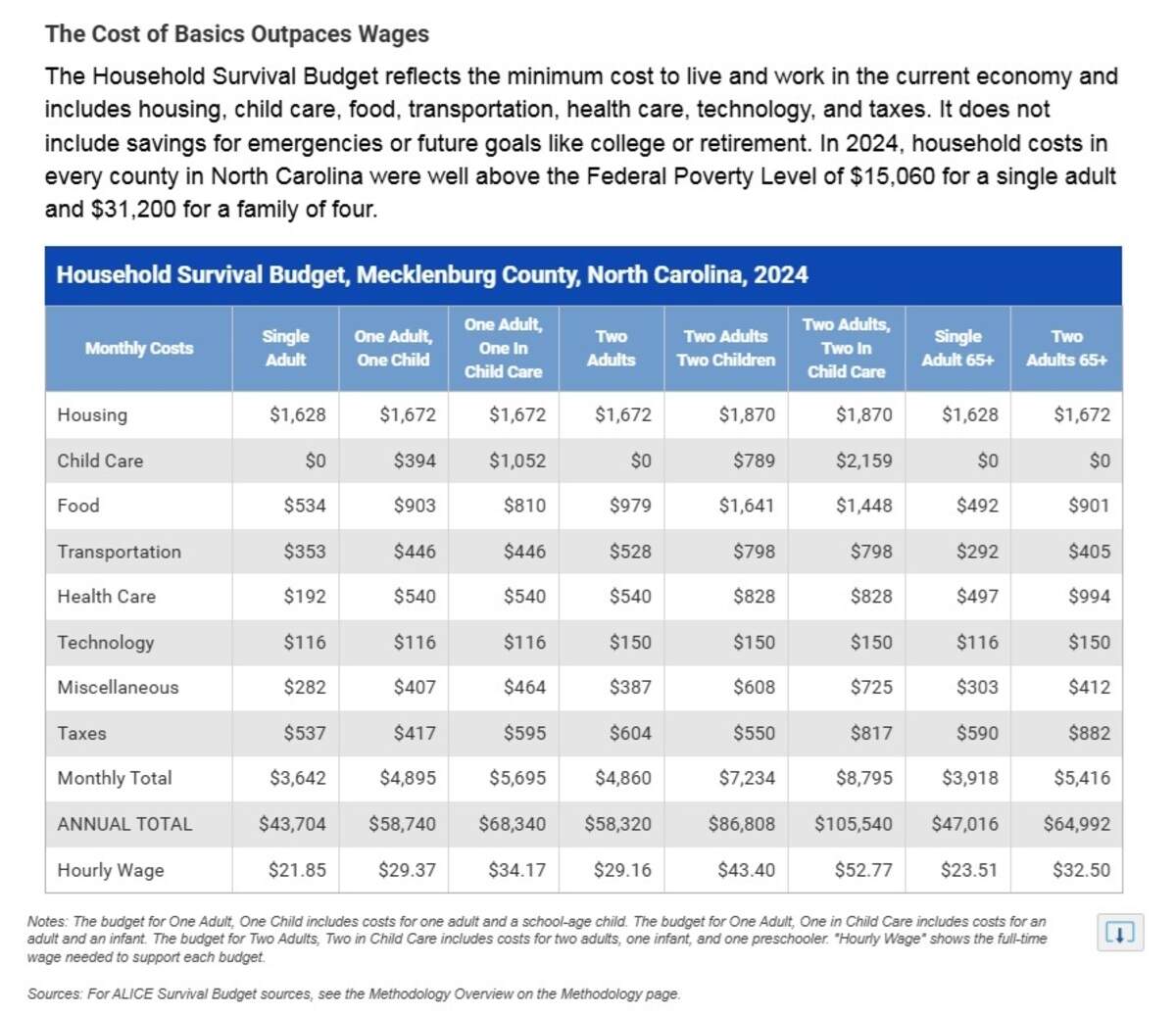
The methodology behind the report is similar to how the poverty level is determined, but on a local scale. ALICE looks at income versus a household survival budget, which includes area-specifc costs such as housing, food and transportation.
In Mecklenburg, a single person under the age of 65 making $43,704 would be considered an ALICE household. That’s the total for Mecklenburg’s household survival budget. The federal poverty line for a single adult regardless of age is $15,060.
In order to be stable economically a single person in Mecklenburg County would need to make at least $69,564.
Mecklenburg has the highest survival budget, or the basic costs of living, for a single adult in North Carolina, according to the report. On the state level, that budget is $31,740.
While compiling ALICE data and giving the population a name is new, the information tracks with what nonprofits and government officials have seen in the community, according to Kathryn Firmin-Sellers, president and CEO United Way of Greater Charlotte.
The report indicates that basic needs in the county are on the rise.
Half of Mecklenburg County renters are considered cost-burdened, meaning they spend more than 30% of their income on housing, according to the county’s State of Housing Instability and Homelessness report from February.
And wages remain stagnant. North Carolina’s minimum wage is $7.25. It hasn’t changed since 2009, when the federal rate changed.
However, Firmin-Sellers is hoping that the ALICE data will provide an introduction and conversation starter in helping Mecklenburg’s vulnerable population.
“All of the community conversations we are having right now in Charlotte align with the conversation around how do you support ALICE,” Firmin-Sellers said. “We do go where the need is greatest, and the ALICE data affirms that.”
Mecklenburg County’s vulnerable population
Here’s a closer look at the ALICE population in Mecklenburg County, according to the report.
- Households run by those 25 years old or younger, along with those run by folks 65 years or older, make up the majority of ALICE households. About 70% of households under 25 years old are part of ALICE, while 50% are 65 and older.
- The ZIP codes with the most ALICE households are on par with Charlotte’s crescent. The crescent is comprised of neighborhoods in the city’s west, north and east sides. Some ZIP codes with the highest number of ALICE households include: 28212 on the eastside with 62% of ALICE households and 28206 in the north with 55% of ALICE households.
- Single-female households with children represent a large number of ALICE homes in the county at 65%. Single-male households with children are second at 58%.
- The occupations most likely to fall into the ALICE category include construction laborers and food service workers. The details on occupation aren’t specific to Mecklenburg, but in the state 50% of construction laborers fall under ALICE.
- Even some high-paying fields such as registered nurses, software developers and financial managers see ALICE households. Those percents are 7%, 6% and 8%, respectively.
ALICE in surrounding Mecklenburg counties
Here’s a look at ALICE data in near Mecklenburg County.
- Anson County has the highest number of ALICE households and those under the poverty in the state at 61%. A main reason is because of its rural nature. Anson has a survival budget of $30,192 but a stability budget of $52,608.
- Gaston County has a higher number of ALICE households compared to the state at 33%.
- Cabarrus and Union counties are on par with Mecklenburg with 27% of households falling under ALICE.
What’s next for ALICE?
Now that the report is out, the next step is to educate stakeholders in the community and policymakers, Firmin-Sellers said. That looks like introducing them to data to see what can be done for the population.
And as Firmin-Sellers said, organizations around Charlotte and the county are already in ALICE neighborhoods, assisting those in need when they can.
On the county level, the newly adopted budget is giving millions of dollars to programs aimed at increasing upward economic mobility and to county employees.

Last year, United Way of Greater Charlotte invested $17.9 million in communities across the four counties it serves, including $4.9 million to its program that reaches Charlotte’s Corridors of Opportunity. Those corridors are in ALICE neighborhoods including Freedom Drive and Wilkinson Boulevard.
The ALICE data puts a broader face to those struggling in the county.
It’s the cashiers working at sporting events or the laborers building Charlotte’s housing. Charlotte is touted as one of the fastest-growing cities in the U.S., Firmin-Sellers said. Companies with high paying jobs are relocating, and some people are flourishing.
But how does the city grow equitable if help for its lowest paid workers isn’t available?
Firmin-Sellers is hoping stakeholders and policymakers see that the need is greater than what federal standard looks like.
“Poverty is what benefits are tied to, but that is grossly inadequate because it doesn’t vary by region,” Firmin-Sellers said. “If we want to have healthy communities, healthy neighborhoods, a healthy labor force, by definition, we have to support all parts of that labor force, including positions that are the bread and butter of our economy, and many of those are ALICE positions.
“We are at a moment where I think we really have to grapple with who is the growth going to benefit and what strategies do we need to have in place to make sure that the growth benefits everyone at Charlotte.”
Julian Berger with Observer news partner WFAE contributed to this report