
‘There’s no margin for error.’ Inside one Black banker’s struggle to reach the top.

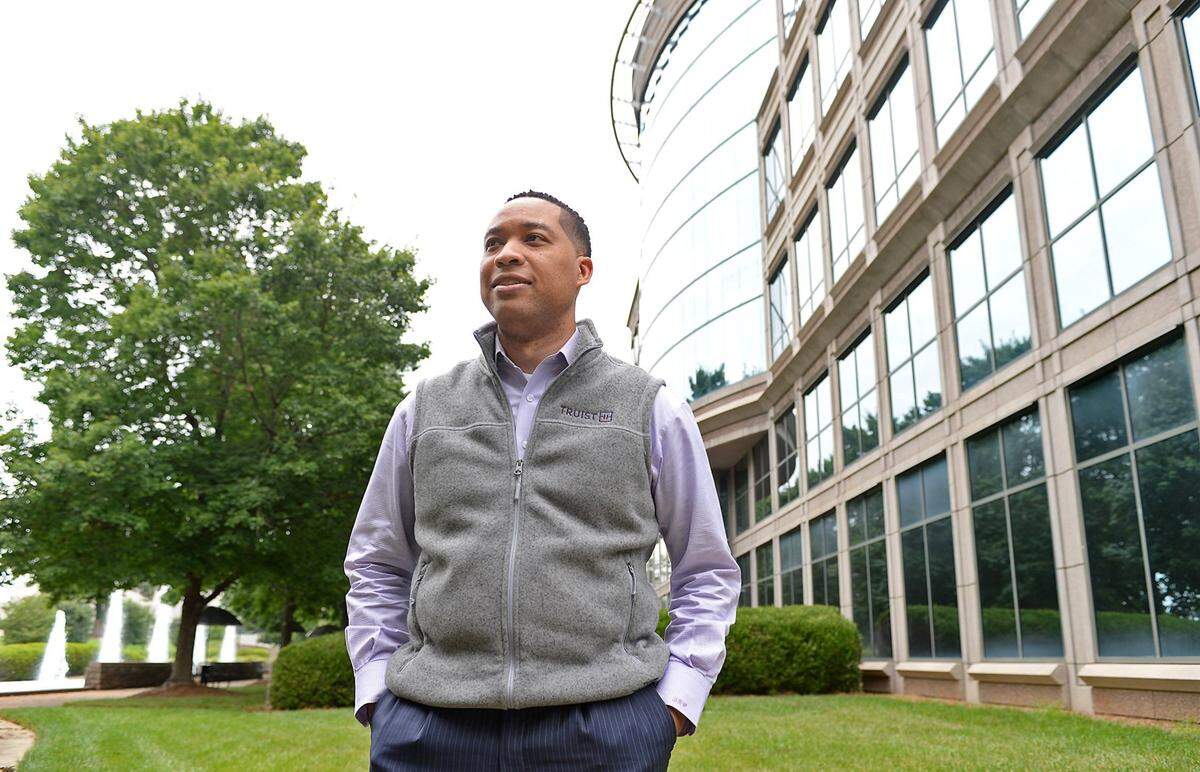
As a young executive, Truist’s Dontá Wilson remembers going with a subordinate white banker to meet a client. The client complimented the white banker on bringing his “assistant” along.
It was a small incident for Wilson, one that he says he didn’t take personally.
“Maybe it’s part of the DNA of a lot of African-American executives. You grow up understanding that world to already be that way,” Wilson said. “You almost have a slight immunity to it because you’ve been dealing with it your whole life.”
As a Black man, climbing the ladder is different than it was for the white men (and only white men) who have run the bank he started at, BB&T, now known as Truist after a $66 billion merger with SunTrust last year. The headquarters of the combined bank is in Charlotte.
Different words are used to describe you. You’ll never look the part for a role a Black person has seldom played.
“It’s been tough navigating an industry that does not have much representation of African Americans and limited footsteps to follow,” Wilson said in an interview earlier this year. Prior to this summer’s unrest over racial injustice, Wilson was the only Black executive on the senior management committee of any of Charlotte’s big three banks.
This year, Bank of America and Wells Fargo both added two black men to their senior management groups. Truist added Kimberly Moore-Wright, a Black woman who runs human resources, to theirs.
Wilson, now 44, started at the bank while attending UNC Charlotte. He was a military brat growing up, moving 12 times before the 10th grade. As a college sophomore, he pleaded to get into BB&T, taking a job in operations in October 1995.
Since then, he’s handled many roles, from managing a branch to overseeing the bank’s operations in Alabama and in Georgia.
In 2016, he joined BB&T’s management committee as the chief client experience officer, later adding on the bank’s digital operations. He kept the title after the SunTrust merger.
Now, he’s responsible for much of why the merger of the two Southern banks made sense. The banks badly needed to modernize their digital systems and offer the online products that would allow the firm to compete with in-town rivals Bank of America and Wells Fargo.
He’s also got to help finesse the combination of two client bases into one — all while helping close hundreds of duplicate bank branches in the process. Easy, right?
‘Are you truly ready?’
There are few Black CEOs for Wilson to model a path on.
Stan O’Neal ran Merrill Lynch from 2002 into the financial crisis, which saw the firm bought by Bank of America in a fire sale after his departure. Tidjane Thiam ran Credit Suisse from 2015 until February, when he was forced out amid a corporate espionage scandal. To date, the pair are the only two Black people to run major banks.
So when Wilson told former Bank of America executive Mike Dulan that he wanted to run a major bank, Dulan had to warn him.
“I told him ‘Are you ready to go on that path? Are you truly ready for that?’ ” Dulan, who is Black and has served as a mentor to Wilson, said in an interview. “Ninety-nine percent of people out here, you tell them what that path is and they tap out. There’s no margin for error. Once you get on it, the spotlight is so bright on you, it’s intense.”
The data on diversity in banking is awful, but it’s awful for almost all industries, according to Lissa Lamkin Broome, a law professor and director of the Center for Banking and Finance at UNC-Chapel Hill.
At Truist, about 12% of senior leadership are racially diverse, according to the bank’s social responsibility report. At Wells Fargo, that figure is about 13%. For Bank of America, it’s 19%.
This lack of diversity starts with the educational discrepancies that children of color face versus white kids, and only continues from there, Broome said.
“Are you recruiting at historically Black colleges and universities? Is the pipeline full at the beginning or does it have holes in it?” Broome asked in an interview.
From there, do people of color get the support they need to make it in a white-dominated space? At each point along the ladder, people of color fall off. Still, many executives make it the upper echelons of finance. Bias lives there, too.
Wells Fargo’s CEO, Charlie Scharf, apologized in September for saying “there is a very limited pool of Black talent” for senior roles at the bank. He said the remark reflected his “unconscious bias.”
There are deeper racist threads that help explain the lack of diversity in banking, too. Redlining by banks kept Black people from getting mortgages for decades. Only after their hands were forced by the federal government in the 1970s did most white-run banks actually start lending in earnest in Black and brown communities.
Wilson felt the impact of the inequality between the finances of Black and white families growing up. He remembers a funeral for an uncle where a hat was passed around to collect money.
“I saw where banking is so much of a relationship business,” he said, “and so I saw where different individuals didn’t have the relationship at the right time to get the capital that they needed.”
For Truist, the threads of racism go back to the Reconstruction era.
The bank that would become Truist was founded in 1872 by two Confederate veterans and sons of wealthy slave-owning planters. CEO Kelly King apologized this year for “the role that our heritage companies played more than 100 years ago to perpetuate the atrocity of slavery and the repression of enslaved peoples and their descendants.”
Those are on top of the struggles that Black Americans face every day. Wilson knows those, too.
In 2010, Wilson says he was driving home with his wife in the passenger’s seat and his boys in the back. It was late, about 12:15 a.m. He gets pulled over. He didn’t want to say where, but he was the head of BB&T in Alabama at the time.
The talk he got from his parents kicks in: “If you ever get pulled over by police, you better do these eight things.” He says he did all the right things. Didn’t work. Wilson reaches to get some registration information, and the officer pulls a gun.
“This is not what type of education you have, what’s your position,” Wilson said. The situation passed without anything “negative” happening, Wilson said.
Get lucky
Wilson is doing everything right. He’s climbed the ladder. He goes to church, at a bank where that matters. He’s bought into the bank’s system.
He does the charity work expected of budding executives: He washes the feet of poor kids and gives them new shoes with a Charlotte-based charity called Samaritan’s Feet, where he serves on the board.
But running a Wall Street bank isn’t as simple as doing it all right. It also relies on a ton of luck. Finance is littered with former executives at major banks who were at the wrong place at the wrong time.
King will relinquish the top job at Truist next year and be succeeded by Bill Rogers, his former counterpart at SunTrust. After Rogers, who is 62, retires, it’s fair game.
Wilson knows the odds are against him. There’s almost a dozen white guys in the bank’s senior management who don’t have to fight the battles Wilson does.
But for him, it’s worth it.
“You get in the system, you do the best you can, you endure it,” Wilson said. “And when you’re in a position to make the change, then you start to impact and change it and evolve it.”
This story was originally published November 12, 2020 at 6:30 AM.