
All counties in Charlotte region are in COVID red zone, new NC data show
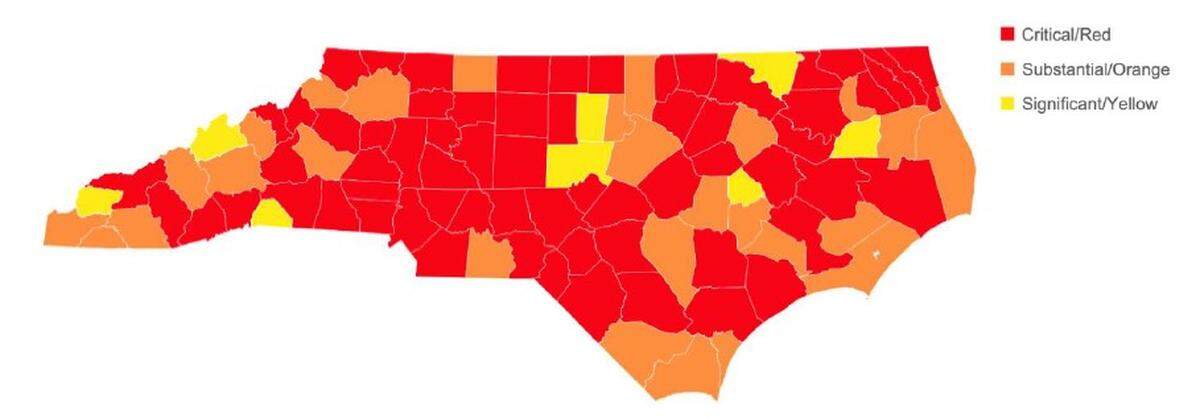
With Mecklenburg’s elevated COVID-19 positivity rate and local hospitals now treating nearly twice as many patients compared to just last month, the county landed in the “red zone” Tuesday in North Carolina’s coronavirus alert system.
Many neighboring counties were already in the red, which signals the most severe spread of the virus based on case rates, percent of positive tests and current strain on hospital beds and staff.
Mecklenburg reached the highest tier with a case rate of 805 infections for every 100,000 residents in the past two weeks. The county’s average positivity rate of COVID-19 tests among residents is about 12%, the latest data show. That’s up from less than 10% at the end of November and 6% average in all of October.
Hospitalizations averaged 340 in the past week, which is almost double the volume seen last month, according to a Charlotte Observer analysis of public health data. On Sunday, Mecklenburg set a new record: 378 people being treated in local hospitals.
While the red zone designation does not trigger any additional restrictions beyond existing state orders, N.C. Gov. Roy Cooper said Tuesday residents must stay home as often as possible and scale down or go virtual for holiday gatherings. Mecklenburg officials have not considered imposing more restrictions either, such as closing down indoor dining, Public Health Director Gibbie Harris said this week.
“If you are in a red or orange county, you should limit going out to essential activities and avoid people who you don’t live with,” said Dr. Mandy Cohen, secretary of the North Carolina Department of Health and Human Services, during a news conference.
When the color-coded alert system was unveiled in mid-November, Mecklenburg and 46 other counties fell into the lowest tier: yellow, indicating significant community spread of COVID-19. Earlier this month, Mecklenburg moved into the orange zone, meaning substantial community spread.
In total, 65 counties are now in the red. That includes all counties in the greater Charlotte region: Mecklenburg, Union, Gaston, Cabarrus, Iredell, Rowan, Cleveland, Lincoln and Stanly.
There are 27 counties in the orange zone and only eight in the yellow zone, the updated map shows. With the alert system, state leaders bring together the most important data points used to monitor virus impacts in local communities.
Hospitalizations — considered a lagging indicator in the pandemic, due to the incubation period of the virus and how long it takes for symptoms to worsen — are now reflecting illnesses likely contracted over Thanksgiving, health experts say.
Upcoming holidays like Christmas and New Year’s are expected to fuel an even higher caseload.
”These kinds of spreading events are kind of like dropping a pebble in a pond and there’s this ripple effect,” said Dr. David Priest, Novant Health infectious disease expert.
“If you have a large event where people are unmasked and the virus is spreading and then they leave that event, they go somewhere else and those people are infected — and they go somewhere else, and so it continues to spread,” Priest told reporters Tuesday morning.
Holiday COVID spike
Every holiday so far has produced a spike, Harris told reporters Monday. With “COVID fatigue” taking a firmer hold, Harris said she’s worried how increasingly lax behavior, including ill-advised travel and crowded parties, will translate into a January peak, putting further strain on local hospitals.
She pleaded with residents to limit gatherings around Christmas and asked churches to adapt with virtual services.
“It is a challenge, I know, this time of year for us to ask that of our community, but it’s what’s going to get us through the next month,” Harris said. “It’s what’s going to help us keep our cases down, and it’s what’s going to prevent unnecessary deaths.”
Mecklenburg has logged 57,131 coronavirus cases since the start of the pandemic, the North Carolina Department of Health and Human Services reported Tuesday. Local officials say 518 county residents have died of coronavirus-related complications.
On average, the county is adding 670 new cases per day — close to double the volume from one month ago, an Observer analysis finds.
Michael Thompson, associate chair of the Public Health Science Department at UNC Charlotte, said coronavirus trends now reflect exponential growth, which makes it increasingly risky for people to interact with individuals outside their immediate household.
If the public doesn’t commit to consistent mask wearing and social distancing, Thompson fears hospitals could soon become inundated with coronavirus patients.
“The Christmas season is supposed to be one of giving and looking out for each other,” Thompson said. “Any one slip-up can impact the entire community. It’s very discouraging to see videos of bars and restaurants where people are just flagrantly disregarding these (safety) practices.”
This story was originally published December 22, 2020 at 3:48 PM.