Hundreds in Charlotte protest Supreme Court ruling that overturns Roe v. Wade
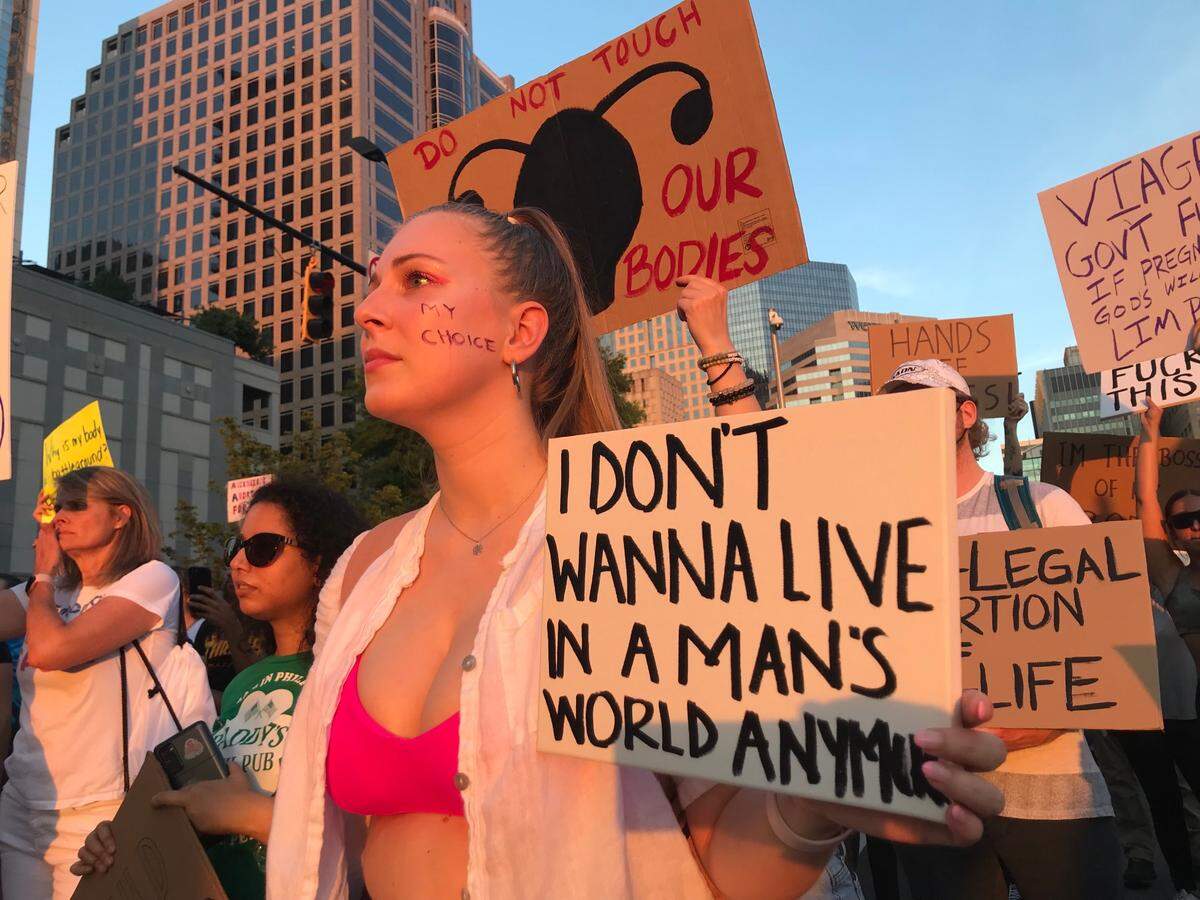
Demonstrators gathered at the Charlotte-Mecklenburg Government Center on Friday evening to protest the U.S. Supreme Court’s decision to overturn Roe v. Wade, ending the constitutional right to an abortion.
The court, in a 6-3 vote, upheld a Mississippi law that called for a ban on most abortions after 15 weeks. The justices then voted 5-4 to completely overturn the landmark 1973 Roe v. Wade ruling.
The ruling now gives states the authority to ban abortions.
About 250-300 people attended Friday’s protest, Charlotte-Mecklenburg police told an Observer reporter. The Black Abortion Defense League organized the protest.
Signs held by demonstrators called for a separation of church and state. Others declared that a uterus is more regulated than a gun.
U.S. Rep. Alma Adams, a Charlotte Democrat, told protesters that she would continue to fight for access to abortion in North Carolina. The state is not one of the 13 with “trigger laws” that will ban abortion outright after Friday’s ruling.
“I’m mad as hell,” Adams said.
“We don’t tell the guys you can’t have a vasectomy,” she said. “We don’t make laws for men’s health care, to tell men what to do with their bodies.”
People will die as a result of Friday’s ruling, she said.
After speakers wrapped up at the Government Center, a large crowd marched through uptown chanting “my body, my choice” and “we keep us safe,” according to tweets from a WBTV reporter.
Among the protesters Friday was Diane Stevens of Waxhaw.
More than 50 years ago, Stevens was arrested for helping people obtain abortions illegally in Chicago through an underground network called the Jane Collective.
Stevens told The Charlotte Observer that she was appalled but not surprised by the court’s decision Friday. The culture surrounding the issue now, she said, is much more dangerous and divided than it was in the 1960s.
However, there is hope, she said.
“Ordinary people can do extraordinary things,” Stevens said, adding that she would not be surprised if Friday’s ruling creates more groups like the Jane Collective.
‘I can’t believe we are here’
Dozens of other speakers, including women, transgender, non-binary people, and those who said they had abortions, expressed fear at what will happen next with other precedents set by the court.
In a concurring opinion, Justice Clarence Thomas said the court should reconsider its decisions on same-sex marriage, same-sex intimacy and contraception.
Brooke Adams, president of the Reproductive Rights Coalition in Charlotte, said the U.S. is going backward.
“This is a truly awful day and a horrible development, and I can’t believe we are here,” Adams said.
Calla Hales, executive director of A Preferred Women’s Health Center, told the crowd the facility had already received calls from those whose appointments have been canceled in other states.
“Everyone knows and loves someone who had an abortion,” Hales said.
Abortion rights in NC
Abortion remains legal in North Carolina, but that could change if Republicans regain a supermajority in the state’s General Assembly in November’s elections. Gov. Roy Cooper, a Democrat, has vowed to veto any abortion ban that comes across his desk, but a supermajority can override his veto.
“I will continue to trust women to make their own medical decisions as we fight to keep politicians out of the doctors exam room,” Cooper said Friday.
North Carolina is already a destination for those from other states seeking abortions. About 25,000 people every year get abortions in North Carolina. And nearly one out of five come from other states, The Charlotte Observer previously reported.
Now, the state could be one of the final states in the region with access to abortion, as South Carolina is poised to restrict the procedure even further.
This story was originally published June 24, 2022 at 7:08 PM.