From Asheville sit-ins to Supreme Court, see a timeline of James Ferguson’s career
READ MORE
Remembering James Ferguson
James Ferguson II, a Charlotte civil rights lawyer whose landmark cases desegregated schools nationwide died July 21, 2025 at 82. Ferguson, an Asheville native, was also a co-founder of North Carolina’s first interracial law firm.
Expand All

Family plans celebration of life for late civil rights lawyer James Ferguson II
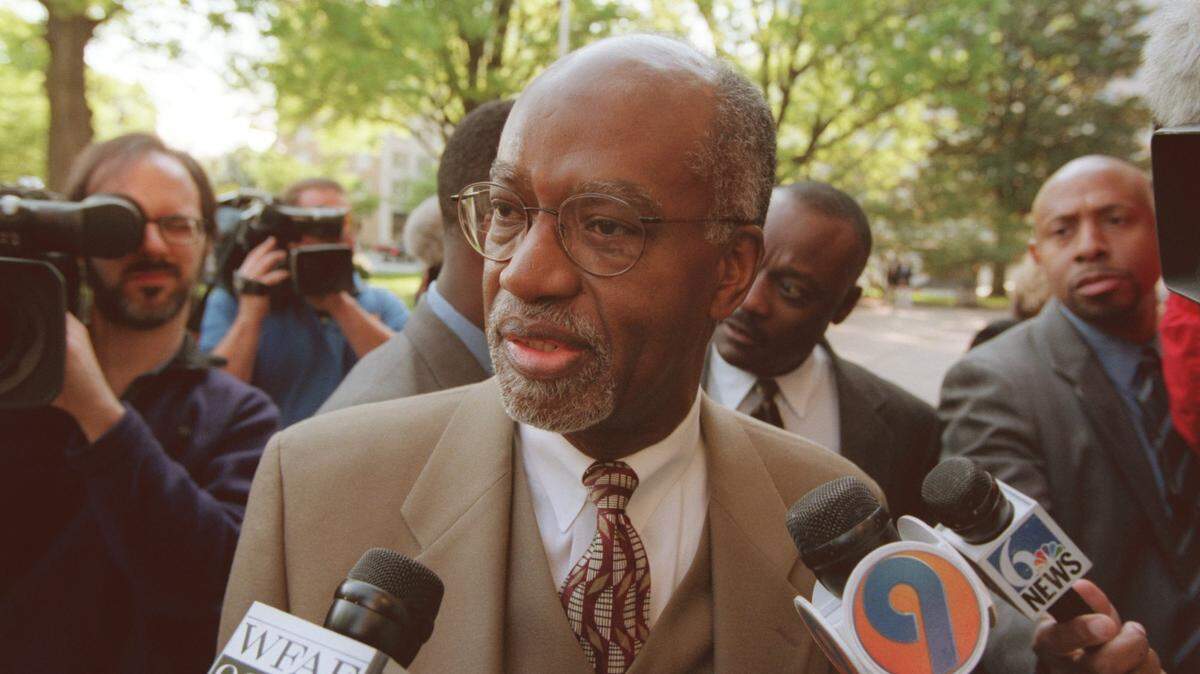
Why one of NC lawyer James Ferguson’s biggest cases still affects Charlotte today
From Asheville sit-ins to Supreme Court, see a timeline of James Ferguson’s career

NC leaders mourn death of legendary Charlotte civil rights attorney James Ferguson

Prominent Charlotte civil rights attorney James Ferguson dies at age 82
James Ferguson II, a pioneering Charlotte civil rights attorney whose landmark cases helped desegregate schools nationwide, died Monday at 82. An Asheville native, he co-founded North Carolina’s first interracial law firm and played a pivotal role in shaping the legal battle for racial justice across the country.
Ferguson’s pursuit of equity began in junior high, when he helped organize interracial discussions among local youth – meetings held outside Asheville city limits because no venue within the city would allow integrated gatherings. It marked the beginning of a legal career grounded in community, resistance and reform.
Here’s a timeline of Ferguson’s activism, drawn from Charlotte Observer archives, his biography on the Ferguson, Chambers & Sumter, PA website, and a 2023 oral history interview conducted by the Legal Defense Fund in partnership with the Southern Oral History Program at the University of North Carolina at Chapel Hill.
1942 - Born the youngest of seven to a laborer and a maid, Ferguson grew up on Grove Street and later Blanton Street, both part of Black neighborhoods in a fully segregated Asheville.
1955 - While in junior high, Ferguson joins the Greater Asheville Intergroup Youth Association, a coalition of Black and white students united in frustration over their school board’s refusal to act on Brown II, the Supreme Court’s directive requiring districts to develop and implement desegregation plans.
1958 - As a student at Stephens-Lee High School in Asheville, Ferguson decides to go to a school dance instead of joining nine of his Black friends who are later charged with raping a white woman after visiting an all-white park that night.
1960 - Organizes demonstrations that successfully desegregated several city lunch counters with a group that later became the Asheville Student Committee on Racial Equality, or ASCORE, a student-led chapter of one of the Civil Rights Movement’s most prominent organizations.
1964 - Enrolls at Columbia Law School as one of its few Black students following his graduation from North Carolina Central University in Durham, where Ferguson majored in history and English and led the Student Government Association.
1967 - Visits the NAACP Legal Defense Fund’s New York City office during the spring of his final year at Columbia Law, where Ferguson meets an intern named Julius Chambers. That year, Ferguson joins Chambers and Adam Stein in setting up a civil rights practice in a small walk-up office on Trade Street in Charlotte, furnished with nothing more than a table and two chairs. Months later, the three men partner with Jim Lanning to establish North Carolina’s first racially integrated law firm, a firm that would later become known as Ferguson Chambers & Sumter, PA.
1970 - Leads a landmark lawsuit against the Asheville school district over discriminatory student assignment and busing policies, forcing greater compliance with federal desegregation mandates.
1970 - Helps represent the Swann family in the landmark Supreme Court case that paved the way for busing as a means to integrate public schools across the country.
1971 - Drives to his Uptown office after learning it’s been firebombed by arsonists, arriving to find piles of legal records destroyed in an act that deepened mounting frustration over the fight for educational equity as the nation awaited the Supreme Court’s decision in Swann.
1971 - Represents the Wilmington 10, a group charged with arson and conspiracy following the burning of a white-owned store in a Black Wilmington neighborhood, leading their multiyear appeals process until the U.S. Court of Appeals for the Fourth Circuit overturned their convictions in 1980.
1986 - Serves as local counsel in the landmark Supreme Court case Thornburg v. Gingles, which upheld key amendments to the Voting Rights Act and set enduring standards for challenging vote dilution.
1987 - Inducted as a fellow of the American College of Trial Lawyers.
2009 - With the introduction of North Carolina’s Racial Justice Act, which allowed defendants facing the death penalty to challenge their sentences if they believed race was a significant factor in its determination, Ferguson secured sentence reductions for four clients – the only cases decided under the law before its 2013 repeal.
2014 - Represents former Charlotte Mayor Patrick Cannon following his arrest on federal public corruption charges.
2024 - Retires from leading the firm Ferguson, Chambers & Sumter.
In roles spanning several decades, Ferguson co-founded South Africa’s first Trial Advocacy Program during apartheid, served as president of two major North Carolina legal associations, and spent more than 15 years as General Counsel and Executive Committee member for the ACLU. He held teaching positions at Harvard and North Carolina Central law schools, taught trial advocacy in the U.S. and U.K., and was honored as a Fellow by the University of Pennsylvania Law School. He also chaired the Charlotte Community Building Initiative and served on the North Carolina Commission on Alternatives to Incarceration.
This story was originally published July 21, 2025 at 5:20 PM.