NC museum removes LGBTQ Pride photo, sparking outrage
READ MORE
Charlotte Pride 2022
The Charlotte Observer’s coverage leading up to the Charlotte Pride Festival and Parade.
Expand All
Editor’s note: This article was updated on Thursday, June 16, 2022, after Gaston County government released an additional statement addressing the rejection of a photograph of an arrest for an exhibit at the Gaston County Museum.
LGBTQ equality advocates are demanding officials in Gaston County reverse their decision to remove a photo showing two men recently engaged, kissing, from a museum exhibit.
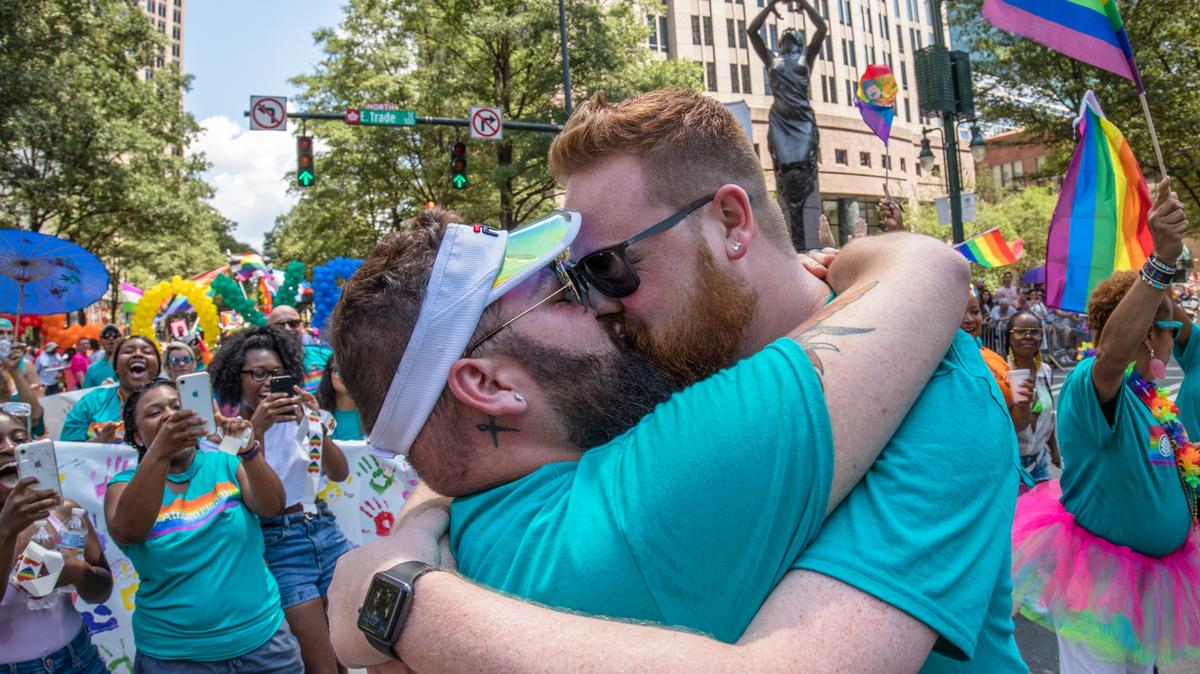
The photograph, taken by Charlotte freelance photojournalist Grant Baldwin, shows Justin Colasacco and his husband Bren Hipp kissing after Colasacco dropped to one knee and proposed in front of the crowd at the 2019 Charlotte Pride Festival & Parade. They married Oct. 4, 2020.
“As a gay man living in a state that celebrates diversity, it is truly disheartening to learn that there are still organizations that continue to deny us the same liberties as the heterosexual community,” Justin Colasacco said in a text to The Charlotte Observer.
“To remove a moment in history that gave us visibility and celebrated same-sex marriage that has been legal in North Carolina since 2014, is unjustified,” Colasacco said.
Hipp was walking with the Atrium Health group when they approached the parade judges in the center of uptown and Colasacco proposed to him, Spectrum News 1 reported at the time.
“Congratulations to one of our nurses who was proposed to during the Charlotte Pride Parade!” Atrium Health posted on Facebook at the time. “He said “yes!”
According to a Gaston County government statement first reported by the Gaston Gazette Tuesday night, County Manager Kim Eagle told Gaston County Museum staff to have the photographer submit a replacement picture “that would be more considerate of differing viewpoints in the community.”
“The idea behind the exhibit is to document a historical event, and there are other options from the photographer’s work that more fully capture the context of the parade that was documented,” according to the statement.
Eagle, a former Charlotte assistant city manager, didn’t return a phone message from The Charlotte Observer.
County spokesman Adam Gaub provided the same statement to the Observer Wednesday and said the county had no further comment.
Photograph was ‘political advocacy,’ official says
In the county statement, Eagle said: “The museum is government-funded, and as such, it is important for the items it shares to be informational without championing political issues. As a public administrator, there is a delicate balance between the effort to foster an inclusive workplace and community, while avoiding political advocacy.”
In a phone interview Wednesday, Baldwin said his role as a photojournalist who has freelanced for The Charlotte Observer and other media outlets is “to tell a narrative I’m not a part of,” and not to be an advocate through his lens.
He was under contract with Charlotte Pride to take images at the festival, he said. “There was no advocacy on my part and no request that I present any advocacy images,” he said.
Baldwin said he and several other photographers in the region were asked to submit three or four photographs that represented their work for consideration in the museum’s Into the Darkroom: Photography as History and Artform exhibit. The exhibit opened May 31 and continues through July 29, 2023, according to the museum website.
Baldwin said he’s happy his photograph has drawn attention.
“When a photograph takes on a life of its own and has its own narrative from the perspective of the people who view it, that’s a job well done,” he said.
“I’m not happy that it does appear that issue is being taken because it’s an LGBTQ image,” he said.
After the photograph’s removal gained national headlines, Baldwin said, Monroe Gallery of Photography in Santa Fe, New Mexico, contacted him and is including the photo in its “Imagine a World Without Photojournalism” exhibit July 1-Sept. 18.
Charlotte Pride condemns removal of photos
The county manager’s remarks drew a swift rebuke from Charlotte Pride, which said in a statement Wednesday it “condemned” Eagle’s decision as “abhorrent” and a violation of First Amendment rights.
“Here we go again,” Charlotte Pride board president Clark Simon said in Wednesday’s statement. “Gaston County’s decision ... seeks to silence and erase the existence of LGBTQ and minority people in Gaston County and the wider region.”
Simon, who lives in Gastonia, said he found it “especially astonishing” that Gaston County also censored a second photograph by Baldwin, one that documented protests against a Confederate monument on Gaston County government property in downtown Gastonia.
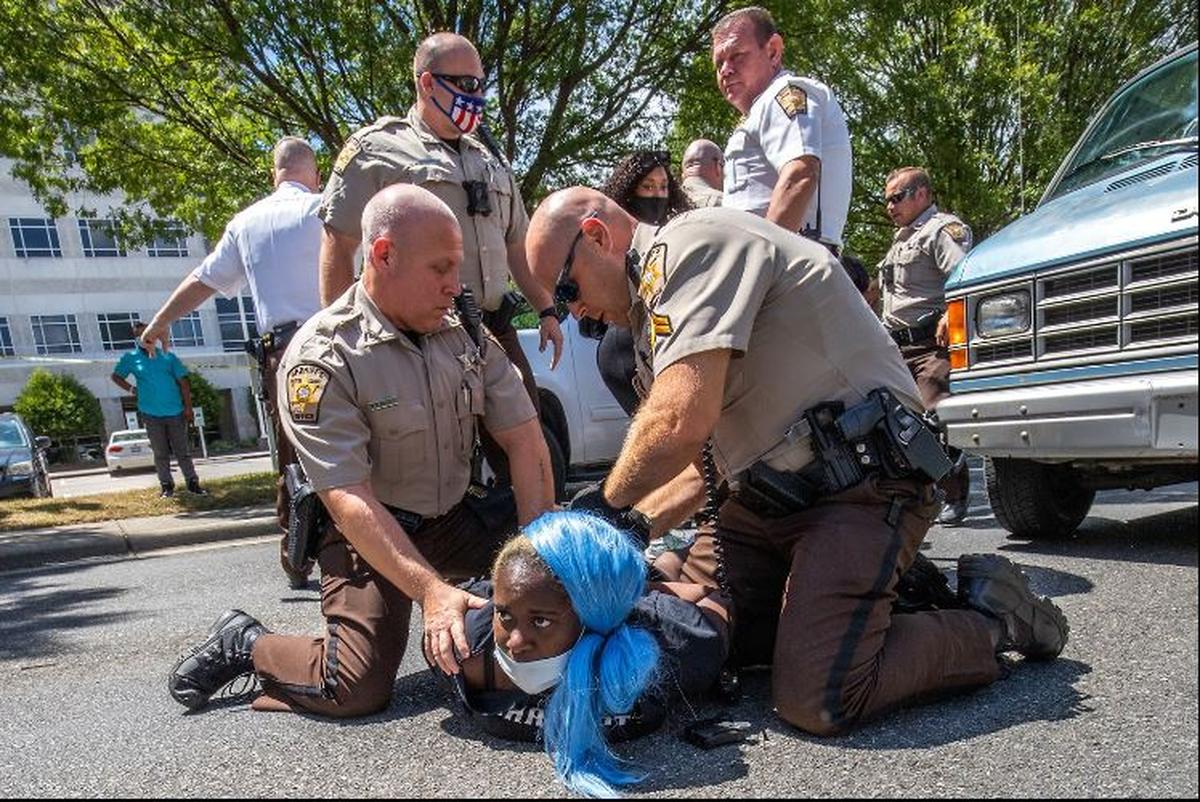
In the statement released by its communications director, Matt Comer, Charlotte Pride said it finds it “especially offensive that a local government body would seek to censor photographs of LGBTQ and Black life during June, a month in which LGBTQ people commemorate their rights and when Black people celebrate Juneteenth, the official end of slavery in the United States.”
“Charlotte Pride believes that all people are worthy of dignity and respect and are due equal treatment under the law,” Charlotte Pride said in the statement. “Charlotte Pride affirms the Supreme Court decision in Obergefell that legalized marriage equality in 2015.
“We find it abhorrent that any democratically-elected government or its employees would seek to censor a photograph of a marriage proposal in an artistic, photographic art display contained in a government-funded museum like the Gaston County Museum.”
On Thursday morning, Gaub issued a statement addressing the rejection of Baldwin’s photograph showing sheriff’s deputies arresting a protester at the Confederate monument in Gastonia.
“The Gaston County manager was originally unaware of the submission of the photo from Mr. Baldwin taken during a protest in front of the Gaston County Courthouse,” according to the statement. “Upon conversation with staff, it was discovered that the museum director had decided against displaying the photo as part of the ‘Into the Darkroom’ exhibit.
“There were numerous submissions for the exhibit, and this was one of many that did not make the final cut for display,” the statement read.”
Hipp said his first reaction to Gaston County pulling the photo was “surprise.” He and Colasacco weren’t aware the photo was in the exhibit, although they gave Baldwin permission to use the picture, he said.
He said he agrees with Simon’s thoughts on the matter.
“Since the legalization of same-sex marriage for the entire U.S. in 2015, the LGBTQ community has become more mainstream — movies, sitcoms, large businesses and corporations — ... and this makes people uncomfortable,” Hipp said in a text to the Observer. “People wish to keep us in the shadows and pretend as if we do not exist. Well, they wish to pretend our ‘lifestyle’ does not exist.
“We have been here, and we will always be here,” Hipp said. “... We deserve to be respected and appreciated. We deserve to love and be loved. Every person deserves the right to be who they are and be a part of the community without judgment or suppression.”
‘A huge step backwards’
Baldwin said he learned his photographs had been removed only when a Gazette reporter contacted him Tuesday.
“I haven’t had any dialogue with the county manager, so I’m pretty far out of the loop” as to her reasoning, he said.
He said he called Gaston County Museum Director Jason Luker, who apologized to him for not having yet notified him of the county’s actions.
When the Observer reached Luker by phone Wednesday, he declined comment and referred a reporter to Gaston County spokesman Gaub.
In its statement, Charlotte Pride said the organization “represents a large and diverse community that spans the entire Charlotte region. LGBTQ and minority individuals call every county, city, neighborhood, and census tract in our region their home ... Charlotte Pride demands both photographs be immediately displayed again in the Gaston County Museum.”
Said Colasacco: “Something must be done if we want to protect the hard work that we, the LGBTQ community have done to normalize acceptance. This is a huge step backwards for both LGBTQ and heterosexual communities.”
This story was originally published June 15, 2022 at 3:04 PM.
.jpg)