Mecklenburg County disappointed NC Democrats again. What went wrong? | Opinion
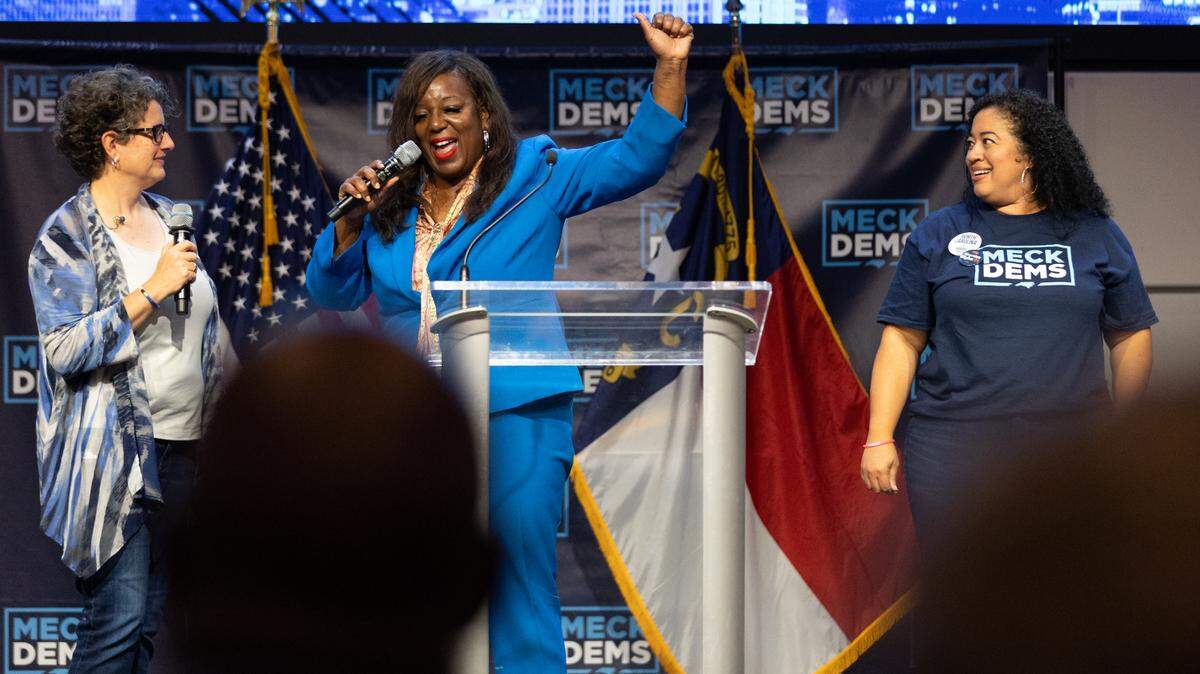
Mecklenburg County has a turnout problem. The county has consistently lagged behind statewide turnout in important elections, and 2024 was no exception.
The difference, though, is that Democrats hoped that this year would be different.
Mecklenburg County isn’t big enough to deliver the state of North Carolina for Democrats on its own. But it is big enough that its performance can be a bust or a boon. Just 45% of Mecklenburg County voters cast a ballot in 2022 — significantly lower than the statewide turnout rate of 51%.
New county party chair Drew Kromer, who was elected after the 2022 midterms, said he had a plan to increase voter turnout in the 2024 election cycle. Kromer dramatically increased the number of paid staff and raised millions of dollars this election cycle in pursuit of that goal.
But in the end, the story appeared to be the same. Mecklenburg County’s voter turnout for the 2024 election was 69%, lower than the statewide average of 73% and the vast majority of North Carolina’s 100 counties. It was lower, too, than 2020, when Mecklenburg Democrats raised just $152,000 and had zero paid staff members. Turnout in Mecklenburg was 72% in 2020, which still lagged the statewide average but is higher than anything the county has seen since.
So what went wrong? Without a complete picture of the data — including partisan-level turnout — it’s hard to say exactly. But we do know that Kamala Harris got fewer votes than Joe Biden in Mecklenburg County, and that many parts of the county shifted to the right.
Douglas Wilson, a Democratic strategist based in Charlotte, said that Democrats could have done a better job of mobilizing their base.
“Some of these crescent precincts in historical Black neighborhoods, they were touched by the Democratic Party, but they were not touched as early and often as they should have been,” Wilson said.
Turnout among North Carolina’s Black voters appeared to be down during early voting, something that raised warning signs for Democrats. Mecklenburg County has more Black voters than any other county in the state, and mobilizing them is an important piece of Democratic success in North Carolina.
Wilson said that it’s important for Mecklenburg Democrats to reach out to Black communities early and listen to their specific concerns.
“You have to figure out what their issues are and form a messaging plan around those issues to get them to come out and vote,” Wilson said. “African Americans are going to vote for Democrats in higher numbers anyway, but you can’t just assume that. You have to persuade them to come out, and I think that’s where we kind of missed the mark.”
That’s a sentiment shared by other Democrats. Some precinct chairs say that Black voters were neglected in the party’s 2024 plans, despite warnings about lackluster grassroots organizing in Black communities, The Charlotte Observer reported this week. And in a scathing resignation letter after the election, the party’s now-former executive director accused party leadership of “racism and disregard for minority communities.”
Kromer, the county party chair, told me that while the complete data is not yet available, he’s confident that the party’s strategy made an impact. He pointed to the fact that Democrats flipped a state House seat in northern Mecklenburg County and defended a highly competitive state Senate seat in southern Mecklenburg — both areas where the party concentrated a significant amount of resources.
Local Democratic strategist Dan McCorkle says he still believes the party should have focused more on areas with the greatest potential for new voter registrations and turnout growth, particularly in west and east Charlotte.
“James Taylor was not in east Charlotte,” McCorkle said, referring to an event in which the singer canvassed with Democrats in southern Mecklenburg County a few weeks before the election.
At least one expert questions whether squeezing turnout out of Mecklenburg County is still a fruitful goal for Democrats. Duke University professor and former Democratic strategist Mac McCorkle pointed out that the Democratic advantage in Mecklenburg County was nearly wiped out by surrounding counties in the Charlotte metro area, many of which Republicans are winning by increasingly large margins. He encouraged Democrats to start looking outside of the county for answers.
“I think we’re getting towards the end limit of a narrow, urban, college town Black Belt strategy that gets us close but can’t give the push over the line,” he said. “Maybe we’ve reached the maximum feasible level in Mecklenburg.”
This story was originally published November 15, 2024 at 8:43 AM.