Can anything stop I-77 South toll lanes in Charlotte? We answer your questions
In recent months, the Interstate 77 South toll lane project has been wrought with angered and disappointed residents as well as shocked government officials and a multitude of questions.
Charlotte City Council is expected to vote Monday, March 2, on whether it wants to demand a 60-day pause on the project. Meanwhile, the Charlotte region’s transportation board was told by its attorney it could not rescind its resolution to fund the project or pause it.
But questions are still swirling over what’s next and whether council, or any other government body, can halt the development.
Business leaders and some members of council are also concerned whether a pause in the project would mean a loss of $600 million in state funds. Another key concern is how will this project affect residents of the historically Black neighborhoods along the interstate.
Here’s a breakdown of how the project came to be and what might happen in the coming months.
If you have additional questions, email us at dmathurin@charlotteobserver.com or nsullivan@charlotteobserver.com
What’s the history behind the I-77 South toll lane project?
“Managed lanes” or toll lanes were proposed along I-77 from Mooresville to the South Carolina border almost 20 years ago.
There were two major reasons: to ease congestion due to the region’s growing population and to offer an alternative funding mechanism to support the infrastructure project.
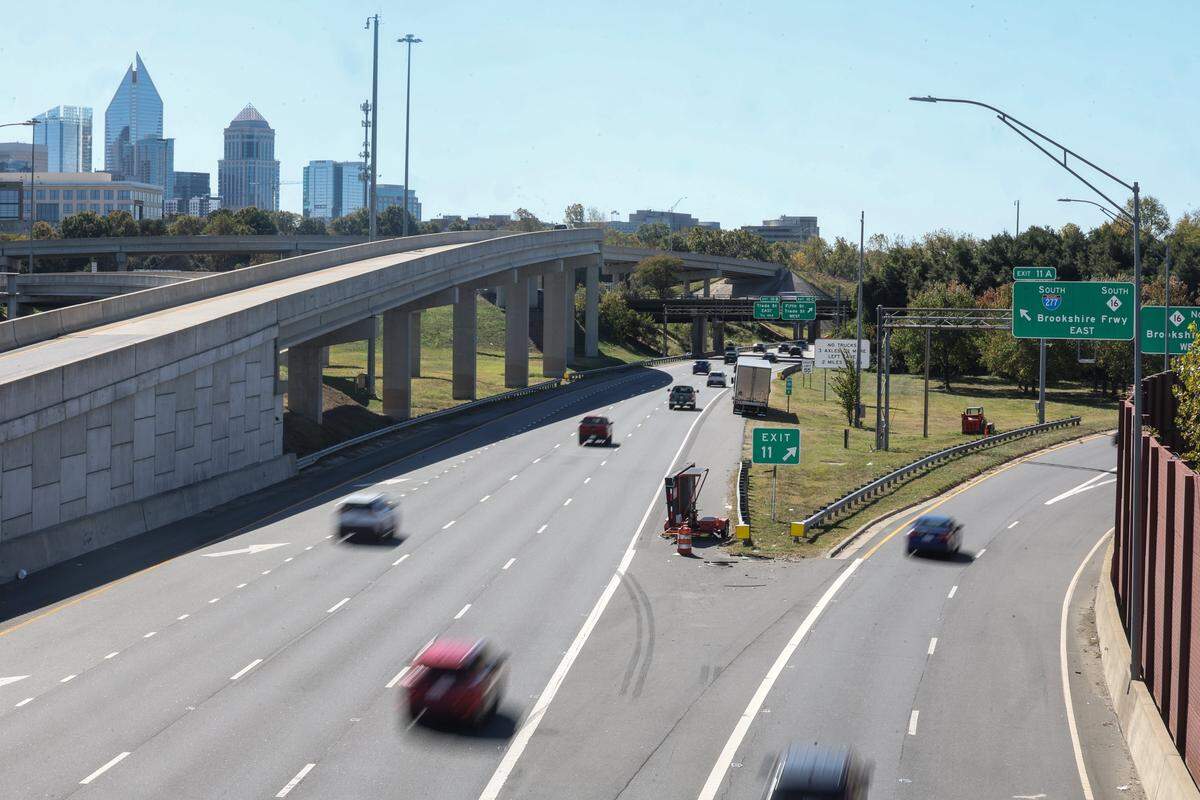
Gas taxes are the main funding source for infrastructure projects, but with the rise of electric vehicles and fuel efficiency, that pot of money is dwindling.
So, North Carolina’s first toll lane project was born: I-77 North Express Lanes. It would run 26 miles from Charlotte to the Lake Norman area.
In 2014, a public-private funding mechanism was approved by the Charlotte Regional Transportation Planning Organization, which looks at urban transportation improvements in Iredell, Mecklenburg and Union counties.
Cintra Infraestructures, a Spanish transportation construction firm, was chosen as the private partner. For 50 years, Cintra would run, maintain and receive the toll revenue from the project. It would do so under the name I-77 Mobility Partners.
That was the first time the state outsourced operation of a highway.
Residents and some municipalities were not happy about the toll lanes, the developer and the project in general. An anti-toll lane group was formed by residents who sued NCDOT and Cintra to halt the project. A judge denied the request.
And Cintra had its own problems. It faced issues with toll roads it built or bought in Texas and Indiana, including revenue shortfalls.
NCDOT fined I-77 Mobility Partners heavily for not completing work throughout the project. And at one point NCDOT thought about buying the roads back from Cintra.
So, how is I-77 North doing?
The I-77 Express lanes opened in November 2019.
And since 2020, crash numbers from the Brookshire Freeway to the Mooresville exit on I-77 have varied, according to data from NCDOT. From 2020 to 2023, crashes increased by about 22%. That makes sense given the increase of cars on the road coming back from the pandemic.
From the peak of 2,048 crashes along that stretch in 2023 until October of last year, crashes decreased by 23%. Data up to October 2025 were the latest numbers available that were provided by the state to The Charlotte Observer.
It’s unclear how much Cintra has made so far. But in the third quarter of last year, I-77 North generated 10.5 million traffic transactions and $33.1 million in toll revenue, according to a traffic and revenue summary from I-77 Mobility Partners.
The I-77 express lanes use dynamic pricing, meaning the cost fluctuates based on traffic on the highway. Congestion increases demand and, therefore, prices during peak traffic times.
At peak hours, from 6 a.m. to 10 a.m. and again from 4 p.m. to 8 p.m., traveling along the full length one way could cost more than $30, according to Toll Guru, a toll and fuel calculating website.
Drivers who don’t have an NC Quick Pass account and transponder will pay higher prices.
Let’s get back to I-77 South
CRTPO approved toll lanes for I-77 South in 2014. The project was placed on a long-ranged planning document and a public-private funding mechanism was approved in 2024.
NCDOT didn’t release the design for the project until last November, however.
NCDOT went with a proposal elevating toll lanes in the uptown portion of the project near McCrorey Heights. That plan would see the construction of express lanes either over the interstate or to the side of the interstate.
But residents in the historically Black neighborhoods along I-77 say the design is still a major concern. They also fear history could repeat itself.
Hundreds of families in the West End were displaced by eminent domain in the late 1960s to make way for the very Interstate at the center of today’s controversy.
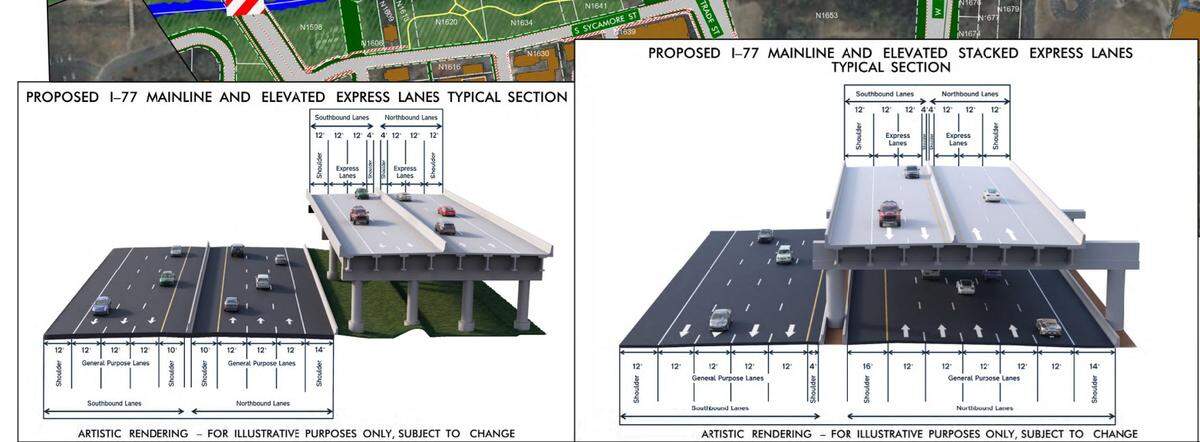
People in Biddleville, McCrorey Heights, Oaklawn Park and Wesley Heights worry they could lose their homes to the expansion or see the character of their neighborhoods disrupted by giant concrete pillars holding up the elevated lanes.
A secondary concern is that the southern expansion might follow in the steps of its northern predecessor.
Residents across Charlotte still grumble about the northern toll lanes. Some argue the tolls, managed by a foreign company, are too expensive for most residents and have done little to alleviate congestion.
Who has a say in the I-77 design?
The answer: NCDOT.
Several CRTPO members said they felt slighted by NCDOT’s design proposal, which wasn’t presented to the committee, according to Mecklenburg Commissioner and CRTPO member Leigh Altman. Some Charlotte city council members echoed the sentiment.
But CRTPO doesn’t have a say in engineering, design, construction or project delivery, according to Merritt McCully, a spokesman for the board. Typically, those functions are completed by the owner of the infrastructure project, which in this case would be NCDOT.
Who or what can slow or halt I-77 South tolls?
NCDOT did not answer questions on whether the project could be paused or stopped.
However, some municipal leaders are attempting to delay the project.
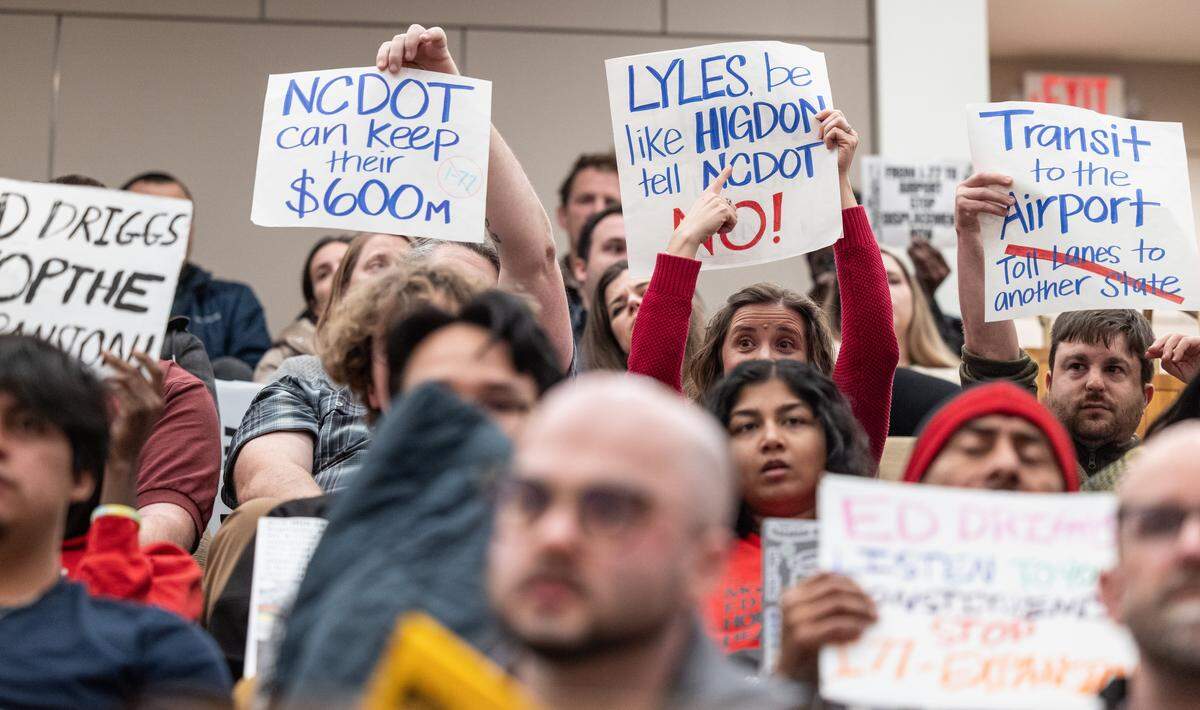
Charlotte City Council members are nearly unanimous in their calls to halt the project for 60 days. But City Attorney Andrea Leslie-Fite said they do not have authority to unilaterally make that call.
The council intends to vote during its retreat on Monday to direct Councilman Ed Driggs to initiate CRTPO action to pause the project. Driggs is the only council member who indicated he will not support City Council’s motion.
“I’m in kind of a tough spot because some of my colleagues are very concerned about the passion of the opponents and want to be responsive,” Driggs told The Charlotte Observer. “I do too, but I’m in the position as the Charlotte delegate to consider NCDOT’s side of the story.”
According to Driggs, the CRTPO had until August to revoke its agreement on the funding mechanism. The board’s attorney with Shah-Khan Law confirmed Driggs’ statement.
Altman asked CRTPO’s attorney in January whether the board could pause or cancel the funding agreement.
On Friday, the board’s on-call attorney with Shah-Khan Law said no to both requests. The board can’t cancel the resolution because it missed the agreed-upon August deadline. And the board can’t call for a delay because it has no further say in the project, according to the attorney’s memorandum.
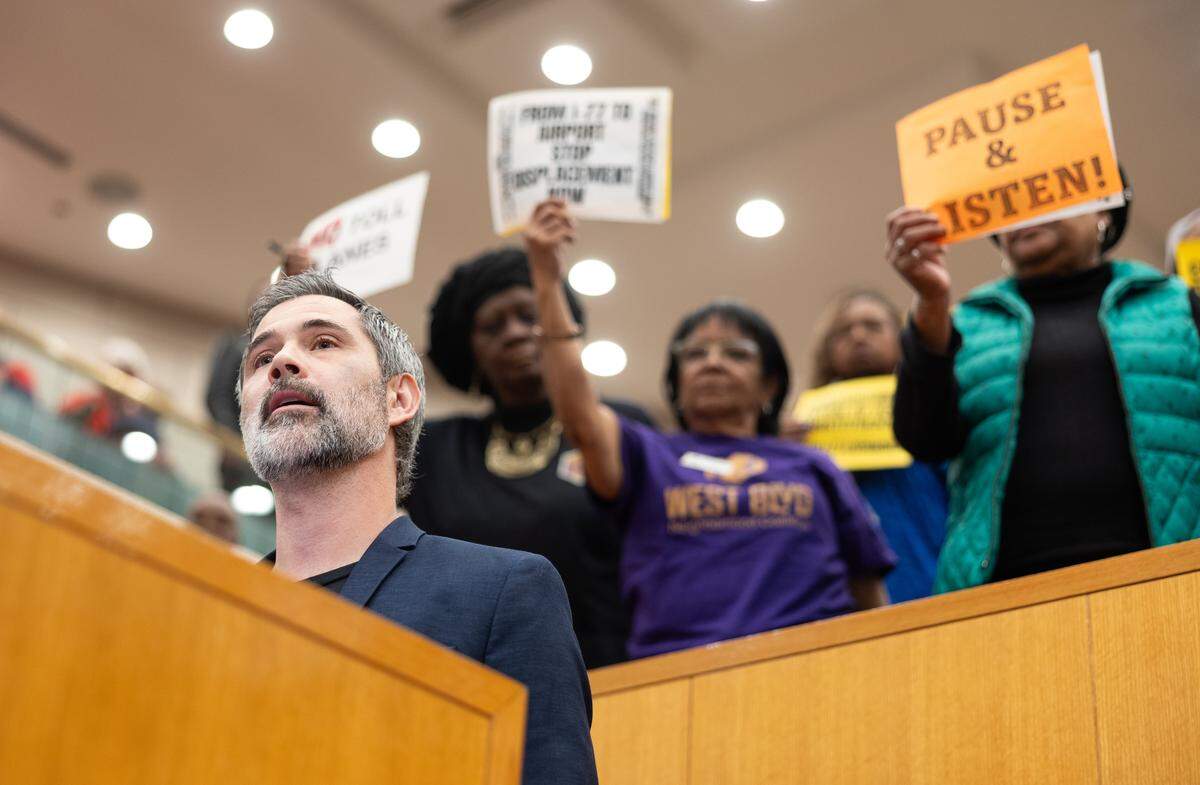
Altman said the attorney provided no legal rationale or statute behind the conclusion. She added that the board’s question of whether the funding resolution could be legally rescinded was not answered.
The board will likely discuss the attorney’s response and next step at its March 18 meeting. Altman previously said if the board couldn’t rescind the funding resolution, the next step would be going to the state’s Secretary of Transportation Daniel Johnson.
“There may be a finding that they can (pause the project) but we need to think hard about whether we should,” Driggs said. “You lose $600 million of state funding for a critical local road project. Do you want to walk away from that?”
Would the Charlotte region lose $600M if it paused the project?
If the project doesn’t move forward, the $600 million would go back to the statewide fund and be distributed to other projects, according to NCDOT spokeswoman Jen Goodwin.
NCDOT did not answer whether a pause would eliminate the funding or if a pause can happen at all.
A pause could be risky, according to Anthony Foxx, the former mayor of Charlotte and U.S. Secretary of Transportation under the Obama administration. He previously served on the CRTPO when it served only Mecklenburg and Union counties.
In Foxx’s experience, CRTPO could decide to stop a project but would face repercussions for doing so.
One big risk was the state deprioritizing and pulling future funding from the project. Pausing, rather than stopping, the project could also jeopardize its spot in the prioritization line, Foxx said.
“For the locals, it’s often a very, very tough choice to either accept money for some optimal project or reject it with no timeframe by which you could see the project come back,” Foxx said. “My strong guess of what they would be told is, ‘Well, OK, you could do that, but now your project’s going to go more or less to the back of the line.’ ”
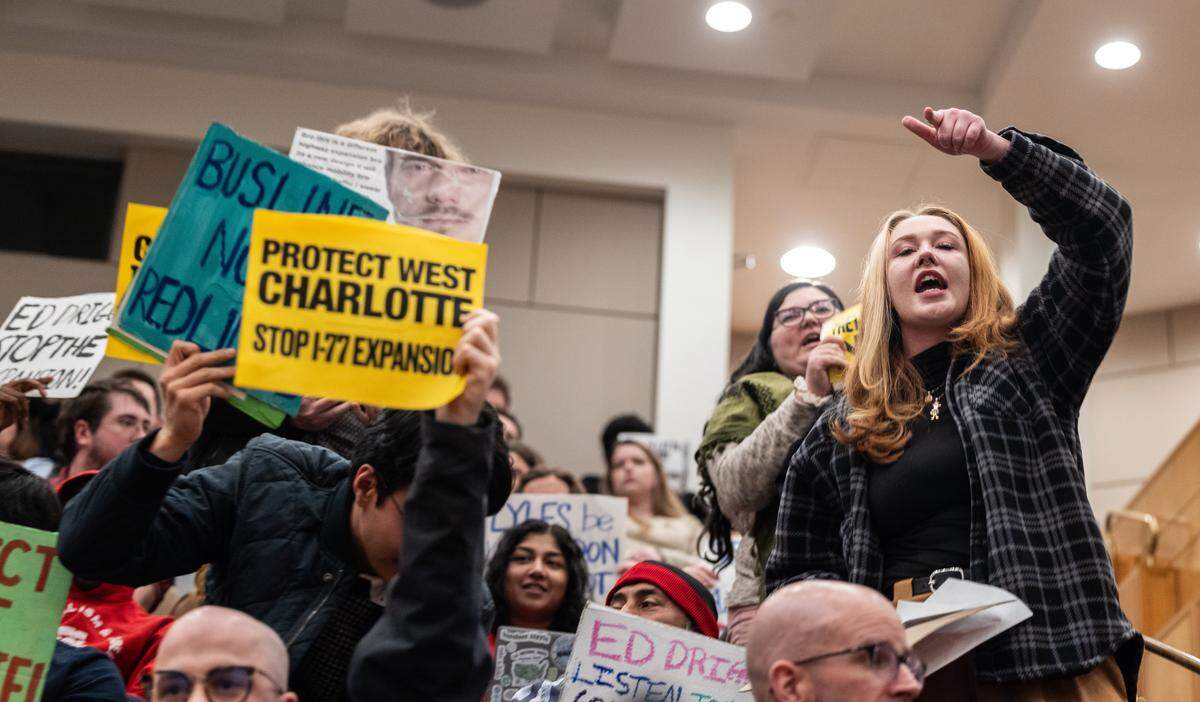
In January, Charlotte Mayor Vi Lyles said in a statement that she is working closely with the NCDOT secretary to make sure community concerns are incorporated into the plan.
In a letter to Lyles, Secretary Johnson said NCDOT was “committed to doing things differently than they were done in the past.” It’s unclear how the agency will do so.
What are the next steps on the I-77 project?
NCDOT released a shortlist of four contractors who could work on the project. One is Ferrovial, the parent company of Cintra.
When asked why NCDOT would include Cintra on the shortlist, considering the problems it has had with the developer during the I-77 North project, the agency said it picked “four strong teams as part of a competitive bid process.”
On March 13, NCDOT will send developers its requests for proposals on the project. Opponents of the project want to pause the project before then.
If all else fails, City Council members said they would use their influence as elected officials to nudge NCDOT in an agreeable direction or call on Gov. Josh Stein to intervene. Stein’s office did not respond to a request for comment on what, if anything, he would do.
It is “theoretically possible” for the governor to intervene but would be “highly unusual,” Foxx said.
Governors delegate day-to-day decisions on specific issues, like transportation, to their respective departments and rarely supersede their judgment.
“It’s very much not something that happens,” Foxx said.
NC Reality Check reflects the Charlotte Observer’s commitment to holding those in power to account, shining a light on public issues that affect our local readers and illuminating the stories that set the Charlotte area and North Carolina apart. Have a suggestion for a future story? Email realitycheck@charlotteobserver.com
This story was originally published March 2, 2026 at 5:20 AM.