Optimist Hall has almost everything — why not more Black business owners?
When Barry Greene reached out about leasing space in Optimist Hall last year, the agent on the phone didn’t even pretend to seem interested, he said.
“There was no ‘I’ll keep you in mind’ or ‘what’s your contact information?’” Greene recalls. “It was just like, no effort.”
He hasn’t been able to forget the experience, even though it’s not an uncommon one — Greene said such is the life of small Black business owners in Charlotte. In September, Optimist Hall announced a new retail offering in Paradiso Plant Shop, a store similar to Greene’s Shades of Moss, which Greene was hoping to open in Optimist Hall last year.
When Optimist Hall opened in 2019, it was billed as a space that lifted up local business owners and satisfied both picky eaters and adventurous foodies.
But Black Charlotteans have questioned the food hall’s diversity since its inception. Optimist Hall will welcome its first Black tenant this winter.
“We need another Optimist Hall but in Black,” one person tweeted last September. Months later, local photographer Josh Galloway tweeted, “Optimist Hall still doesn’t have a black-owned food joint in there.”
As Charlotte grows, its businesses do, too. Charlotte is home to 10,500 small businesses with 25 or fewer employees, according to the city.
But Greene sees a lack of representation for Black entrepreneurs in the city’s business community.
Charlotte’s a city with a legacy of destroying Black businesses. In the 1960s and 70s, Brooklyn, a thriving hub of Black commerce, home-ownership and culture, was demolished in the name of urban renewal, and its impact echoes through the city still today.
In Charlotte, dead last of major U.S. cities in socioeconomic mobility outcomes, residents can’t accumulate wealth without a foundation, and with no anchor, longtime, mostly Black residents are getting swept away in soaring property values and rent costs.
“Charlotte’s 35% Black,” Greene said. “So why doesn’t it feel like that? Why is it when I walk into businesses, the owners never look like me?”
That’s on display inside Optimist Hall.
While an Optimist Hall spokesperson reported that approximately 35% of their tenant mix is minority-owned and that they’re “looking to expand” on that diversity in the future, none of their current tenants are Black. The first Black business owner joining the space will be Tehetina “Tina” Tedla, owner of Enat Ethiopian, this winter, it was announced this week.
An Optimist Hall spokesperson said that the food hall doesn’t share information on tenant selection and leasing processes but said just under half of the current businesses are Charlotte-based.
Greene says he was told last year “a generic ‘We are currently fully leased for retail.’”
A year later, a plant shop owned by an Atlanta business is opening where Greene saw opportunity in Optimist Hall.
Greene did manage to find a place eventually, but because of uncertainty brought on by the pandemic, Greene didn’t renew the lease.
Right now, Shades of Moss just exists as a self-serve kiosk at The Pauline Tea-Bar Apothecary in west Charlotte. Customers can pick up plants through a contactless experience.
It’s a temporary way to keep Greene’s name out there until he finds a place in Charlotte to put down roots.
From plant to place
A houseplant hobby grew into Greene’s new business venture during the pandemic.
Greene, a Richmond native, moved to Charlotte from Brooklyn, New York, five years ago. He worked in retail and finance for a decade before deciding to start his plant business in 2020.
It was an unexpected pleasure, he said, decorating his home with plants after moving to Charlotte. An Instagram page he started became very successful — that’s when he realized there was a community here that needed something “a little bit more.” He hoped they’d find it in a plant store.
Last spring, he started looking for space. It was more difficult than it should have been, he said, during the pandemic.
“There should have been so much availability,” Greene said.
After being passed over at Optimist Hall, Greene took Shades of Moss to Elizabeth.
“Now, if you walk around there’s a plant shop at almost every corner in Charlotte,” he said. “But then, I was one of maybe two or three brick-and-mortar locations.”
Customers got to interact with him, the owner, one-on-one. They’d bring in their plants, sit on his couch and get his advice on how to make them thrive.
“It felt like you were in my living room,” Greene said. His favorite part was when customers brought back pictures of revived monsteras and pothos.
Black-owned spaces allow Black customers to feel at home, Greene said. The customers that shopped at Shades of Moss admired houseplants to 90s R&B tunes — without being followed around the store because of suspicion.
“I would have mothers bring their kids by and tell them that this is what it’s like to own your own business. That made my day — to see little Black boys to be able to have a conversation with me, that you can step outside of the niche that they box us in,” he said. “I did have people come in there and didn’t know I was the owner… because the aesthetics didn’t scream out Black-owned. I just wanted them to feel at home.”
Some Black business owners in Charlotte never even get the chance to make it to a storefront.
Roquiya Baymon inquired about leasing a space for her plant and candle business in Optimist Hall last June. Her pop-ups at Lenny Boy Brewing sold out within a few hours every time, and she figured it was time to expand.
After hearing that Baymon didn’t already have a storefront, the leasing director Shelbi Bodner said the partnership wouldn’t be possible, according to emails Baymon shared with the Observer.
“Unfortunately, the only spaces we have left are for restaurant only. We also only lease to proven, existing concepts so we couldn’t do a first time venture here,” she replied via email. “Best of luck in your search!”
The Observer emailed Bodner to ask about leasing practices at Optimist Hall. She didn’t reply. Instead, a representative from Sprouthouse, a branding and media relations company, reached out with data on tenants.
Optimist Hall wasn’t the only place to turn her down.
“A lot of places did not want to lease a space to me because I was a new business. That’s just like with a company saying, ‘You have to have experience.’ I can’t get experienced if no one would hire me,” she said. “It’s just impossible.”
Right now, Baymon is focused on making her handmade candles, creating a website for Noire Oasis and continuing her pop-ups around town. Hearing that Optimist Hall is just now welcoming its first Black tenant isn’t surprising, she said.
“Charlotte is and up-and-coming city. You would think that they would be offering more opportunities to Black businesses, but I’m realizing that Charlotte has gatekeepers,” she said. “And I see great amount of Black people spending their money at Optimist Hall, but they don’t want Black people to make money.
“I feel like that’s the culture here in Charlotte.”
Businesses in Optimist Hall
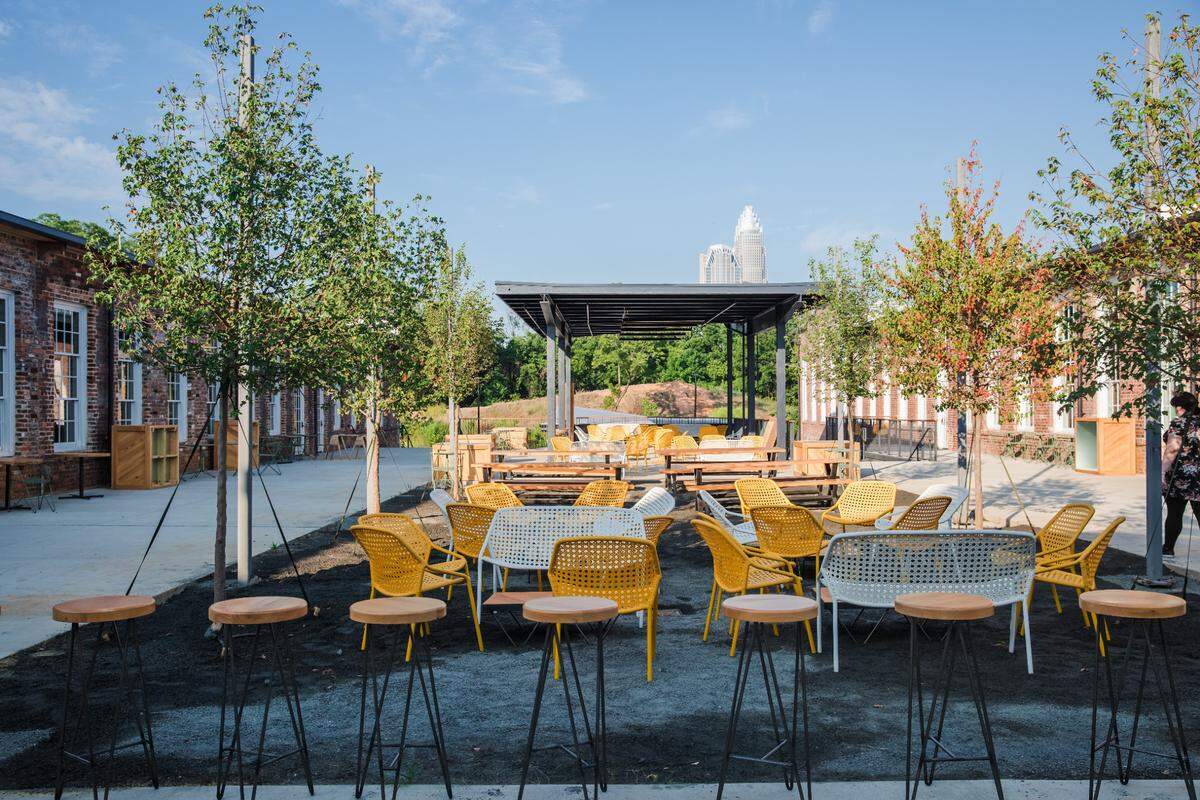
When visitors step into Optimist Hall, they’re greeted with the smells of spicy pork belly dumplings, chicken tikka tacos and fried chicken sandwiches.
Despite the pandemic, around lunchtime and on the weekends, it’s hard to find sitting room at Optimist Hall — its amenities are that high in demand.
Of the hall’s 23 current businesses listed online, around a third are owned by people of color — though none of them are Black.
The hall just announced that three new businesses will join the space in the upcoming months: a plant shop owned by the same Atlanta-based company that owns Archer Paper Goods and Collier Candy Company; Enat Ethiopian (Optimist Hall’s first local Black-owned business, which will open this winter); and Noble Smoke, owned by Charlotte’s Jim Noble.
The decision to add Noble Smoke to the space has drawn criticism — Noble spoke out in 2015 in favor of North Carolina’s infamous and later replaced House Bill 2, which restricted people who identify as transgender from using the bathrooms they wished and barred North Carolina cities from passing nondiscrimination ordinances.
Jim Noble refused to comment on renewed criticism sparked by the Optimistic Hall announcement.
The majority of businesses in Optimist Hall are from out of town — ranging from Chicago and Atlanta to other North Carolina cities. A spokesperson said that Charlotte-based businesses represent 46% of the tenants.
For Greene, seeing the announcement about the plant company felt like a slap in the face.
Brick-and-mortar locations can make or break a business, he said, especially when it comes to Black-owned businesses.
“It’s one thing to have an online platform, but when you have your space, you have something that you can physically walk into that can’t really be taken from you. I really stand behind that,” he said. “I understand not wanting to be in the politics of things… but how do you stay neutral when there are no Black-owned businesses, and then you invite other tenants that are known for bigotry and known for being vocal in all the wrong places?”
There are many local Black food truck owners, photographer Josh Galloway said, that would better suit the space.
“Food is a big gateway to community,” he said. “So many Black food trucks with amazing food barely have parking space or street space to serve it. The majority of Black people in the city don’t feel comfortable at breweries, but that’s the only space food trucks can occupy.”
Galloway said it’s small business owners and creatives that help make Charlotte the city it is — so the city should do a better job of accommodating them. Galloway refuses to take meetings at Optimist Hall anymore.
“As a Black business owner, you really don’t have value unless you have a physical space,” he said. “Unless you have an address, you’re not seen as valuable.”
‘Saw it coming’
While Galloway lived in Charlotte’s Optimist Park neighborhood for a year, he witnessed the slow rot of gentrification firsthand — and the creation of Optimist Hall.
“I saw it all coming,” he said.
The year before it was built, Galloway lived in 300 Optimist Park apartments. He loved the view from his one-bedroom — he always wanted to live close to uptown, and as someone who has to be creative for a living, the space was motivating.
But he also knew as a Black man, Galloway said, he had to show respect to the neighborhood and the people who lived there decades before him. However, it was clear some of his neighbors who moved in around the same time didn’t feel the same.
With the addition of the light rail and the area’s proximity to uptown, more than 1,000 white people have flocked to the historically Black neighborhood since 2010. Optimist Park saw its white population increase by 461% over the past decade, census data revealed, while Black residents living there increased by just 21%.
Longtime residents of Optimist Park would often use the apartments’ parking lot to get to the light rail, making the new tenants uneasy, Galloway said.
“I would see moments why people would feel uncomfortable,” Galloway said. “But this is their neighborhood. You moved here.”
One food and retail space that has tried to get it right is Camp North End, Galloway said.
The new repurposed industrial space is home to more Black artists, restaurants and retail spaces.
“Look at Leah and Louise,” Galloway said, referring to Greg and Subrina Collier’s Southern juke joint-inspired spot. “That was named some of the best food in the country. You see what happens when you allow Black people to occupy space?”
Still, it’s not clear yet whether Camp North End has planted the first seeds of gentrification in the surrounding community.
A year has changed a lot for Greene — he’s going to be a father in a few months.
He plans on making moves with his plant business again soon. But not everyone has the resolve to try again. Many Black businesses are leaving Charlotte because the city refuses to give them space, Greene said.
“I just want us to be valued more as local merchants, because otherwise we’re gonna move,” he said. “We’re going to go to Atlanta, to Richmond, to Pittsburgh, to Denver — the cities that are at least open to us having space.
“It’s just sad because I feel like these are all just missed opportunities.”
This story was originally published October 1, 2021 at 6:00 AM.