Growing up Chambers: What it means to walk in the footsteps of a civil rights giant
READ MORE
Living Black History: A new generation rises in Charlotte
For this year’s Black History Month, we’re exploring Charlotte’s Black history through family legacies, young leaders and more.
Expand All
Growing up Chambers: What it means to walk in the footsteps of a civil rights giant
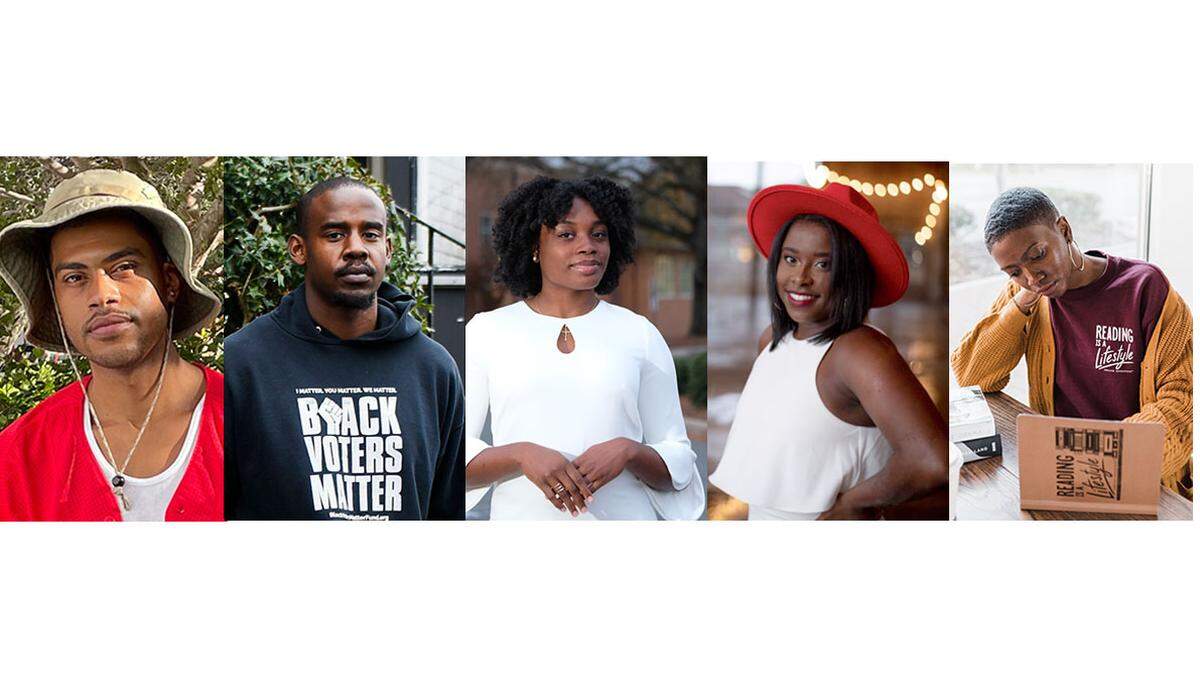
Black history is alive — and these 5 Charlotteans are helping shape it
Have battles over critical race theory had a ‘chilling effect’ in Charlotte classrooms?
Do you know these Black leaders who shaped Charlotte’s history? Take our quiz.
When there’s a break in the traffic, Derrick and Myles Chambers run across South Kings Drive.
They step onto the paved area surrounding a large fountain on this section of greenway in Charlotte known as “The Trail of History.” Here, the father and son stop.
Before them, the life-sized man of bronze is bespectacled, and he carries a briefcase as he firmly plants his left foot ahead of the other.
History, legacy and family collide as a woman walking two goldendoodles near the statue calls over: “Are y’all related?”
Derrick’s mouth quirks up a little in a soft smile.
“Yes ma’am,” he says, voice deep. “That’s my father.”
Dad, Papa, Hero
Few Charlotte heroes of the civil rights movement are as well-known as Julius L. Chambers.
His storied career of advocacy and legal victories for racial justice included taking eight cases to the U.S. Supreme Court — and winning all of them. Born in rural North Carolina, he co-founded in the ‘60s the state’s first integrated law firm, where he’d spend his life helping Black Americans fight discrimination at school, in housing and at work.
Derrick, 55, has had a lot of time to get used to his father’s legacy. Ask him about what his father did and pride shines in his eyes. He was just a young child at the height of his father’s legal career — making him Derrick’s idol, not just his dad.
“My dad was my hero,” he said. “I didn’t tell him that enough.”
Julius Chambers died in 2013.
Myles had his grandfather only for nine years.
While many think “hero” or “icon” when they see the statue (or buildings and a part of Interstate 85 named for Julius Chambers), Myles knew him simply as “Papa.”
Now 17, Myles remembers a loving and often silent grandpa who came to his peewee football games and took him on his boat.
Unlike his father, Myles is just now starting to grow into his family’s history, and he’s starting to feel the pressure of his last name.
“I know I have a duty to make sure everybody is treated equally,” Myles said. “I don’t want nobody to feel like they don’t have equal rights as everybody else.”
For both Myles and Derrick, their earliest memories of understanding Julius Chambers’ legendary status stem from time spent in his law office.
“My first time realizing who my grandfather was, I remember one day he got me from preschool and he took me to his office,” Myles said. “I was with him for most of the afternoon and people would just come up to him to talk to him.
“Even though I was young, I was like, ‘Wow. A lot of people know my Papa.’”
Decades earlier, Derrick — at a similar age — had come to the same realization. But back then, Julius Chambers wasn’t a universally admired hero as much as he was the target of racist attacks.
Making his own footsteps
The year before Derrick was born, his father’s car was destroyed by a bomb and his family’s home was attacked with explosives. At the time, Julius Chambers was working on the case of Swann v. Charlotte-Mecklenburg Board of Education, arguing that public schools had failed to follow federal law and desegregate. His victory in the legal fight ultimately led to integrating schools in Charlotte, and in other places, through mandatory busing plans.
Six years later, in 1971, his law office was firebombed.
“I knew my father was pretty famous when I was about 4 or 5 years old, when his office was attacked,” Derrick says.
Derrick grew up seeing his dad on the 6 o’clock news and in the Charlotte Observer. And Derrick will never forget when his father visited then-President Jimmy Carter in the White House. He still has a signed picture of the occasion — it’s framed at his house.
But he also remembers the father who took him on long car rides on quiet Carolina evenings, sharing priceless wisdom. As Derrick grew up, they switched spots and Derrick chauffeured, but it didn’t change the sanctity of that time with his father.
“When you’re 5 years old, you’re just amazed at the bright lights and all the attention. I really didn’t understand back then. I had an idea, but I really did not understand the effects of his work and what he had done throughout his career and what it meant for the civil rights movement,” Derrick said. “But as I’ve grown older, I fully understand … what his work meant.”
Along with a deeper understanding of his father’s work, there’s been a deeper realization of the expectations laid out for him.
And Derrick hates disappointing people.
“A lot of times, people try to compare you to your father or whomever in your family that is pretty famous, so you have to measure up,” he said. “And everybody is not built for that. You worry about disappointing people … that pressure is something that you have to live with day in and day out.”
That’s why he decided to do something totally different. Derrick avoided practicing law — he knew there would be no way to live up to his father’s legacy. So he went into law enforcement, which is what he did for nearly three decades.
“Sometimes you got to make your own footsteps,” he said.
Myles’ hero
Myles Chambers has big dreams.
After he graduates from Mallard Creek High School next year, he wants to play football in college and travel the world after majoring in sports marketing. He likes to play basketball video games after school and hang out with his friends. And his favorite music is by artists like Jeremih and North Carolina native J. Cole.
Myles’ football coach Kennedy Tinsley says the defensive lineman is a leader on his team — he’s even won an award for his leadership skills.
“As a coach, you immediately know or see which players are really, really, really committed. And there’s all the kids that have different talent and ability. But what’s most important is that you need a large number of committed athletes,” Tinsley said. “And Myles was committed from Day 1.”
And next year, Myles’ senior year, Tinsley hopes he takes on an even bigger role as a leader on the team.
“Leadership, it just feels so natural to me,” Myles said. “My dad, he’s built me up to the standard.”
“The hardest part is that people want me to live up to (Julius Chambers’) standards,” Myles said. “But the best thing is that a lot of people support me and my family.”
When Myles was born, Derrick took him to his father’s law office, the same one where Derrick ran up and down the halls as a kid. He proudly showed off his new son, and his father’s colleagues laughingly said, “’I hope he isn’t gonna be like you,’” Derrick remembers.
Derrick knew they were teasing. But he still tries to make sure Myles doesn’t “drift off” too much. “I try to keep him grounded,” he said.
With Derrick’s help, Myles honors his grandfather’s legacy and chronicles Julius’s accomplishments often for school history projects, and calls him his “hero.”
“My father loved his grandkids dearly,” Derrick said. “If you wanted to put a smile on his face, you would talk about his grandkids.
“So I know he was happy that he had a grandson to carry on his name.”
‘Proud, proud, proud’
In the last four years especially, Julius Chambers has been honored in numerous ways throughout Charlotte.
Last year, the former Vance High School was formally renamed after Chambers and a law introduced by U.S. Rep. Alma Adams changed the name of the Derita Station Post Office to the Julius Chambers Civil Rights Memorial Post Office.
The latest reminder of his legacy is the statue, which was installed Oct. 30, 2021. At the time of the statue’s unveiling and ceremony, his son said: “The feeling is hard to put into words. His lifelong work that he did for mankind … you can see now that people appreciate it so much.”
Three months later, ahead of Black History Month, Derrick and Myles returned to the place where Chambers’ statue permanently memorializes his life.
“Sometimes I cry. It’s just elated joy,” Derrick said. “I’m grinning now. … These last few years have been something for me and my family. It’s just proud, proud, proud.”
But Derrick wishes his father had “gotten his flowers while he was living.”
“To see how much people appreciated his work and that his work didn’t go in vain,” he said. “... To be recognized like that ... we may be dead and gone, but the statue will still be here. That’s a legacy within itself.”
Derrick said he’s tried to shield Myles from some of the pressure that comes with being a Chambers. But recently, he’s clued him in more and more to the importance of his grandfather’s legacy — and has been pushing him to come into it.
“I make sure that he understands being a Black male and his role that he has to play,” he said. “I try to keep him staying humble.”
Though he respects Myles’ goals, as he looks at the world around them, Derrick fears more and more that Myles and his generation will have to step into their own legacy. He tells him so, on the drives they take now as father and son.
“I see this country slowly going backwards in time. I’m letting him know to be more serious about things in life and that he needs to have a better understanding, especially as a Black man in America, about the times and the struggles that my father had to go through,” Derrick said. “We may have to go back into this fight, but this fight is gonna be different this time.
“What worries me is that he has to get himself ready for that … this is what he has to understand: This is time for him now to get ready to pick up that mantle. Because this fight is never going to be over until the old way of thinking is no longer there.”
Derrick and Myles have decided they’ll be visiting Julius’ statue together more often.
While standing nearby it recently, Myles said: “I could never have fear in carrying on the name. But it’s a lot of … what’s the word?”
Myles cocked his head, looking expectantly at Derrick, who replied:
“Responsibility, son.”
This story was originally published February 13, 2022 at 6:00 AM.