Here are 3 ways Charlotte found that could improve its transportation connections
READ MORE
Trust in transit?
Charlotte plans transit expansions. But riders ask: Where’s the reliability?
Expand All
How transit-friendly is Charlotte? I (mostly) left my car parked for a week to find out

Charlotte plans transit expansions. But riders ask: Where’s the reliability?
Here are 3 ways Charlotte found that could improve its transportation connections
CATS wants on-demand rides to replace some transit routes. Are LA, Philly good examples?
How CATS can repair its broken trust in North Mecklenburg and get a ‘yes’ on transit tax
Seven years ago, Alan Sussman was on a bicycle ride a few miles from his uptown home when a car slammed into him.
The car was making a left turn as he biked along his regular route on streets he purposefully chose because of lower traffic volumes and relative safety. Sussman believes his helmet saved his life on that August morning as he rode by the intersection of Thomasboro and Bradford drives.
Over the next year or two, Sussman learned to get around by wheelchair as he recovered from his injuries. He relied on buses and the light rail, both in Charlotte and Atlanta where he was seeking medical treatment.
Charlotte is looking to improve both its bus and rail systems over the next 20 years as it seeks to make them faster and more reliable. That fits into a city goal for people to rely less on cars to get around and more on other ways like walking, biking and riding public transportation.
Below is a look at three key connectivity issues facing CATS, as outlined in the Strategic Mobility Plan, a 164-page document outlining the city’s vision for safer and more equitable mobility. The plan was adopted by City Council in June.
Bike friendliness and bike score
How does Charlotte fare when it comes to bicycle friendliness? Well, not too well, according to the mobility plan.
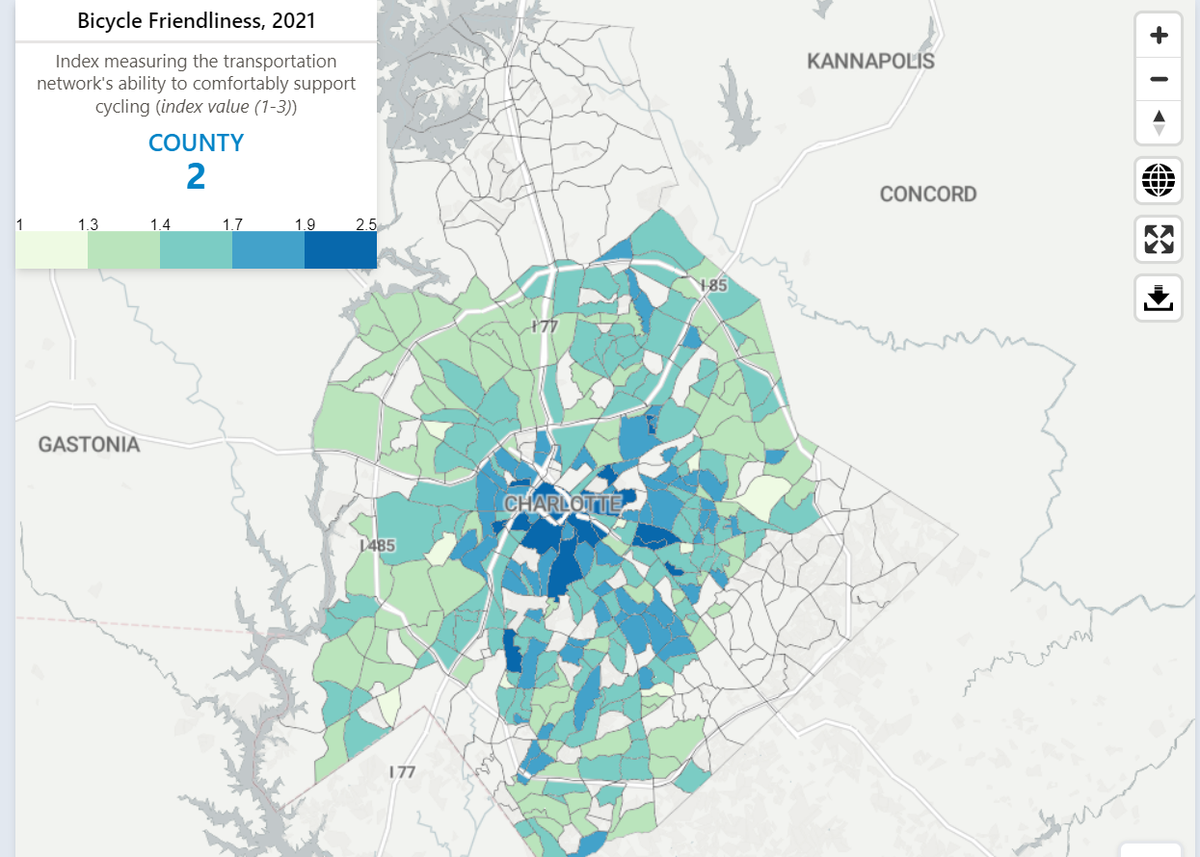
A map included in the mobility plan shows bike friendliness scores across the city calculated by street speeds, bicycle lane miles and greenway and multi-use path miles.
Measured by an index number of 1 (least friendly) to 3 (most friendly), Mecklenburg County’s average score was 1.5. The most bicycle-friendly areas tended to be closer to the center city.
A similar map found that areas that weren’t uptown or in neighborhoods to the south did not have good access to bike facilities like greenways and protected bike lanes.
There were no bicycle lanes in the city of Charlotte before 2000, according to the Charlotte/Mecklenburg Quality of Life Explorer. The explorer looks at social, economic, safety and other conditions in the Charlotte region. It’s a collaboration between the city, county and UNC Charlotte Urban Institute.
There now are more than 144 miles of bike lanes and close to 60 miles of signed bike routes.
Speaking of bike scores, Charlotte ranked below Austin, Texas, Minneapolis and Denver on a bike score calculated by measuring things like road connectivity and the number of bike commuters, according to the plan. Charlotte, did, however, rank slightly higher than our friends in Nashville, Tennessee.
Street connectivity
Charlotte didn’t have good scores in the street connectivity category either.
Higher street connectivity scores mean an area has more ways to get to local stores or services. Higher scores also mean there are more route options when traveling throughout the county.
Better connected neighborhoods tend to be more walkable, more bike-friendly, are easier to serve with transit, have less congestion and have more efficient response times for emergency services, according to the Quality of Life Explorer.
In 2018, the average index score in Charlotte was 1.16; the city has a goal to reach an average of 1.4, though it’s not clear from the mobility plan when that goal is set for.
Uptown had the highest scores, according to the map.
Sidewalk coverage
There are more than 250 miles of streets that lack sidewalks on at least one side across the city’s street network, according to the mobility plan. Countywide, there are more than 2,400 miles of streets with adjacent sidewalks in Mecklenburg, according to the Quality of Life Explorer. That’s 44% of all paved streets.
That lack of coverage disrupts the ability of pedestrians to get around. It also creates safety and accessibility issues for people in wheelchairs or those pushing a stroller.
“These gaps are often in our more suburban areas where the existing street connectivity is limited and/or still being completed through development, further constraining pedestrian access,” the mobility plan states.
The plan calls for building out sidewalks along higher-volume streets among other smaller, connector streets.
Challenges remain
As for Sussman, his experience recuperating gave him insight into how connected Charlotte and Atlanta are from a public transportation viewpoint.
“I will tell you that the Atlanta system was eons better than CATS at the time,” Sussman said, referring to Charlotte Area Transit System, which runs the buses and light rail system.
Since his 2015 injury, CATS has made some improvements when it comes to challenges Sussman and others encountered. One example is that a one-way CATS ticket works for both the bus and light rail. That wasn’t the case when Sussman was taking public transit about five or six years ago.
But other examples still stand out, like a light rail not going to the airport.
For Sussman, the issue of a better-connected public transportation system comes down to convenience. “People don’t use the system if it’s not convenient,” he said.
Sussman is back on the road, only this time he rides his three-wheel, recumbent bicycle on greenways, away from cars and mostly for exercise. He points to how other cities have more bike-only lanes that are clearly divided from car traffic.
“In Charlotte, we just don’t have that,” Sussman said. He believes the system can get there one day, especially in a growing city like Charlotte.
This story was originally published November 17, 2022 at 6:00 AM.