Charlotte plans transit expansions. But riders ask: Where’s the reliability?
READ MORE
Trust in transit?
Charlotte plans transit expansions. But riders ask: Where’s the reliability?
Expand All
How transit-friendly is Charlotte? I (mostly) left my car parked for a week to find out

Charlotte plans transit expansions. But riders ask: Where’s the reliability?
Here are 3 ways Charlotte found that could improve its transportation connections
CATS wants on-demand rides to replace some transit routes. Are LA, Philly good examples?
How CATS can repair its broken trust in North Mecklenburg and get a ‘yes’ on transit tax
When Chris Wallace needs to get uptown from his home in Cornelius, the 20-mile trek can take two hours.
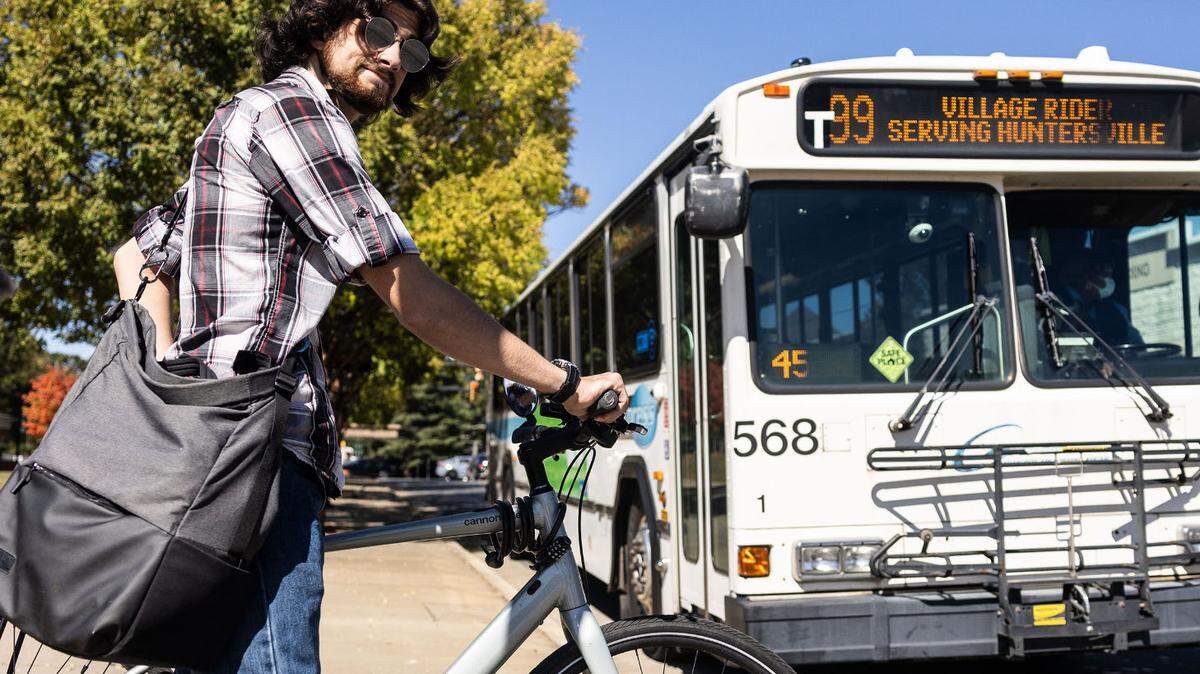
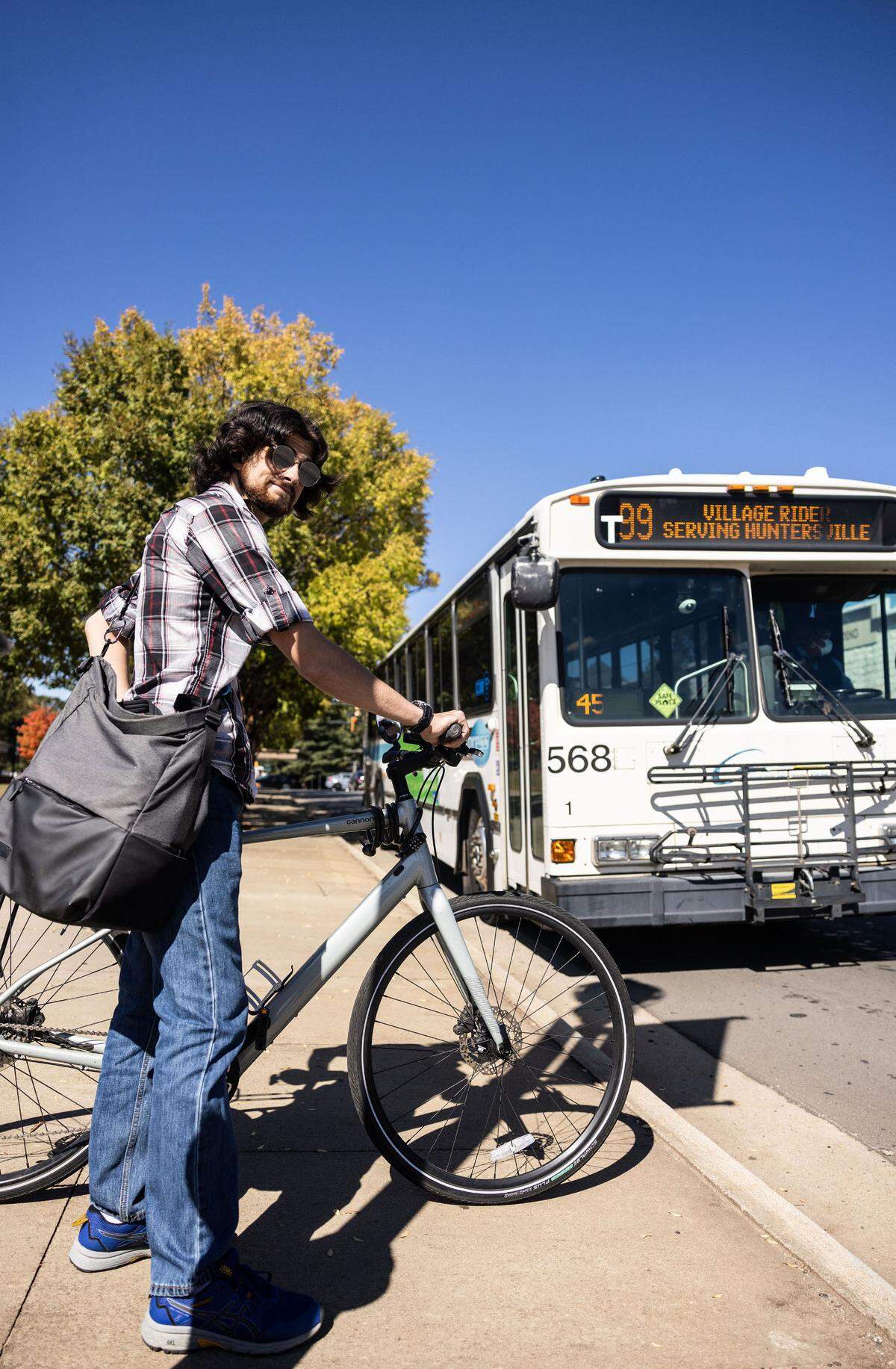
Wallace doesn’t own a car. So the luxury of hopping on Interstate 77 isn’t an option. Instead, his journey starts by riding an electric bike to the bus stop.
If it’s raining, he stands in mud while he waits for the bus — if it ever comes. There’s no covered area at his bus stop — just a metal pole on the side of the road displaying the route number.
When the bus arrives, Wallace attaches his bike to the front of the mostly empty vehicle and shows his fare pass to the driver before taking a seat. When he arrives uptown — sometimes still dripping from rain or the heat — he takes his bike and goes about his day.
Wallace is among the quarter of all Charlotte workers who don’t rely on a car to commute. His frustrations have gotten him thinking about ways to solve Charlotte’s transit problems, including creating his own bus routes.
.png "image (40).png")
Charlotte’s strategic mobility plan includes a proposal for 1,000 more miles of high-frequency routes to strengthen commutes for people like Wallace. But those routes have no completion date.
The city’s and Charlotte Area Transit System’s long-term plans for the future prioritize rail, streetcar and light rail. Riders and experts says CATS needs to prioritize bulking up its bus system instead to ensure a consistent, reliable service for all Mecklenburg County residents.
CATS’ plans for rail remain stagnant
Despite buses moving 60% of CATS ridership, the city’s plans for rapid transit corridors built in 2030 is largely focused on rail.
Charlotte’s strategic mobility plan calls for 25 miles of commuter rail, 38 miles of streetcar and light rail and 27 miles of bus rapid transit complete by 2030.
Those plans include:
▪ MetroRapid Interstate 77 Bus Rapid Transit — a 27.4-mile bus corridor in I-77 express lanes with four new park and rides.
▪ LYNX Silver Line — a 26.6-mile light rail corridor that would run from Belmont to the Central Piedmont Community College Levine Campus in Matthews, passing Charlotte Douglas International Airport on its way.
▪ LYNX Red Line — a 25-mile commuter rail corridor with 10 stations and nine park-and-rides in north Mecklenburg County. An extension into Iredell County would require regional support, but the line has remained stalled for more than two decades.
▪ CityLYNX Gold Line extension — extending Charlotte’s streetcar 6 miles with 20 additional stops from the Rosa Parks Transit Center on Beatties Ford Road to the former Eastland Mall.
▪ LYNX Blue Line extension - a 5.5-mile light rail extension with five new stations through Pineville and Ballantyne.
Ron Tober, CATS’ first chief executive from 1999 to 2007, said Norfolk Southern in the early 2000s wasn’t opposed to having commuter rail on its lines. That changed when Norfolk Southern management changed and relations between the rail company and North Carolina soured, Tober said.
With delays to long-promised plans for north Mecklenburg towns, some residents and officials are unsure whether the Red Line will move forward.
“I think there’s a level of looking towards the future and laying a foundation,” Charlotte City Councilwoman LaWana Mayfield said. “A goal of wanting to have a robust system is good, but commitments can’t be made to a rail line we don’t own. It gives a false sense of how we’re going to move forward.”
Giovanni Trevisan, owner of Slice House Pizza in Huntersville, can see the Norfolk Southern rail that would be used for the Red Line when he steps outside of his restaurant.
“Would it be great? Yeah,” Trevisan said. “I just don’t see it happening.”

Rail replacement service in the interim?
Ely Portillo, who now works for WFAE and formerly was research engagement director at the UNC Charlotte Urban Institute, offered a short-term solution: expanding the bus fleet to include more bus rapid transit. That typically means dedicated bus lanes on roads.
Bus service is significantly less expensive than rail because it requires less infrastructure to build. Even a brand new electric bus is cheaper than building a new light rail line.
“There’s a lot that you can do to connect more suburban areas short of building a dozen light rail lines that will take decades,” Portillo said.
This solution would help riders such as Wallace, whose north-south bus route is so inconvenient that he dreamed up another route himself.
Wallace designed a fixed-route bus line on Google Earth that goes along North Carolina Highway 115 from Davidson College to Bryton Town Center in Huntersville. It would serve north Mecklenburg towns who pay a 1997 half-cent transit tax and haven’t received investments to match, Wallace said.
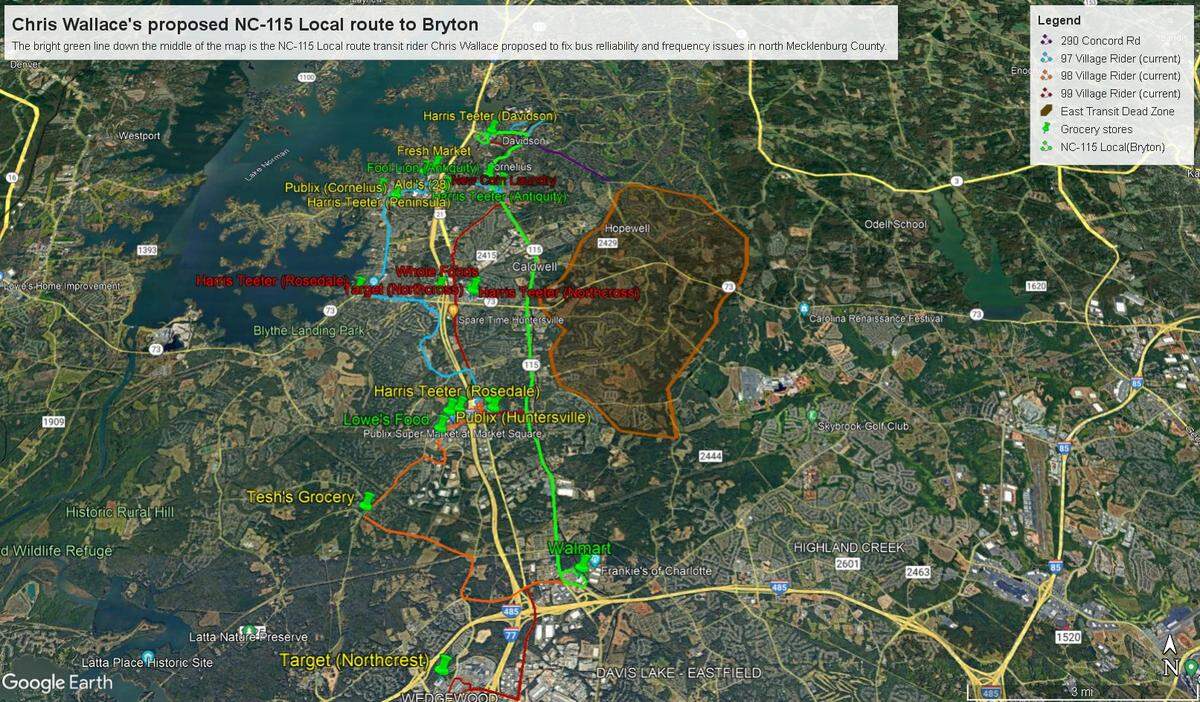
The existing north-south bus line on I-77 goes to park and rides, but doesn’t serve businesses, employment centers and neighborhoods that need it most, Wallace said.
“For the vast majority of people it feels like we’ve been paying for decades but getting nothing useful,” Wallace said. “The biggest change that needs to happen is the implementation of at least one good frequency fixed route service.”
Wallace didn’t stop with designing one bus route; he designed an entire extended bus service for his community in north Mecklenburg with stops in denser subdivisions and grocery stores.
He’s since shared the ideas with northern Mecklenburg town planners, CATS employees, local business owners and elected officials — but said it’s difficult to get on the same page with CATS management.
Huntersville Mayor Melinda Bales described north Mecklenburg as a transit desert.
“Right now, if you don’t have a car in north Mecklenburg, you don’t go anywhere,” she said.
Bales said she broached the topic of adding a dedicated bus rapid transit route along NC 115, but the challenge was adding a lane or using an existing one for buses.
“Is it possible to have a route that’s not bus rapid that’s still a bus service up and down 115?” Bales said. “That’s a question that should be vetted through.”
CATS bus service problems
Existing bus offerings need work, too, said east Charlotte resident John Holmes III.
Holmes, who regularly rides his bicycle and the bus, said he hopes interim CATS chief Brent Cagle and the new CEO take energy that John Lewis put toward rail and redirect it to buses.
Cagle will take the transit system’s helm on Nov. 30. City Manager Marcus Jones announced in October Lewis, the current CEO, would resign to pursue a private sector opportunity. CATS will conduct a nationwide search for a new CEO.
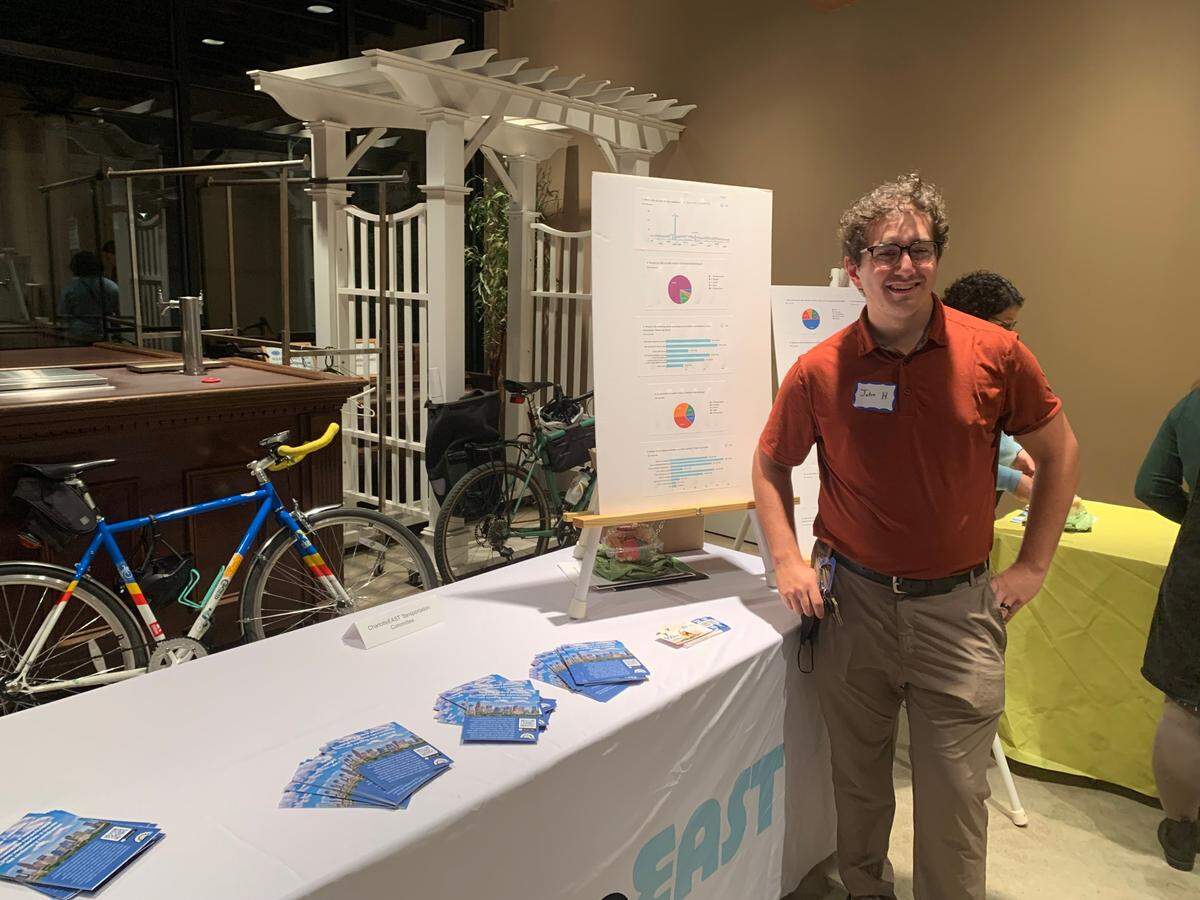
“It’s really frustrating to advocate for these bigger projects because people in the city are really hurting,” Holmes said.
In July, CATS cut some bus trips, decreased frequency for buses and the light rail by up to 10 minutes and eliminated some trips entirely. This was an uncharacteristic move under Lewis, whose goal as CATS CEO was to increase frequency. But he cited driver vacancies, absences, scheduled vacations and days off as leaving him with no choice.
South Charlotte resident Louise Turan was affected. She remembers waiting four hours at the transit center for her bus to get home in one instance. In October, Turan’s route began to return to normal.
CATS cited COVID-19’s effect on decreased ridership, too, when cutting service frequency. But bus ridership began to decline pre-COVID. In January 2020, local bus operations saw a 3.6% decrease in ridership compared to January 2019, Metropolitan Transit Commission meeting minutes show.
One of the reasons? It’s not convenient to ride the bus, said at-large Mecklenburg County Commissioner Pat Cotham.
“We have so many hotel and service workers that need buses at night and they don’t run,” Cotham said.
Charlotte bus lines end service before 2 a.m., when many bars and restaurants close.
.png "image (20).png")
Could a new transit center help?
Charlotte plans to build a new uptown bus hub by 2028 moving the transit center underground or to multiple levels above ground.
“It has served us well for nearly three decades,” Lewis said in September. “To meet the mobility needs today and into the future, the Charlotte Transportation Center would require major renovations and is nearing the end of its useful life.”
Lewis said he hopes a new CTC would:
▪ Create a more comfortable experience;
▪ Centralize bus transfer; and
▪ Minimize pedestrian and automobile conflicts.
Rider Charles Hardy said he’s excited about the new transit center. He’s from Buffalo, New York, where the bus hub is underground and said Charlotte could benefit from it.
“It’s nice and cool on a hot summer day,” Hardy said.
Turan disagreed and is worried for public safety.
“It’s not safe in here right now on the street level,” Turan said.
This story was originally published November 17, 2022 at 6:00 AM.