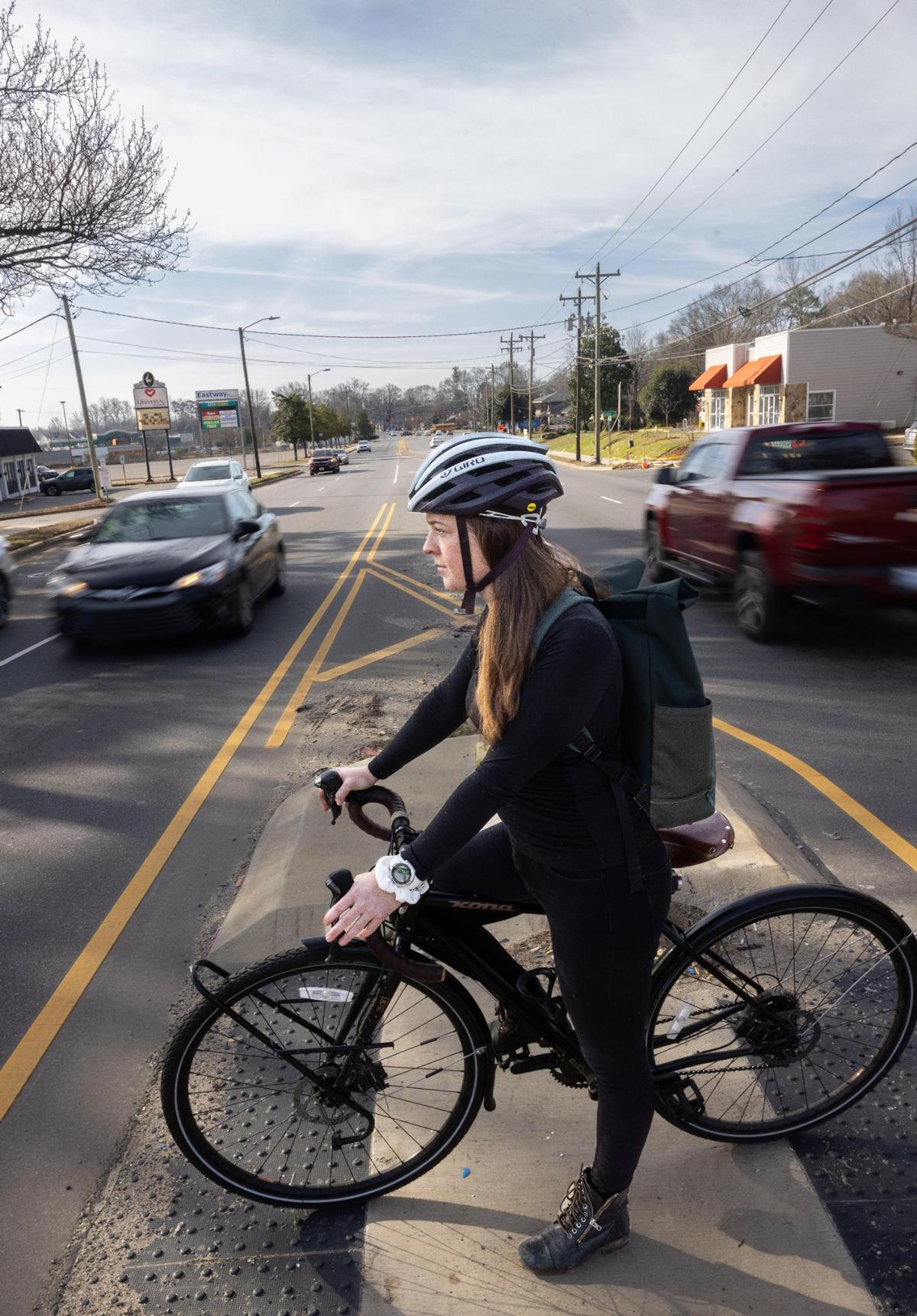
Graham Stevens looks both ways — and does it twice — before crossing 11th Street.
Stevens and his dog, Happy, make the 1-mile trek from uptown to Optimist Park on his daily coffee run, but he’s lost count of how many times he’s almost been hit by motorists turning from Davidson Street onto 11th Street or the Interstate 277 on-ramp.
“Drivers think of it as a freeway entrance and don’t expect to see pedestrian traffic,” Stevens said. “Amazingly, the visibility at this intersection is awesome. There really isn’t any reason to run me over.”
The intersection Stevens crosses daily sits within an arch around uptown where crashes more frequently occur between cars and pedestrians and bicyclists, Charlotte Department of Transportation data show.
Communities within the arch include areas around Wilkinson Boulevard to the west, Beatties Ford Road to the north and North Tryon Street to the east. They recorded some of the highest numbers of severe injuries and fatalities, according to data from 2018 to 2022. They’re also where Charlotte has plotted a majority of its pedestrian- and bicycle-oriented infrastructure improvements.
The most dangerous areas for pedestrians and cyclists are the same parts of Charlotte where communities of color and poverty are concentrated, city data show. This phenomena, referred to as the crescent and wedge, reflects the affluent and white demographics of south Charlotte surrounded by a crescent shape, a result of segregation and redlining, according to the city’s comprehensive plan.
“Equity has become very important to all of us as a department just because we do recognize that we have been historically inequitable,” said Angela Berry, who leads the city of Charlotte’s traffic safety initiative. “We’re trying to make sure that we’re putting infrastructure where it’s most needed to benefit the most people.”
For Berry, the work isn’t done until Stevens can get his morning coffee on foot without fearing for his life. The work ends when police officers no longer have to knock on doors to inform someone they’ve lost a loved one to a traffic crash.
“I joke with our police department, ‘My job is to put you guys out of the job,’” Berry said. “’I want you back doing detective work.’”
Berry’s work is finished when Charlotte achieves Vision Zero — no traffic fatalities.
Where crashes involving cyclists, pedestrians occur
Laurel Yohe stops in the middle of Eastway Drive on a small island for pedestrians to cross in the Eastway Recreation Center in Charlotte, N.C., on Tuesday, February 7, 2023. Khadejeh Nikouyeh Knikouyeh@charlotteobserver.com
Some of the hot spots for crashes from 2018 to 2022 include:
▪ Five people were killed and two seriously injured on South Tryon Street between West Arrowood and Steele Creek roads, a distance of about 3 miles.
▪ Five more were killed and another seriously injured on Sunset Road near Interstate 77 in north Charlotte.
▪ On East Independence Boulevard between N. Sharon Amity and Wallace roads, vehicles struck five people, killing three.
▪ The roughly 1-mile stretch of The Plaza, between East 36th Street and Eastway Drive, recorded eight fatalities, including two in August 2019.
In all, vehicles hit and killed about 120 pedestrians and bicyclists from 2018 through 2022 and seriously injured roughly 85 more, a Charlotte Observer analysis found.
Another 1,900 were hit but suffered minor injuries or no injuries at all, data show.
Here’s where Charlotte is making investments
One of the deadliest roads within the crescent is The Plaza in east Charlotte that stretches north from Plaza Midwood. Last year, the website Moneygeek examined more than 4,000 fatal crashes in North Carolina from 2018 to 2020 and rated The Plaza, around East 36th Street, as one of the 10 deadliest stretches in the state.
Last March, a car struck and killed a 21-year-old man near the intersection of The Plaza and East Sugar Creek Road when the man tried to cross the street shortly after midnight. According to CDOT records, the pedestrian did not have a green light to cross.
The driver, meanwhile, was arrested after recording a blood-alcohol content of .06, records show.
One way Berry and the Vision Zero team are using their $17.1 million budget is a pedestrian beacon within that dangerous stretch of The Plaza on Sweetbriar Street, but the total cost and completion date aren’t set.
The project would build a traffic-controlled crossing for pedestrians, ramps and crosswalks needed for pedestrians to safely cross this part of the road, city data show.
Of the 312 pedestrian and cyclist safety projects underway within city limits, 69 are within Charlotte City Council District 1, which mostly contains The Plaza. Districts 2 and 3, also within the crescent, have 50 and 51 projects, respectively, underway.
District 5, covering far east Charlotte, is an outlier, with only 17 pedestrian and cyclist projects planned.
The south Charlotte wedge, composed of Districts 6 and 7, have a combined 53 capital projects underway, city data shows.
Connie Proctor, a Charlotte resident who lives near Queens University and walks her children to school, wants to see more of a focus on pedestrian and cyclist safety. As long as Charlotte prioritizes speed and roadway investment for cars, the city will continue to get more dangerous for those without cars, she said.
“Cars are getting easier and easier to drive faster, and many of our street lanes are as wide as those on the interstate,” Proctor said. “We should not be even remotely surprised that people are speeding.”
While infrastructure investments are the government’s responsibility, some say the blame should fall on individual motorists, too.
Optimist Park resident Bobby Chambers said he notices cars swerving into bike lanes and disregarding pedestrians when walking around his neighborhood.
“Multiple cars are turning onto 12th Street and don’t look for pedestrians walking along the street or going across it where Little Sugar Creek Greenway intersects,” Chambers said.
How to achieve Vision Zero
If you live in a south Charlotte neighborhood off of Pineville-Matthews Road and want to walk to the McMullen Greenway, you have two options: cross a busy highway or walk a mile to the nearest crosswalk.
Terry Landsell, director of advocacy group BikeWalkNC, says the city of Charlotte, Mecklenburg County and the state of North Carolina share the blame for a lack of crosswalks on major Charlotte thoroughfares like the one on this stretch of Pineville-Matthews Road. That includes a lack of lights, paint or signals connecting two bus stops facing each other across the road’s five lanes.
“The city of Charlotte knew there were two bus stops here,” Lansdell said. “They did not provide a connection between the two bus stops when they put them in.”
The county, he said, didn’t ensure a safe crossing near the entrance to its greenway. The state maintains the road and, therefore, could have put in more safety measures during its construction or since, Lansdell said.
A new traffic light is being designed for Pineville-Matthews Road, right where the greenway is, city data shows. A city database of capital improvement projects shows its expected completion date in 2021. But in 2023, cars still fly by the greenway with no traffic light to slow them down.
Charlotte cyclist and advocate John Holmes said he thinks the city needs to prioritize funding for safety in the next fiscal year if it truly wants to achieve its Vision Zero goals.
“When you look at the budget, we spent a lot of money on building new roads for new projects and also widening roads,” Holmes said. “We have competing priorities but we’re funding expansion of roadways instead of street safety.”
Cycling instructor Pamela Murray says infrastructure should go hand-in-hand with education. Since 2006, a bike has been Murray’s primary mode of transportation, racking up to 9,000 miles a year.
The city has several bike-specific signals, she said, and crashes can occur if cyclists are looking at the wrong signal.
“People don’t know what different signals and paint mean,” Murray said. “People implementing (safety improvements) need to teach people how to use them properly and safety.”
This story was originally published February 10, 2023 at 6:00 AM.
Genna Contino previously covered local government for the Observer, where she wrote about Charlotte and Mecklenburg County. She attended the University of South Carolina and grew up in Rock Hill.
Gavin Off was previously the Charlotte Observer’s data reporter, since 2011. He also worked as a data reporter at the Tulsa World and at Scripps Howard News Service in Washington, D.C. His journalism, including his data analysis and reporting for the investigative series Big Poultry, won multiple national journalism awards.