As people buy more stuff, the supply of truck drivers fails to keep pace
READ MORE
Help (still) wanted
By many accounts, the economic news is bad. Yet almost everywhere you look there are still Help Wanted signs. In North Carolina and nationwide, the tight job market is showing signs of easing. We take a closer look at 5 job fields where everyone can feel the effect.
Expand All
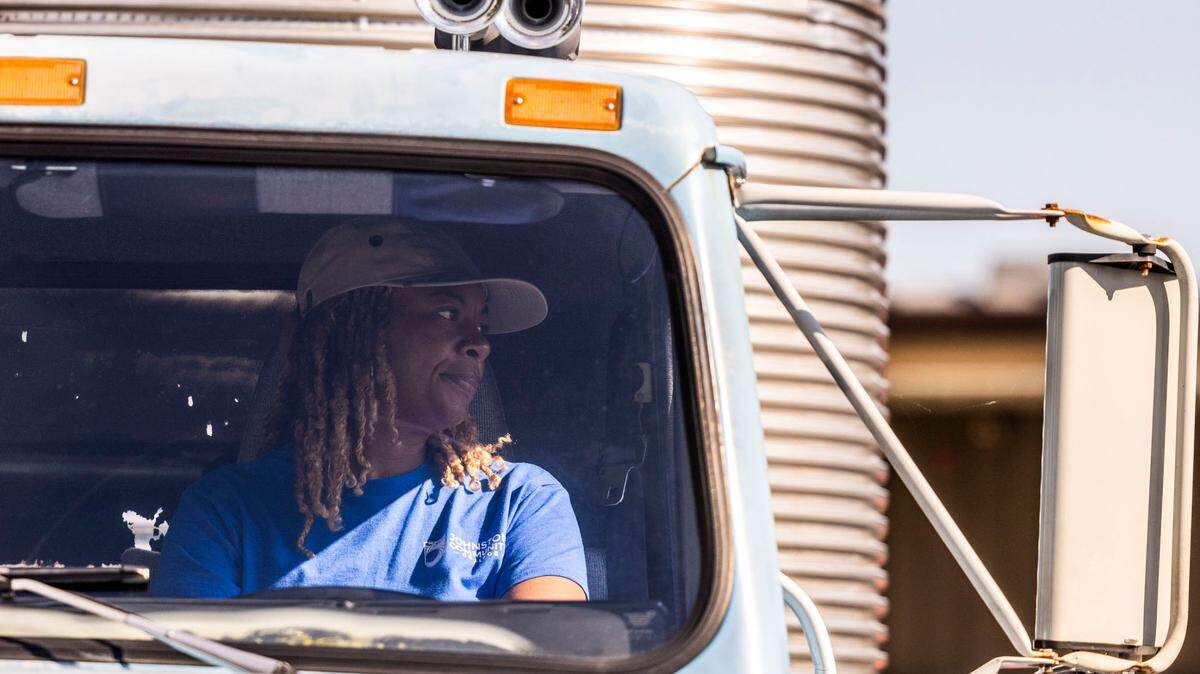
As Aletheia Britt prepared to climb into the cab of a tractor-trailer at Johnston County Community College earlier this fall, she acknowledged that she found the truck driving school there a little intense.
“Just being in that truck,” said Britt, who lives in Smithfield. “It is a little intimidating, knowing that you have all that right behind you like that. And backing up. Yeah, it’s a little intimidating.”
What Britt isn’t too worried about is finding a job after she finishes the eight-week course and goes to get her commercial driver’s license. As she began looking for a new career, her father and brother, both truck drivers, told her there is plenty of work for people who can drive a big rig.
“They broke down the industry, letting me know that it’s really in high demand,” said Britt, who just turned 40. “Like, if you could just get that CDL license, it will take you anywhere. Literally anywhere.”
About 3.5 million people make a living driving trucks in the United States, and that’s about 78,000 fewer drivers than the industry needs, according to the American Trucking Association. With current trends, including baby boomer retirements and growing demand for goods, the driver shortage could more than double by 2031, according to the association’s latest assessment out last week. It says companies will need to hire 1.2 million drivers in the coming decade.
The industry is paying more to try to attract new drivers and keep the ones its has. A trucking association survey released over the summer found that more than 90% of companies that haul freight had increased pay in 2021 and that their drivers earned a median of $69,000, up 18% from 2019.
To shore up its fleet of 12,000 drivers, Walmart announced a new pay and incentive program in April that would pay drivers up to $110,000 in their first year with the company.
“The driver shortage, coupled with increased demand for goods in the post-pandemic economy, really drove driver salaries,” the ATA’s chief economist, Bob Costello, said in a statement. “These pay increases should put to lie the myths about the nature of this job — trucking is a path that can provide a well-paid career for Americans looking for one.”
The shortage of drivers and the higher costs to keep them on the road are among what have come to be known as “supply chain issues” affecting nearly all aspects of the economy. The lack of truck drivers is a factor in the cost and in some cases scarcity of retail goods, says Andy Ellen, president of the N.C. Retail Merchants Association.
“The combination of diesel prices where they are plus the shortage of truck drivers certainly plays a part in increasing costs for retailers,” Ellen said in an interview. “Because those items are generally moving from a manufacturer into a distribution center, then from a distribution center to the store. So most of the time you get two legs that you’re relying on a truck driver with a CDL to get that product to the place where the customer can pick it off the shelf.”

Driver shortages predate COVID-19 pandemic
The COVID-19 pandemic disrupted the training and licensing of new drivers and prompted some to retire early. But the lagging supply of drivers predates the pandemic and won’t be easily solved as the threat of the coronavirus wanes.
One challenge is an aging workforce. The average age of a long-haul trucker in 2019 was 46, according to the trucking association, and the average age of new drivers was 35. The industry is already scrambling to replace baby boomers, who are retiring in growing numbers.
Companies have also struggled to attract women, who make up about 47% of the country’s labor force, according to the Bureau of Labor Statistics, but accounted for only 7.8% of truck drivers in 2020.
The industry cites two other factors: The inability of some drivers to pass a drug test, particularly in the 31 states that have decriminalized marijuana, and a long-standing federal rule that prevents people younger than 21 from driving across state lines.
John Freer, the lead instructor at the Johnston County Community College driver training school, says there’s another factor: fewer young people are attracted to the lifestyle of a long-haul trucker.
Freer says truck drivers are the last of the cowboys, out there on the range all by themselves for days and weeks on end. It can be a grind on drivers and their families.
“This is a big sacrifice that not only you make to go on the road but your family makes, because of you leaving,” Freer said. “There’s a lifestyle change there for a lot of families that they may not be prepared for.”
Besides pay, Freer said, companies are trying to make driving more attractive by redesigning routes and their operations to try to get drivers home more often.
Still, he knows many new drivers find the job is not for them. Of 18 would-be drivers in his most recent class, he expects no more than five will still be driving in a few years.
Wayne Ashley of Smithfield hopes he is one of them. Ashley, 53, spent years working in construction and is looking for a new profession to carry him to retirement. Besides being in demand, trucking has other benefits, he said.
“Better pay,” he said. “And hopefully less wear and tear on my body, at my age, than climbing scaffolding and walking rafters and stuff.”
This story was originally published November 2, 2022 at 6:00 AM with the headline "As people buy more stuff, the supply of truck drivers fails to keep pace."