A journey to Dale Earnhardt’s NC roots, 20 years after his death at the Daytona 500
READ MORE
More from the Daytona 500
Expanded coverage from The Observer of 2021’s Great American Race
Expand All
Like a lot of people, I miss Dale Earnhardt.
And so this week, I drove to Kannapolis to see his statue and pay my respects.
It’s been 20 years since Earnhardt died in a last-lap crash in the 2001 Daytona 500, and his death still echoes throughout the sport. NASCAR never had another driver quite like him. He was both the sport’s Darth Vader and its Elvis, and his premature death at age 49 mythologized him permanently.
Before all that, though, Earnhardt was a high-school dropout from Kannapolis, a city of about 50,000 people 25 miles northeast of Charlotte.
Earnhardt was born in 1951. When he was growing up, Kannapolis was a mill town, well-known for its textiles. After he dropped out of school, Earnhardt was working at a gas station and trying to step out of the racing shadow of his own father, legendary short-track racer Ralph Earnhardt.
Kannapolis was always a part of Earnhardt, a blue-collar man as familiar as red clay to the city’s inhabitants. Even after he got rich and famous, he still got his hair cut at the same place. He still ate the same sandwich (white bread, sliced tomato, lettuce and Miracle Whip) at the same restaurant. He still wore cowboy boots everywhere. He still fished at a local lake in Kannapolis.
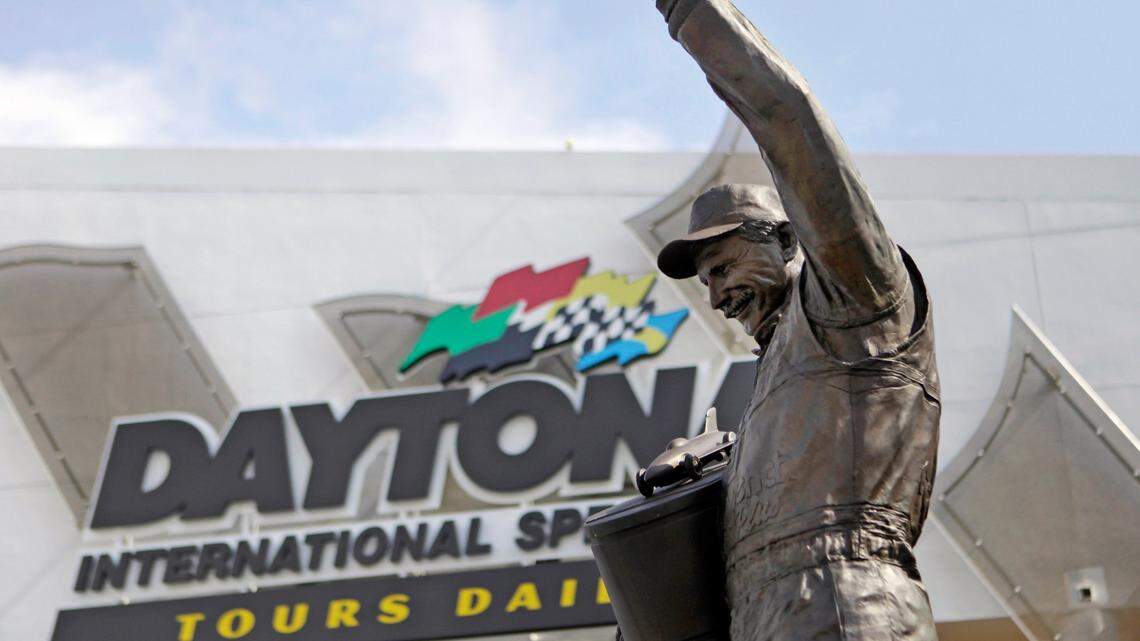
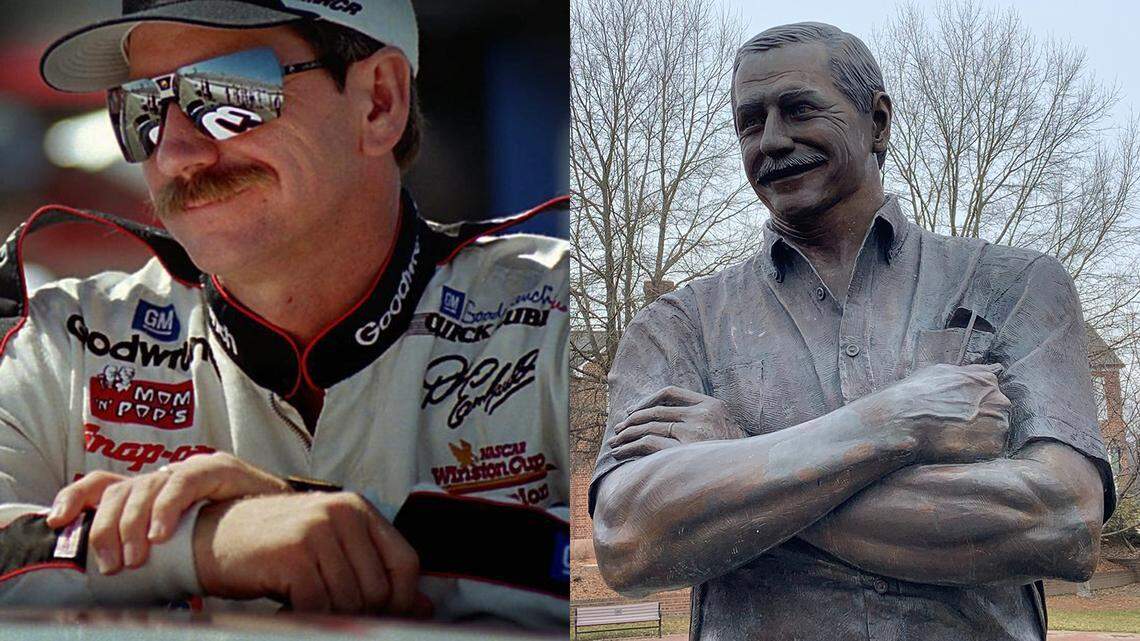
It’s that version of Earnhardt that the bronze statue in Kannapolis commemorates. If you didn’t know Earnhardt was a racer, there’s nothing about the statue itself — which was partially designed by Earnhardt’s widow, Teresa — that would tell you he was. The statue depicts Dale being Dale, dressed the way his hometown most often saw him.
“If you knew Dale, you know that was how he was most comfortable,” said Lynne Scott Safrit, a local business executive who knew Earnhardt and was instrumental in the statue’s development. “He was a common, down-to-earth person. So that was how we wanted to see him portrayed.”
The Earnhardt statue doesn’t wear a fire suit. There’s no trophy in sight and no race car. He’s dressed a lot like a farmer who has come to town to buy his weekly supplies. He wears Wrangler jeans, cowboy boots and a short-sleeved button-down shirt with sunglasses sticking out of the left front pocket. His arms are crossed. His bushy mustache hides a grin as he looks out toward a part of Kannapolis where he went cruising as a teenager, back when he was making slow left turns in preparation for the 200-mph ones he would make a few years later.
The nine-foot, 900-pound statue of Earnhardt was unveiled in October 2002, but until this week I’d never made the pilgrimage to see it in person. Maybe you haven’t, either.
If not, I’d recommend it. It’s a peaceful place, about 1.5 miles from where Earnhardt grew up. The benches in the plaza are arranged in groups of three to honor Earnhardt’s famous black No. 3 Chevrolet. The walkway’s oval shape evokes a racetrack. Commemorative bricks — which the city of Kannapolis still sells for $33 — sport messages like “Thanks Dale for a great ride” and “Racing’s not the same without #3.”
“People still come from all over the country to pay homage to Dale there,” Safrit said. “I’ve seen people get married there. It’s an important place to a lot of people.”
The one-acre Dale Earnhardt Tribute Plaza sits on Main Street, right across from the train station in downtown Kannapolis. It is located near the historic Gem Theatre that opened in 1936 and the minor-league ballpark for the Kannapolis Cannon Ballers.
That team was once called the Intimidators, referencing Kannapolis’s hometown hero, but changed names since it didn’t own full marketing rights to the “Intimidator” nickname. Its mascot, however, still sports a bushy mustache reminiscent of Earnhardt’s.
If you want to feel older, ponder this: If Earnhardt was still alive, he would be turning 70 on April 29th. Instead, Sunday’s 2021 Daytona 500 will mark the 20-year anniversary of NASCAR’s A.D. period — After Dale.
Dale Earnhardt was ‘three-dimensional’
Dale Earnhardt Jr. was 26 years old when his father died. He’s 46 now, only three years younger than his Dad was in 2001. In the intervening years, Dale Jr. had a Hall of Fame racing career himself and has become one of the sport’s most thoughtful spokesmen. His podcast “The Dale Jr. Download” is often fascinating and frequently includes stories about his father.
This week’s episode focused not on Earnhardt’s death in 2001 at the Daytona 500 and its 20th anniversary, but instead on Earnhardt’s lone victory in The Great American Race three years earlier, in 1998. Like all of us, Dale Jr. prefers happier memories.
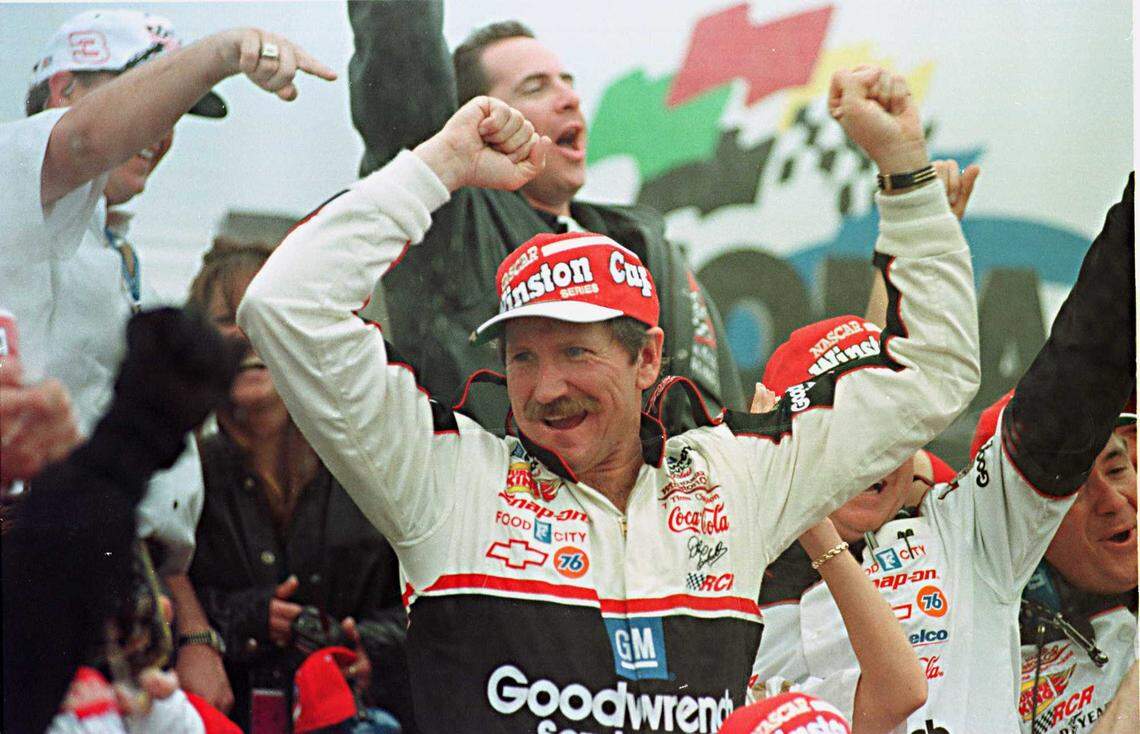
I asked Dale Jr. once, several years back, what was the one thing he hoped that people would remember about his father.
“The one thing that you’re always scared is going to evaporate is how he made people feel when he walked into a room,” Dale Jr. said. “He entered a room and changed its atmosphere. He had just such a powerful personality. Not like the power of a king, but just this energy that just filled the room. And that stuff is so easy to forget. ... One day I’m worried that everybody will just be looking at pictures and stats of him. And that will be it. They’ll just be looking at him in a two-dimensional sort of way. But he was three-dimensional. When he was at the track, you knew he was there, even if you couldn’t see him. You could just feel it. And that was an awesome feeling.”
I didn’t know Earnhardt Sr. as well as I would have liked, but I was in his presence enough to know that Earnhardt Sr. was much like Michael Jordan still is today. When he was around, he was a magnet. Your gaze followed him, even when you were trying hard not to stare.
In 1999, Earnhardt Sr. greeted me in his hauler for a one-on-one interview. He was in a good mood that day, joking about how the drivers 20 years younger could beat him in qualifying but not in a 500-mile race.
“Those young guys can maybe outdo me on a one-lap deal,” Earnhardt said that day. “But when the race starts, here I come, and there they go.”
I asked him that day about where he thought his future was headed. Dale Sr. was 48 by then, still good enough to finish No. 2 in the Cup series one year later but also pointed toward what everyone believed would be a long and successful second NASCAR act as a car owner. What did he want next from the sport?
“Being a championship car owner,” he said. “Seeing our team grow. Seeing Dale Jr. come along. As I step out of the car and step into that car owner’s role, I can still come and be a part of that garage area. That’s going to be fun and important.”
All of that went away on that awful day, Feb. 18, 2001, when Earnhardt suffered a skull fracture in that last-lap, last-turn crash at Daytona and died after hitting the concrete wall at 160 mph. Michael Waltrip won the race and Dale Jr. finished second, both in cars owned by Earnhardt and just ahead of his collision.
It took a moment for most to realize what happened — how bad it really was. Dale Sr.’s wreck, on first glance, didn’t look like much to anyone except those who knew racing well and realized the danger of hitting a wall with the right front of the car first because of the head-whip it caused.
The head-and-neck support device called a HANS device was available then but rarely worn by drivers at the time. It could have saved Earnhardt’s life. But the devices weren’t yet mandatory in NASCAR’s series and they restricted head movement. Earnhardt had recently told a journalist that he didn’t plan to wear “that damn noose.”
Those of us who knew much at all about NASCAR knew immediately how enormous of a news story Earnhardt’s death would be. I wasn’t in Daytona that day but watched the race at home. I wrote a column that night likening the impact of Earnhardt’s death in the Carolinas to the impact of Princess Diana’s death in England in 1997. No editor or reader ever questioned that thesis.
We all knew around here. It took the national media a while to understand, but soon they knew, too.
A hometown that remembers
Kannapolis never forgot Earnhardt.
The statue’s original $200,000 cost was footed largely by David H. Murdock, a billionaire businessman who in the early 1980s owned the now-defunct Cannon Mills (once the world’s largest producer of sheets and towels, and an employer of thousands for decades in the Kannapolis and Concord area). Murdock sold the mill, but many years later re-acquired the land and has developed the enormous North Carolina Research Campus in Kannapolis, focusing on science, at the mill’s original site.
The Earnhardt family was so involved in the statue’s design that Teresa Earnhardt gave Clyde “Ross” Morgan, the Arizona-based sculptor, a pair of her late husband’s Wrangler jeans, as well as a shirt and a belt, to help him make the statue more accurate, Safrit said. Morgan changed his original idea dramatically. The concept sketch he had first presented in 2001 had shown Earnhardt standing on top of a race car, one fist high in the air.
At the 2002 unveiling, Teresa Earnhardt said: “We are very pleased that the statue personifies the Dale Earnhardt we all knew on a daily basis.”
There are other reminders of Earnhardt in Kannapolis, some of which are on what the local tourism board calls “The Dale Trail.”
One of Kannapolis’s main thoroughfares is called Dale Earnhardt Blvd.
You can actually see that road if you stand next to the headstone at the gravesite of Ralph Earnhardt, Dale’s father, who died in 1973 of a heart attack at age 45. His tombstone bears a colorful etching of his No. 8 race car.
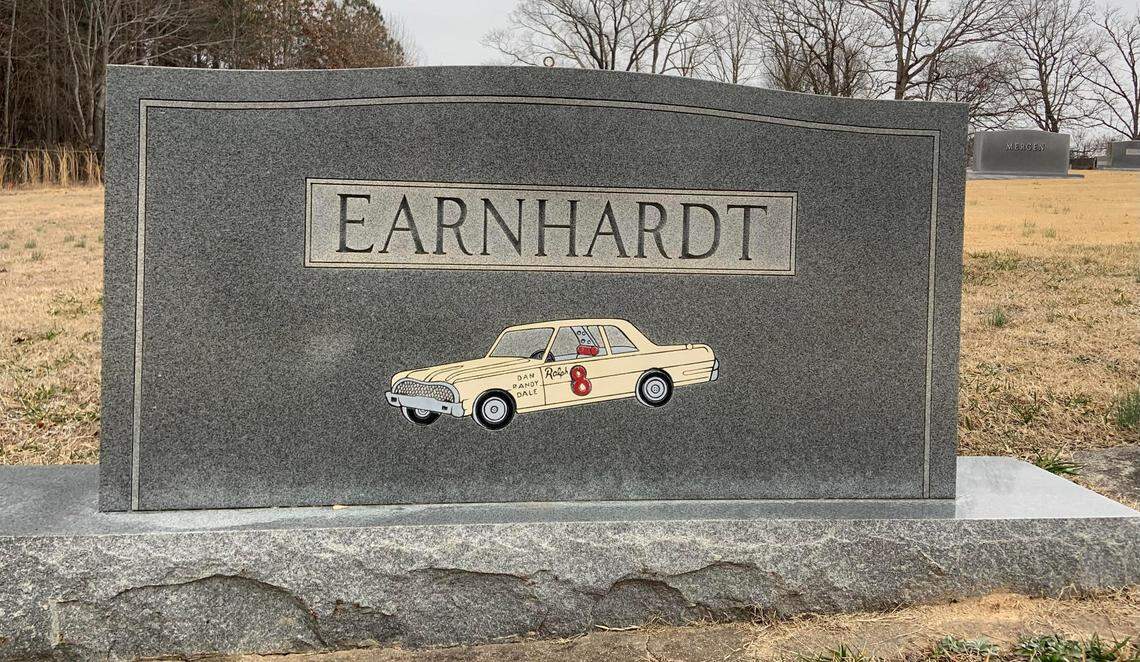
Martha Earnhardt, who was Ralph’s wife and Dale Sr.’s mother, is 90 and still lives in Kannapolis. You can’t visit Dale Earnhardt’s grave, though — it sits on private family property.
Ralph Earnhardt was primarily a short-track racer, and that’s how Dale Sr. got started, too, learning about cars in the family garage. Dale Sr. won 76 Cup races, and his seven NASCAR titles put him in a three-way tie for the most all-time with Richard Petty and Jimmie Johnson. I asked Dale Jr. about why his father was so good once, and he gave this answer.
“I think it had a lot to do with the way he came up,” Dale Jr. said of his father. “His experience in running short tracks in those little old sportsman cars, trying to make an extra $300 or something to put food on the table that week. If you look at pictures of him back then, he looks so rugged — it’s such a contrast to how polished the racing is today.
“And then, when he made it, he never really lost that drive — that willingness to be cut-throat. I don’t know how he was able to do that when he got so established, but he did. He never lost that ‘I’m-doing-this-to-put-food-on-my-table’ mentality, even when he had all the food he could ever need.”
He never forgot Kannapolis, either. Once, he was signing T-shirts at a benefit in Kannapolis. Safrit took her daughter Elizabeth, then 3 years old, to meet Earnhardt. When they got to the front of the line, Earnhardt signed his name on a kid-sized shirt and handed it to the little girl.
As they walked away, Elizabeth started crying.
“That man wrote all over my new T-shirt!” she wailed.
Earnhardt heard the noise.
Dale Jr. has often described his father as both his hero and an expert problem solver, and Dale Sr. solved this one quickly. He grabbed a new T-shirt off the pile, left the Sharpie behind and handed it to Elizabeth.
“Here you go,” Earnhardt said. “Let’s get you a fresh one.”
Elizabeth smiled and went home happy, just like Dale Earnhardt fans almost always did.
This story was originally published February 12, 2021 at 7:00 AM.