This Charlotte chef’s classic fried chicken recipe comes straight from mom’s cookbook
READ MORE
The Skillet: How Black Cuisine Became America’s Supper
For the past six months, we have been interviewing North Carolina-based chefs, who generously shared their expertise in making recipes from Nigeria, the American South, Brazil, and Puerto Rico for a one-of-a-kind journey into how our plates came to look the way they do. Explore food of the African diaspora here:
Expand All
Chef Michael Bowling has had many culinary role models, but one stands head and shoulders above them all – with good reason.
“I’m a mama’s boy,” he unabashedly confessed.
In the light-filled West side kitchen of his business partner and sister, Joy, he shows off his mother’s old recipe book, a lovingly tattered spiral journal written in exquisite penmanship.
“That one, Ma’am B’s Chicken, won PM Magazine’s cooking contest, and she was published in an old Fannie Farmer cookbook,” he beams. “It’s one of those things you can carry and pass down. That’s important to me. My sister keeps it because if I have it, I’ll lose it.”
Bowling founded Hot Box Next Level Kitchen eight years ago, but his culinary journey began long before that. Growing up in Chattanooga, Tennessee, he watched his mother and aunts perfect one after another Southern classic: lemon pound cake, red velvet cake and fried chicken. His mother would use heavy duty brown paper bags to dredge the meat in seasoned flour, shaking them up before laying them in a cast iron pan full of piping hot oil.
“I don’t fry chicken at home much, but it’s still one of my favorite things to cook and eat,” he said.
How to make fried chicken
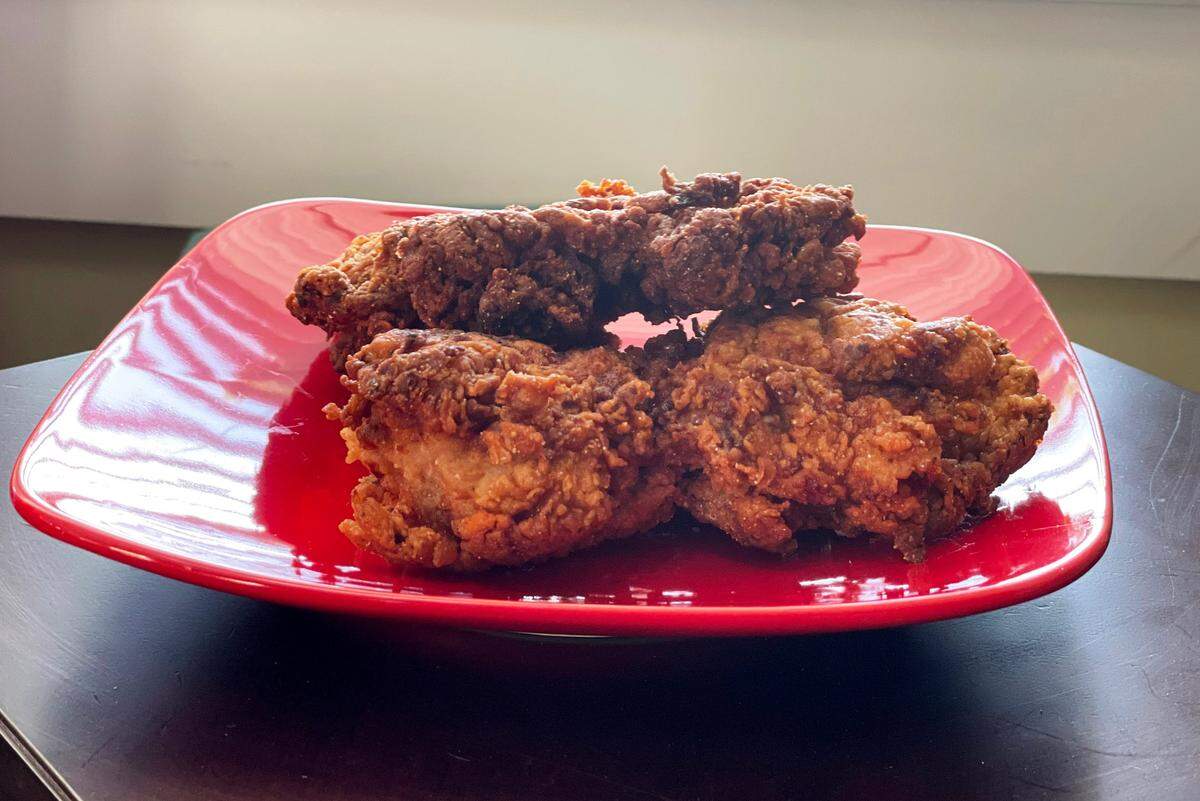
Fried chicken is the undisputed king of African-American cuisine. While Africans had long sauteed chicken in palm oil, and Scots were the first to deep fry it in fat (but without seasonings), it’s in the melting pot of Black American cast iron skillets that fried chicken got its crown. Black American soldiers in the 1950s even took the technique abroad, seeding the genesis of Korean fried chicken.
While the details may vary, the steps of classic fried chicken are essentially the same: brine, wet, dry, fry. Bowling starts off with a brine in buttermilk.
“Buttermilk for me is just part of my past and history,” he said. “And an essential thing in Southern cooking. Think about it: We make buttermilk biscuits, buttermilk in pancakes and fried chicken. Historically, it probably had something to do with the heat; we had to do something with the milk that was going bad.”
An overnight soak in seasoned buttermilk is just the right call. Employing a liberal hand with garlic, paprika, salt and pepper left the liquid almost orange by the time he finished.
“You can’t do too much, but you can do too little to buttermilk,” he advised. “A 12-24 hour space to marinate is just fine.”
The next steps are simple: heat the oil slowly while preparing the wet egg dip and dry batter — a genius 3:1 ratio of flour and cornmeal.
“I ate a lot of cold fried chicken growing up,” Bowling explained. “Even now, it’s one of my favorite things. That hit of cornmeal keeps it crispy. Even if it’s been in the refrigerator or a little moisture has gotten to it, there’s a crunch factor.”
Because he seasoned the marinade so thoroughly, Bowling opted for a lighter hand with the batter.
“I want layers of flavor,” he said. “At the restaurant, we do smoked wings, and we brine them for 24 hours, smoke them, then fry and dust them for a light finish. But we take pride in it.”
Becoming a chef
He was about 8 years old when he first started cooking, but he was helping out way before then. Many Saturday nights were spent on his living room floor, cleaning greens and shelling beans while watching “Hee Haw” with his sister.
“We would start prepping Sunday dinner Saturday night, because there was church in the morning, and if you didn’t start the day before, you wouldn’t be eating until 5 p.m.”
Bowling’s mother kept him involved in a lot of activities, such as choir and camp, that called for out-of-town travel. He looked forward to every one, and not just because of the destination.
“My aunts would always ask me what I wanted to take on my trip. Fried chicken and pound cake was the best way to travel,” Bowling said. “They’d pack me a baby Igloo cooler full of treats. Most of it didn’t make it past the first or second day because my friends all wanted a taste, too.”
Once a year, his parents would fry chicken for the whole shift of mechanics at the railroad where his father was a supervisor. The daylong endeavor became something the employees looked forward to annually. Hefting a cast iron skillet onto the stove, Bowling recalled an almost irreplaceable loss.
“My sister had my mother’s cast iron skillet, but she went to college and her roommate ruined it. The girl scrubbed it down with soap and steel wool. Scrubbed all the seasoning right off it,” he said. “She was young — she didn’t know any better.”
Still, what Bowling lost in that heirloom he more than made up for in knowledge. He began cooking for his friends in high school and kept part-time jobs washing dishes or busing tables. After graduating, he tried to leave the food industry, but “it was like I couldn’t get out of the game. Every time I left, I always kept a part-time job and it was where I was happiest,” he said.
Joy Bowling earned a degree and began traveling as a consultant. Often, she would send her brother pictures of the food she tried in Switzerland, France and London. By then a grill cook at TGI Fridays in Roanoke, Virginia, he always looked upon it wistfully. One day she told him he, too, could be making food like that if he applied himself. He gave it a shot and applied for a fine dining restaurant headed up by a Black chef, who saw his potential and hired him.
“I loved it. We were making roulades with spinach and different types of olives and feta cheeses and all this wonderful stuff that I’d eaten because my mother made sure we were cultured, but I had never made,” Bowling said.
Career growth
Once his mentor left the job, Bowling learned under another chef with a slightly more difficult personality.
“Tom Ford, a white guy with a Napoleon complex. People hated him, but I loved him,” Bowling said. “Around 2000, Tom told me that nobody was going to give me a chance without a degree because I was Black. Some might say, aw, he was being racist. He told me the truth.”
Bowling applied to Johnson & Wales in Charleston, South Carolina, and Ford wrote his letter of recommendation. He also arranged a job and a place to stay if Bowling needed it. After getting his culinary degree and working at fine dining concepts in Charleston, Bowling and his sister eventually went into business as Hot Box Next Level Kitchen.
With a food truck and a brick and mortar in Concord under their belts, the siblings are expanding operations to a stationary site by Johnson C. Smith University in late May. Located near 1622 W. Trade Street, the new operation will sit in the old A&P grocery lot. There will be outdoor seating, lighting and amenities, a boon to the historically Black West side neighborhood. Bowling is excited. He’d briefly lived in the area after a divorce some years back, but hadn’t found an affordable site to open up shop until now.
“We’ll help reactivate that part of the neighborhood. It’s on the light rail and in walking distance from everyone. We’re really excited about being on the beautiful, beautiful West side,” he said. “It’s like coming home.”

Tell us what you think.
We'd love your thoughts on our food series, highlighting connections between foods of the African diaspora and Southern cuisine. Please let us know using our Google Form.
Fried Chicken
Chef Michael Bowling of Hot Box Next Level Kitchen
Ingredients
4 boneless, skin-on chicken thighs
2 cups buttermilk
4 heaping tablespoons HBX Dust (it’s a secret recipe, but you can use this spice mix substitute: 1 tablespoon granulated garlic, 1 tablespoon paprika, 1 tablespoon salt, ½ teaspoon white pepper, ½ teaspoon pepper)
Cooking oil
3 cups all-purpose flour
1 cup cornmeal
HBX Dust to sprinkle after frying
Method of production
Marinate your chicken for 12 to 24 hours in buttermilk and 3 tablespoons of HBX Dust or spice mix. Remove from marinade and discard liquid.
Preheat your oil on medium. Oil should have small, less than pea-sized bubbles.
In a bag, mix flour and cornmeal. Place chicken in a plastic bag and shake it. Massage the batter into the nooks and crannies of the flesh so that it is completely covered. Shake off excess.
Gently place chicken in hot oil.
Fry chicken on medium high heat, 5-7 minutes on each side and adjusting heat as you go so it doesn’t overbrown. Move your chicken around so it does not burn. Use a meat thermometer if needed to check doneness (165 degrees at thickest point).
Using tongs or a fork, place chicken on a paper towel to blot oil.
Sprinkle with remaining spice mix and enjoy.
This story was originally published May 23, 2021 at 5:18 PM.
.jpg)