Not another HB2: Would new Charlotte workplace protections draw legal fight?
READ MORE
Charlotte 2021 nondiscrimination ordinance
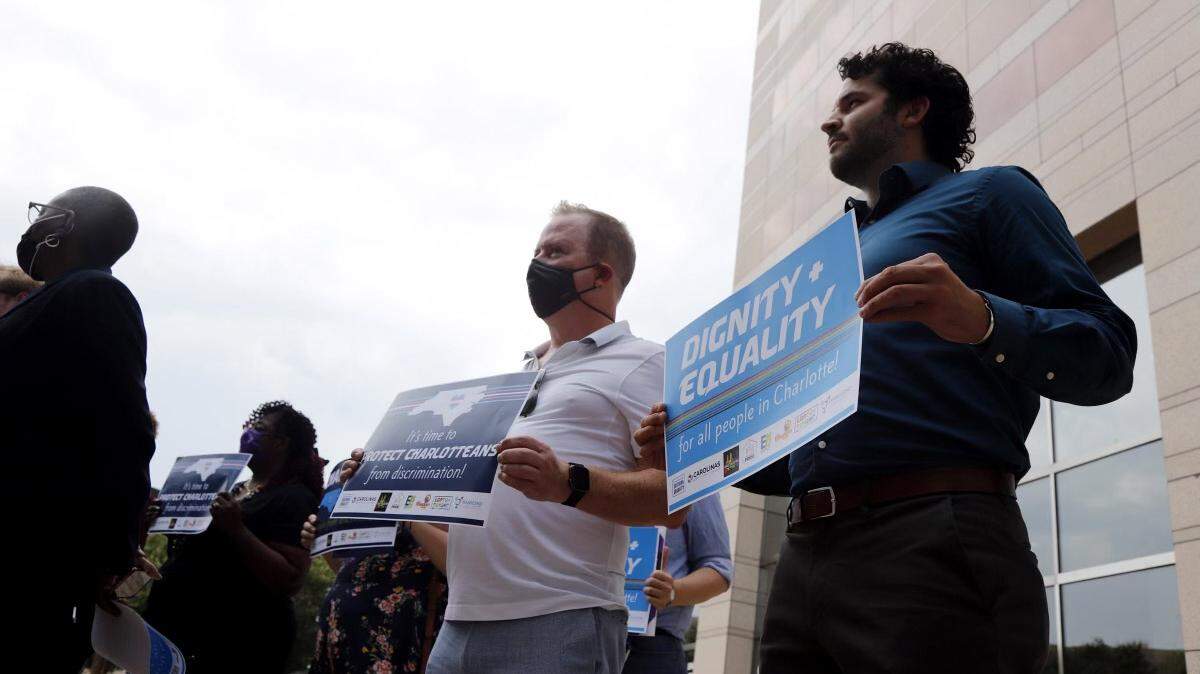
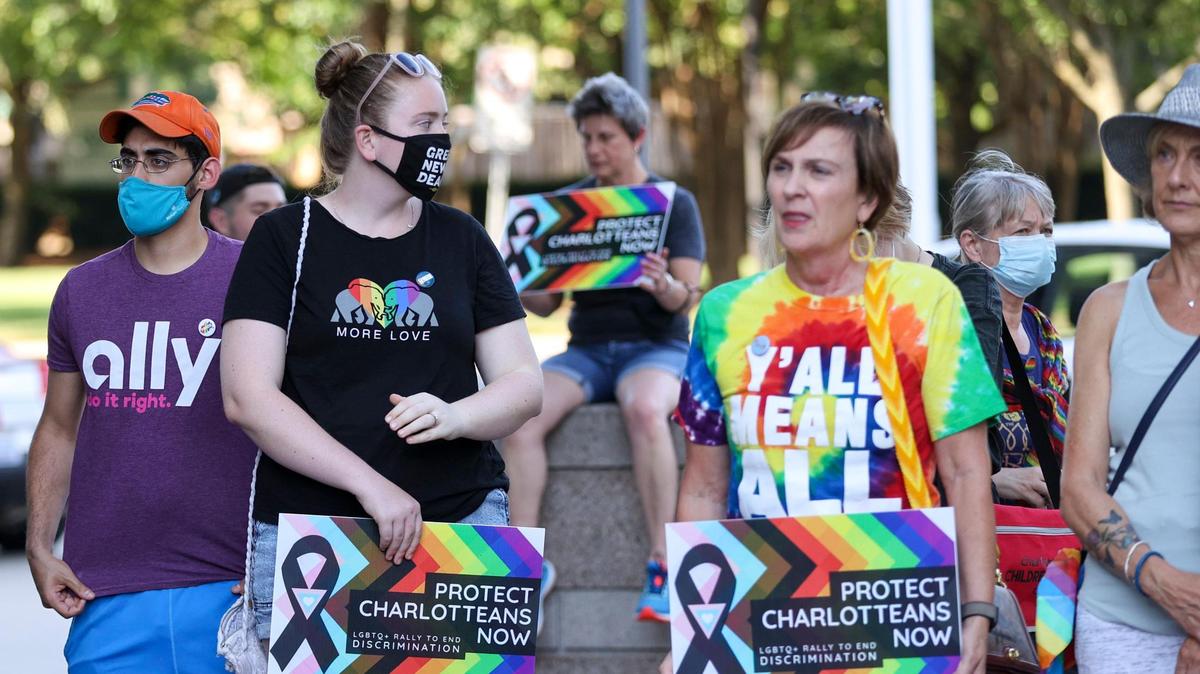
The Charlotte City Council, five years after HB2, passed an updated ordinance prohibiting non-discrimination based on gender identity, and numerous other areas.
Expand All
As Charlotte considers a new and more expansive nondiscrimination ordinance, some warn that it could spark backlash — this time probably not from the state legislature, but in the courts.
The ordinance conjures memories of 2016, one of the most politically fraught periods in recent North Carolina history; so devastating that it may have cost then-Gov. Pat McCrory his reelection.
Then, Charlotte City Council amended its local ordinance to add protections for transgender people who face discrimination throughout public life. Gender identity would have been a protected characteristic, alongside sex, race and religious affiliation, to prohibit discrimination by businesses and city government. And — this is the part you probably remember most clearly — Charlotte’s ordinance would have allowed people to use bathrooms that correspond with their gender identity.
What equality advocates heralded as success, however, later was undermined by a state law invalidating Charlotte’s protections.
The Republican-controlled state legislature’s response was known as “the bathroom bill,” or HB2. A resulting political firestorm cost the state at least hundreds of millions of dollars through boycotts. A year later, HB2 was repealed and replaced with HB142, signed into law by Gov. Roy Cooper.
Now, a key component of HB142 has expired, leaving local governments once again able to develop nondiscrimination ordinances, commonly called NDOs, and make them the local law of the land. Or so they think.
NDO proposals from both Democrats on City Council and Republican council member Tariq Bokhari call for expanding workplace protections via Charlotte’s ordinance — a move not tested in 2016 before the HB2 backlash. Neither draft proposals aim to legislate bathroom use.
Both current proposals would notably add gender identity and natural hair to current city ordinance protections in both employment and public accommodation, referring to most places that serve the public, including restaurants, hotels, taxis and other businesses.
Democrats have initially said they want to cover small employers, as state and federal nondiscrimination protection already exists for workers in companies with 15 or more employees. Bokhari’s proposal seeks to extend protections to workers at companies of all sizes. Through a nonbinding straw vote on Monday, six council members agreed with Bokhari on that approach.
If elected leaders want either provision approved in a local ordinance, the city’s attorney says they must calculate their “level of legal risk tolerance.”
In a memo sent to the council last week, City Attorney Patrick Baker said the issue of local governments regulating employment “may be one of the more controversial portions of the (proposed) ordinance.”
The “safest” option, he wrote, would be to “seek clear legal authority to enact such an ordinance from the General Assembly” before adopting changes. Another avenue Baker offered is to leave employment protections out of the formal ordinance and instead pass a non-enforceable City Council resolution urging employers to not discriminate.
“There is no certainty or clarity that local governments have the legal authority to regulate private employment practices regardless of the size of the employer,” he wrote, adding that “there are good legal arguments both for and against the proposition.”
If the ordinance is challenged in court and the city loses, the court would likely prohibit the city from any further enforcement — and Charlotte would be on the hook for attorney’s fees for the opposing side, Baker wrote.
Some conservatives are already warning that lawsuits are likely and that plaintiffs will contest whether Charlotte has the authority to regulate employment discrimination.
Charlotte Republicans lament the process
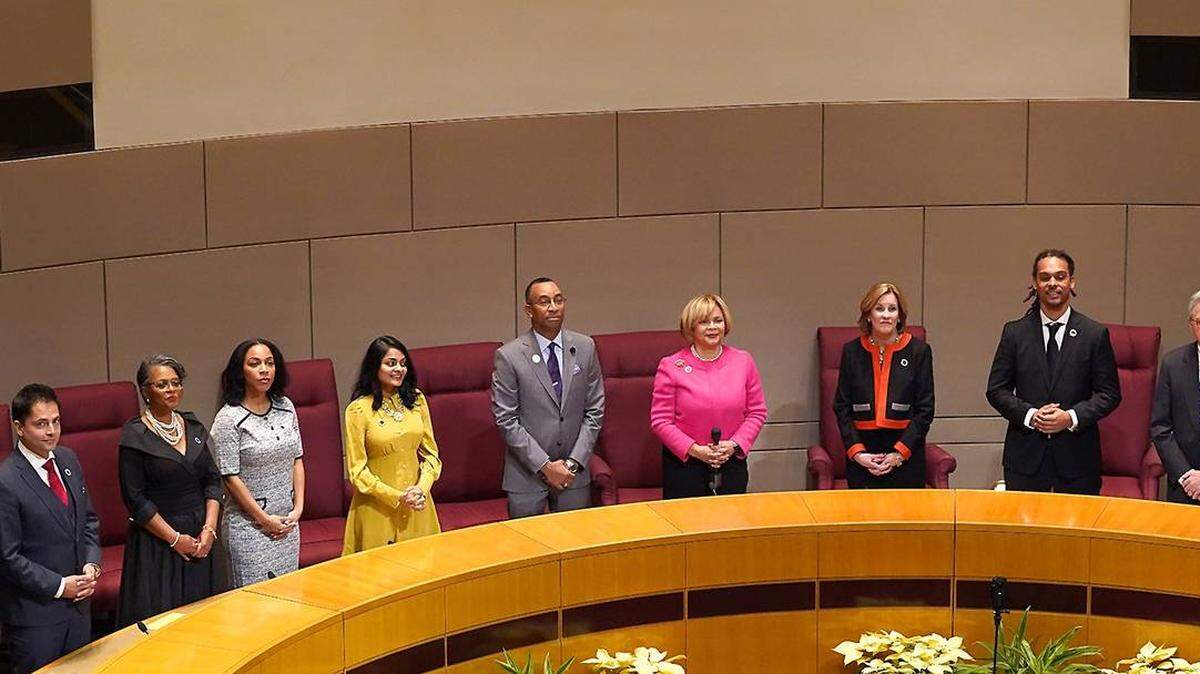
Although the new nondiscrimination ordinance could be passed by a Democrat-controlled City Council as soon as Monday, the first public look at possible 2021 NDO amendments were presented by a Republican.
Bokhari, one of two Republicans on the 11-person council, published his version of an NDO in June, crafted in tandem with the Mecklenburg County Young Republicans.
While “the influence” of Bokhari’s version can be seen in the city’s current draft, “there was very little if any collaboration between anybody on our side of the aisle and anyone on the city’s side,” said Kyle Luebke, an attorney and the treasurer of the Mecklenburg County Young Republicans.
Beyond employment provision differences with the Democratic version, Bokhari’s proposal would insert a detailed religious exemption to Charlotte’s NDO. He’s also tried — so far unsuccessfully — to convince his Democratic counterparts to include political affiliations as a protected class.
“If everybody really wanted to solve this,” said Jeff Tarte, a Republican and former state senator from Mecklenburg County, “they all need to be sitting around the table crafting this.”
Without input from Republicans, “you have issues,” Tarte said.
Still, he added that there is likely little to no appetite to respond in the same way that HB2 did. The blowback was so severe and the financial toll so pronounced that it would seem politically untenable.
“I can’t imagine the legislature wants to dive into that pool again,” Tarte said. “They would drown.”
Progressive groups in Charlotte, meanwhile, have largely praised the city’s effort to pass stronger protections — while also saying it took local leaders too long to act this year.
Even without resistance from Raleigh, local conservatives said the lack of collaboration could lead to problems down the line. Luebke, for example, says the explicit protections for free speech and religious institutions are necessary to avoid lawsuits.
Bokhari told the City Council on Monday that “protecting those that need protection while not requiring adoption of those beliefs and not infringing on other rights” will be the key to whether this ordinance sinks or swims.
Likely paths to conflict
The level of power that local governments have to forge their own standards varies by state. In North Carolina, local governments “operate under authority granted by individual statutes” that come down from Raleigh, according to an analysis by Frayda Bluestein, a professor of public law and government at UNC Chapel Hill.
In cases where the state government has not granted specific authority, it is up to the courts to decide whether the local government was stepping outside of its legal authority. The courts have “meandered among various standards in the course of our state’s history, struggling to adopt a consistent standard for analyzing the scope of local authority,” Bluestein wrote.
In an email, she said a court would first determine whether there is specific authority granted by the state government for Charlotte to pass its NDO. If there is not specific authority, it would then weigh other factors: Is the action covered by the city’s police powers, for example?
The murky legal nature of municipal powers — which the city’s attorney also has alluded to — means an attempt to impose new regulations on businesses in Charlotte could lead to legal challenges. As has occurred in other states, a business owner could claim a nondiscrimination ordinance tramples on religious freedom.
It is unclear how a court would rule in that case. Some conservatives argue that the city does not have the authority to regulate employment discrimination because that power was not specifically granted by the state. Others say that HB142, the bill that repealed HB2, could cause problems for attorneys trying to make that case.
The bill prohibited local governments from “regulating private employment practices” until Dec. 1, 2020. Had local governments not had the authority to do regulate employment discrimination in the first place, then why did the state feel it had to specifically prohibit it? The city, aiming to defend its authority, may use that argument if the issue comes before a court.
Tami Fitzgerald, the executive director of the North Carolina Values Coalition, a conservative lobbying group, said lawsuits are “definitely going to happen, because what the city is about to impose is a government overreach on business owners.”
The NDO would require businesses who contract with the city to include a paragraph in their contracts that says they agree to comply with the city’s new ordinance.
Fitzgerald argues: “This ordinance fails to recognize that all people have a right to exercise their religious beliefs in their everyday lives, wherever they are: at work, at school, in public accommodations — everywhere.”
Asked whether the ordinance is likely to end up in court, Larry Shaheen, an attorney and former chairman of the Mecklenburg County Young Republicans, said “there will be lawsuits,” and argued that in working with conservatives (political leaders most aligned with the business owners most likely to sue), it could be avoided.
The council is expected to vote on the ordinance on Monday but some have suggested the vote be delayed following a public hearing.
This story was originally published August 6, 2021 at 6:00 AM.
.jpg)